
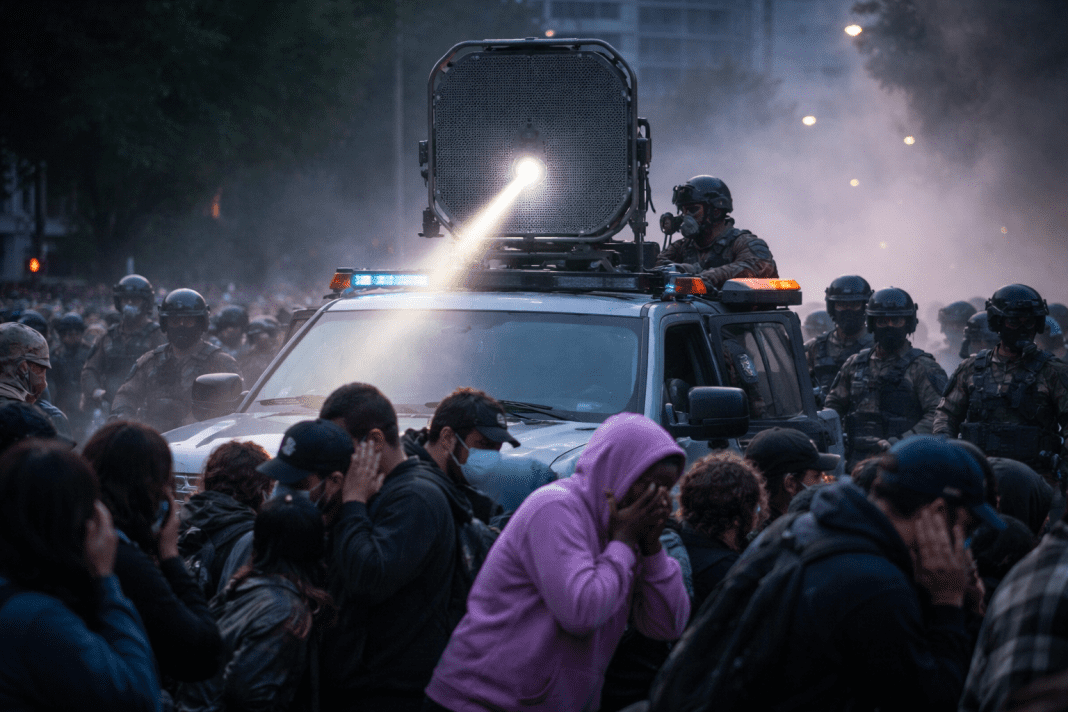

In recent days, people have shared videos and reports showing ICE agents and other officers using a Long Range Acoustic Device, or LRAD, against protesters in Minneapolis, Minnesota. An LRAD is a powerful sound device that can send very loud messages over long distances. It was first developed for military use, and in recent years, police and other agencies have also used it for crowd control.
Loud Confrontation in Minneapolis Streets
During the protests, demonstrators gathered to express concerns about federal immigration enforcement actions. Many exercised their right to assemble and speak out about recent incidents involving federal agents and the deaths of residents during enforcement operations. People at the scene shared videos showing officers aiming the LRAD directly at the crowd from a very short distance, much closer than normal use.
Critics say officers’ close-range use can cause intense pain, hearing damage, and strong physical reactions. People in the crowd described the sound as overwhelming. Some said it made it hard to think clearly or even remain standing. These accounts spread quickly on social media and live streams, raising concerns because the protesters remained mostly peaceful when officers activated the device.
US edges toward government shutdown as deadly Minneapolis shootings ignite DHS funding fight
Many witnesses said officers turned on the LRAD while people were chanting, holding signs, and standing in groups without engaging in violence. This has led to questions about whether such a powerful tool was necessary in that situation.
What Sparked the Protests
The protests began after several serious incidents involving immigration enforcement agents in Minneapolis that caused fear and anger in the community. Earlier in January, an ICE agent fatally shot a local woman during a law enforcement operation. Just weeks later, federal agents also shot and killed a 37-year-old man who worked as an ICU nurse during another encounter.
These deaths deeply affected the community and led thousands of people to take to the streets. Many residents said they were protesting not only the loss of life, but also what they see as aggressive and dangerous enforcement tactics.
Soon, Minneapolis and other parts of Minnesota saw repeated protests, marches, and large public gatherings. In some cases, tens of thousands of people joined together, chanting and calling for changes in how federal immigration enforcement operates.
In Minneapolis, many chants focused on reducing or ending the expanded role of ICE and other federal agencies in local law enforcement. Protesters said the recent shootings raised serious questions about safety, oversight, and accountability.
As the protests continued, tensions remained high. While many demonstrations stayed peaceful, authorities reported that some gatherings later involved property damage or clashes, which added to the already strained atmosphere in the city.
Use of LRAD and Police Response
An LRAD is a powerful sound device designed to send messages or warnings over long distances. When used at close range, it can cause serious discomfort and may harm a person’s hearing.
In Minneapolis, videos and photos showed LRAD units mounted on vehicles or carried by officers and aimed directly at crowds of protesters. Many people present said the device was activated while they were simply standing, chanting, or observing, and not taking part in any violence.
Several law enforcement agencies were involved in managing the crowds, including local police, the Minnesota State Patrol, and federal partners. Officials said they were trying to control large gatherings, especially near places where federal agents were staying or working. In some cases, authorities later declared the protests unlawful and ordered people to leave after reporting property damage or objects thrown.
Along with the LRAD, officers also used other crowd-control tools such as megaphones and chemical irritants. However, the LRAD stood out because of how strong and visible its use was.
Many protesters said the sound felt more like a punishment than a way to communicate. People covered their ears, moved away, and some reported feeling dizzy. The incident has prompted more criticism of how authorities are handling the protests, even as many demonstrators continue to say they want to protest peacefully.