
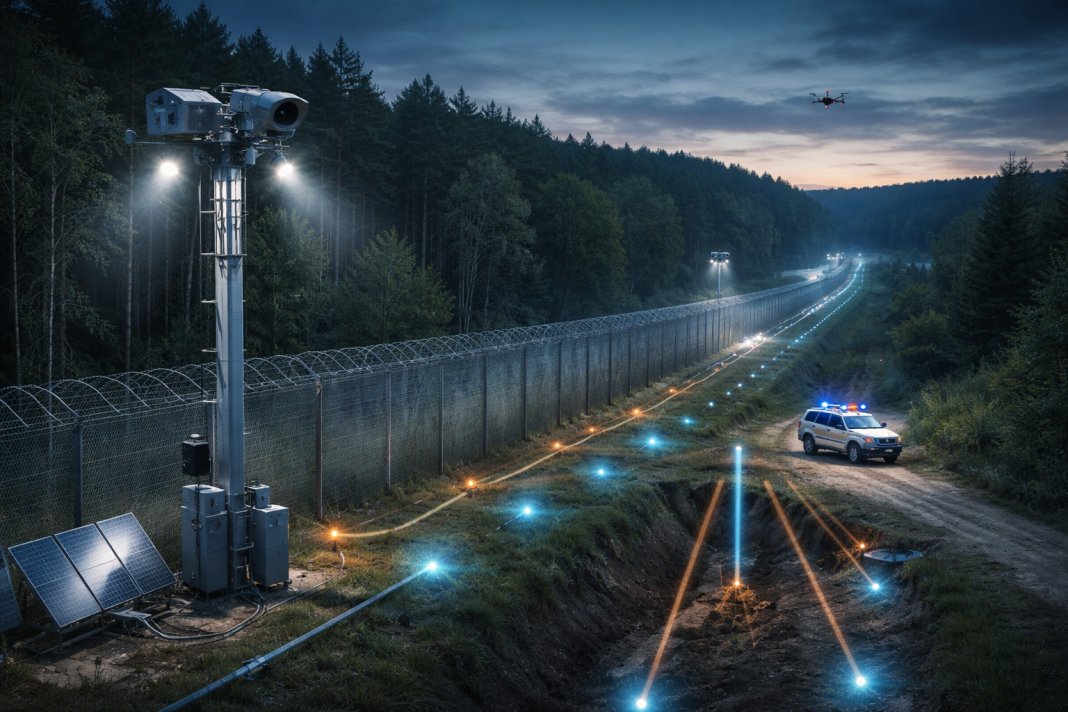

Poland has announced a major security project. It will build a high-tech electronic surveillance barrier along its border with Ukraine. The system is designed as a digital monitoring network. It aims to improve border security. It will help detect movement more effectively. The move comes amid rising regional security concerns.
Major Security Project Announced Along Eastern Border
Poland has announced a major security project to build a high-tech electronic surveillance barrier along its border with Ukraine. The system is expected to cost around 450 million zlotys, or about 120 million US dollars, and is being described as one of the most advanced border monitoring systems in the region.
The barrier will be placed along a section managed by a guard unit responsible for the eastern frontier. This area is seen as sensitive due to growing security concerns linked to regional instability. Officials say the main aim is to improve control and prevent illegal crossings more effectively.
Poland’s Radosław Sikorski says Starlink is being used by Russia in Ukraine drone strikes
The system will be designed to detect movement quickly and send real-time alerts to response teams. This will help security forces react faster when unusual activity is detected near the area. A contractor has not yet been selected, and discussions are still ongoing. Work will begin only after technical approvals, financial arrangements, and contractor selection are completed.
Advanced Sensors, Cameras, and Real-Time Monitoring System
Poland is planning to build a high-tech electronic border barrier along its border with Ukraine to strengthen surveillance and improve security. Unlike a physical wall, this system will function as a digital monitoring network designed to track activity day and night. The project aims to detect movement in multiple ways, including underground, on the surface, and in the air, making border monitoring more precise and responsive.
A major feature of the system will be underground seismic sensors. These sensors can detect vibrations caused by footsteps, vehicles, or other movement near the border area. This helps authorities identify activity even when it is not visible to the human eye or standard cameras. It adds an extra layer of detection for better situational awareness.
Poland on high alert as Russian strikes thunder dangerously close to NATO airspace
Another important component is a fiber-optic communication network. This system will transmit data quickly from various monitoring points to a central control center. Surveillance towers will also be installed at strategic locations, equipped with high-resolution cameras that work during both day and night. Thermal imaging cameras will help detect heat signatures, allowing monitoring even in darkness or poor weather conditions.
All collected information will be sent in real time to a central command center. This facility will analyze data and support quick decision-making. The system is designed to operate continuously, providing 24-hour monitoring and improving overall security response.
Funding Uncertainty, Political Debate, and Expanding Surveillance Plans
Poland’s planned electronic border barrier along its frontier with Ukraine is still facing uncertainty over its funding structure. Authorities expect the project to be financed through multiple sources, including a European Union defense investment program known as SAFE. However, the final funding arrangement has not yet been confirmed, and discussions are still ongoing.
The approval process has been delayed due to political challenges. Internal disagreements, including veto-related complications, have made it difficult to finalize a stable financing plan. Officials are continuing talks to resolve these issues and ensure the project can move forward with secured funding.
Poland steps in against Russia’s energy war, boosting gas flows to keep Ukraine running
Because of this uncertainty, no official construction start date has been announced. The beginning of the project depends on two key factors: selection of a contractor and confirmation of funding. The contract process also includes a clause that allows cancellation if financial support is not ultimately secured, adding further caution to the timeline.
The project is being developed amid growing security concerns along Poland’s eastern border, including illegal migration networks, smuggling activity, and possible sabotage threats linked to regional instability. At the same time, Poland is also expanding its defense capabilities in space through a radar-based satellite program. This includes the MikroSAR satellite initiative and long-term plans to deploy up to 12 radar satellites for advanced Earth observation and monitoring.