
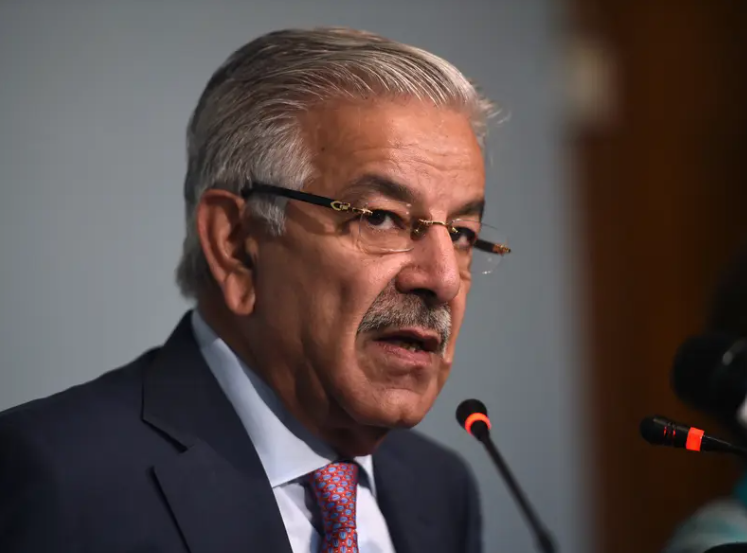

Pakistan’s Defence Minister Khwaja Asif has made a rare and direct admission about Pakistan’s role in the Afghanistan wars. Speaking in the National Assembly, he said Pakistan did not enter the conflicts to defend Islam or carry out jihad. He explained that the real reasons were political power and international legitimacy. He also said Pakistan sought support from powerful countries, especially the United States. Such statements are unusual from a serving defence minister.
Pakistan’s political motives behind the Afghanistan wars
Speaking in the National Assembly, Defence Minister Khwaja Asif said Pakistan’s involvement in Afghanistan was never driven by religion. He said it was often presented that way to the public. According to him, Pakistan entered the wars to gain political legitimacy. He also said the aim was to secure support from powerful countries, especially the United States.
Asif explained that Pakistan’s role began during the Cold War. He said this followed the Soviet Union’s invasion of Afghanistan in 1979. He added that the conflict was commonly described as jihad. However, he said it was actually a proxy war shaped by global powers, mainly the United States and the Soviet Union.
UK Prime Minister Starmer rebukes Trump over NATO troops in Afghanistan and honors fallen soldiers
According to Asif, Pakistan aligned with the US-led bloc to receive military aid, economic support, and international recognition. He added that Pakistan’s Afghanistan policy has shifted over time based on changing geopolitical interests rather than long-term regional stability.
Education changes and lessons not learned after the Soviet withdrawal
One of the most striking parts of Khwaja Asif’s speech was his reference to changes made to Pakistan’s education system during the Soviet-Afghan war. He said the conflict was wrongly presented as jihad. According to him, it was actually driven by a global superpower.
Asif explained that textbooks and teaching methods were changed to support the war narrative. He said the changes were made under international pressure. According to Asif, many of them have still not been fully corrected. He added that this has had a long-term impact on society.
Canadian judge on ICC sanctioned by U.S. for role in Afghanistan war crimes probe
The defence minister also said Pakistan failed to learn from history after the Soviet Union withdrew from Afghanistan in 1989. He noted that Islamabad had a chance to rethink its approach. Instead, Pakistan aligned once again with the United States after the September 11, 2001 attacks.
Asif added that Afghanistan as a country was not responsible for the Twin Tower attacks. He said Afghans were not involved in the attacks. Despite this, Pakistan remained involved in the US-led war in Afghanistan for nearly two decades, mainly to maintain American support.
‘We rented ourselves out’ and admission of past mistakes
Perhaps the strongest part of Khwaja Asif’s speech was his admission that Pakistan allowed itself to be used for foreign interests for many years. He said the country’s leadership kept making the same decisions without accepting their long-term consequences. Asif openly stated that Pakistan remained involved in conflicts not for a short period, but for nearly two decades, mainly to secure American support.
He said Pakistani leaders often avoided admitting past mistakes, which prevented real change. According to him, refusing to take responsibility made it harder to understand how the country reached its current position. Asif told lawmakers that improvement is impossible without honestly acknowledging past errors. He also said he had personally apologised for the decisions taken by earlier generations of political and military leaders, even though he did not name anyone directly.
Asif’s remarks are unusual because senior Pakistani officials rarely speak so plainly about the country’s role in Afghanistan. While journalists and analysts have debated this issue for years, it is uncommon for a serving defence minister to reject the religious explanations often used in the past.
His statements underline that Pakistan’s involvement in Afghanistan was closely linked to global power politics, especially its relationship with the United States. They also show how decisions made for short-term political benefits had lasting effects on Pakistan’s society, policies, and regional position.