
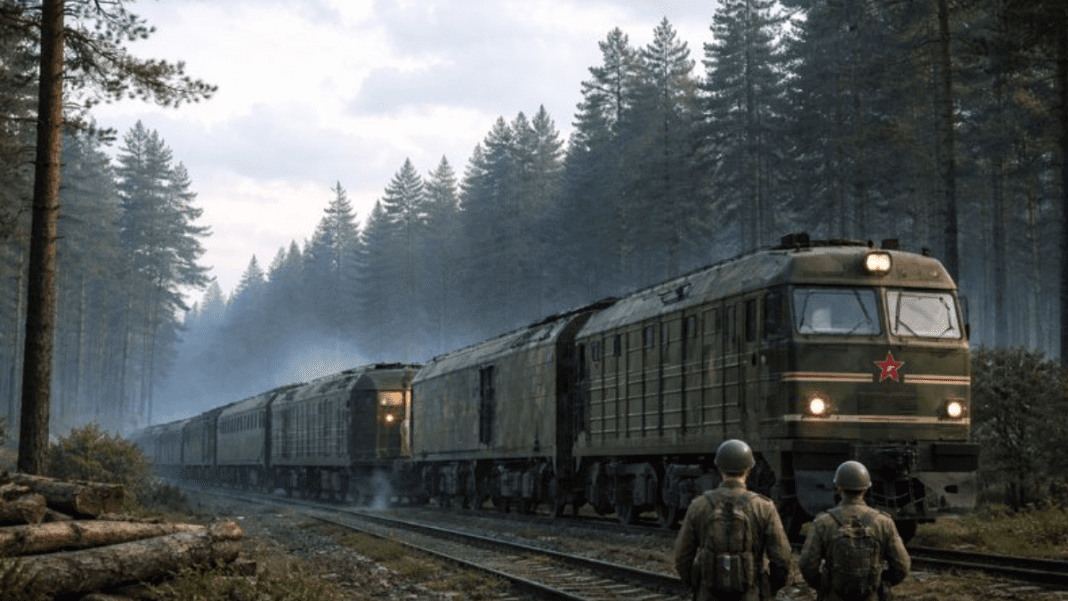

During the Cold War, the biggest fear for powerful nations was not only losing a nuclear war, but also losing the ability to respond at all. Specifically, if enemy attacks destroyed missile silos and air bases, what weapons would remain to strike back? As a result of this concern, the Soviet Union developed one of the most unusual military systems ever created: the RT-23 Molodets, a nuclear missile hidden inside ordinary-looking trains.
Instead of placing weapons in fixed locations, the Soviet Union chose movement as its shield. By doing so, missiles traveling across the country’s massive railway network became harder to find, track, and destroy. Consequently, these trains blended into daily rail traffic, turning regular rail lines into moving platforms for strategic defense.
A Missile Disguised as a Freight Train
The RT-23 Molodets, called the SS-24 Scalpel in the West, was a powerful intercontinental ballistic missile. Importantly, the system launched missiles directly from reinforced railway cars that resembled standard freight wagons.
Each missile weighed more than 100 tons and could travel over 10,000 kilometers. Moreover, it could carry up to 10 nuclear warheads, each aimed at a different target. Therefore, a single missile could strike several locations across long distances.
South Korea confirms talks with U.S. and Japan after North Korea missile launch breaks UN rules
The trains carrying these missiles were fully equipped for long missions. In addition to the missile cars, they included command rooms, communication systems, power generators, and living quarters for the crew. From the outside, there was nothing unusual. However, from the inside, these trains were mobile nuclear bases.
Because of this disguise, the trains were extremely difficult to detect. Satellites scanning from space would see thousands of similar trains, yet could not easily tell which ones carried missiles and which did not.
Turning Rail Lines into Launch Zones
Another key feature of the Molodets system was its ability to launch from almost anywhere along the railway. Thus, the trains did not need fixed launch pads or permanent bases.
When an order was received, the train could stop on a suitable stretch of track. The missile car would stabilize, its roof would open, and the missile would rise into a vertical position. Within moments, it could be launched directly from the rails.
Single U.S. Patriot system shoots down more than 140 Russian ballistic missiles in Ukraine
Consequently, nearly any section of the Soviet railway network could become a launch site. Given that there were more than 120,000 kilometers of tracks, this created thousands of possible launch locations across the country.
Because of this mobility, planning a successful enemy attack became extremely difficult. Even if one train was located, others would still be moving. Furthermore, attacking the wrong train could risk hitting civilian cargo, which could dangerously escalate tensions. In this way, uncertainty itself became part of the system’s strength.
Mobility as a Strategic Shield
The real power of the RT-23 Molodets was not only in its range or payload, but also in its unpredictability. The trains followed changing routes, mixed with civilian traffic, and rarely stayed in one place. As a result, this constant movement made them nearly impossible to track.
A highly trained military crew operated each train and lived onboard for extended periods. In addition, the designers built the trains to function independently, even after a large-scale attack, thereby ensuring the country could still respond if fixed bases were destroyed.
The Molodets system entered service in the late 1980s, just as the Cold War was nearing its end. At its height, several railway units were active, each managing multiple missile trains across the country. During this time, these trains silently moved through cities, countryside, and remote regions, always prepared but rarely noticed.
Zelensky unveils new sanctions plan to choke off foreign tech fueling Russia’s missiles and
drones
After the collapse of the Soviet Union, international arms reduction agreements led to a shift in strategy. Officials considered rail-based missiles costly and politically sensitive. Consequently, they withdrew the Molodets trains from service and dismantled them, ending this unique chapter in military history.
Even today, the idea behind the Molodets continues to attract attention. Overall, the concept of hiding powerful weapons within everyday infrastructure shows how far Cold War engineering went to ensure survival and deterrence. By turning movement into protection, the RT-23 Molodets reshaped how nations thought about security in an age defined by nuclear fear.