
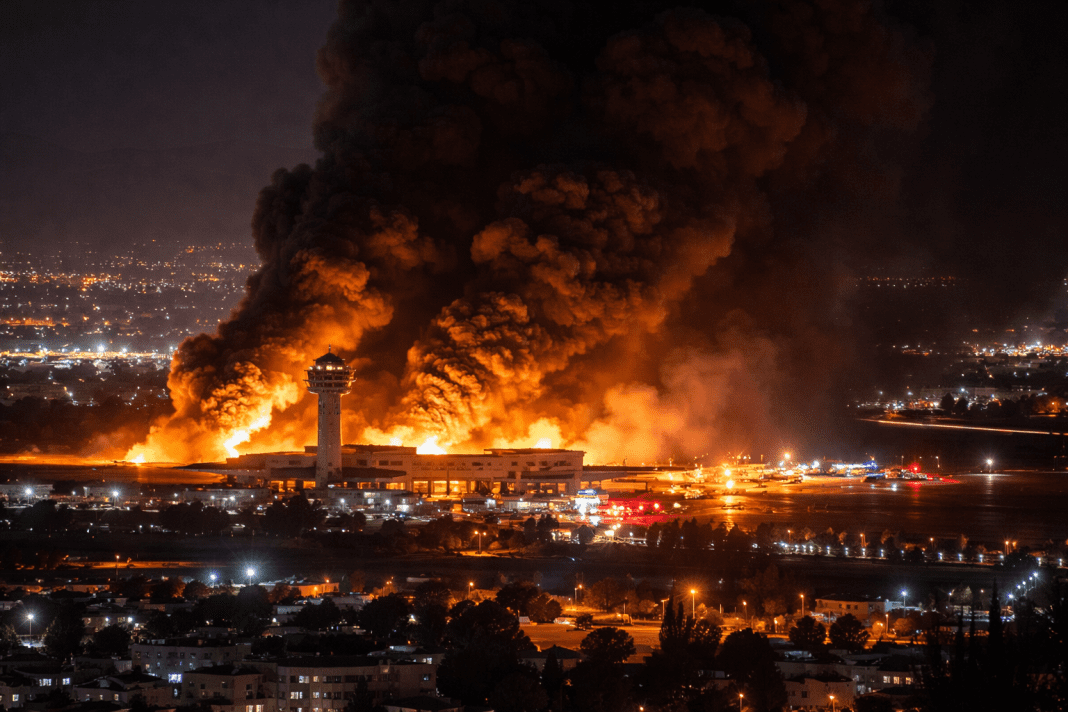

The war involving the United States, Israel, and Iran has entered its 15th day. Fighting across the region is becoming more intense. A major strike reportedly hit Shiraz International Airport in Shiraz. The attack caused a large fire and thick smoke to rise from the airport. Emergency crews rushed to control the blaze.
Major Strike Hits Shiraz Airport
The attack on Shiraz International Airport reportedly took place during the night as part of wider military operations linked to the ongoing war involving Iran, Israel, and the United States. Soon after the strike, a large fire broke out inside the airport complex. Flames spread across sections of the facility while thick black smoke rose high into the sky. The blaze was reportedly visible from several kilometers away.
Airports are considered critical infrastructure because they support transportation, supply routes, and sometimes military logistics. Damage to such locations can disrupt both civilian flights and military movement. Reports suggested that the strike targeted infrastructure linked to military activity near the airport, though the full extent of the damage has not yet been officially confirmed.
Oman dragged into Middle East war as drones strike Salalah port, Iran denies role
The city of Shiraz is one of Iran’s major urban centers and an important transportation hub in the southern part of Iran. The city is home to Shiraz International Airport, which handles both domestic and international flights and connects the region to other major cities. Because of its strategic location and strong transport links, Shiraz plays a key role in moving people, goods, and supplies. This importance is why the strike quickly drew attention across the region.
Iran Launches Missile Strikes on Israeli-Controlled Areas
While the strike on Shiraz International Airport captured global attention, Iran also carried out retaliatory attacks across the region. According to reports, Iranian forces launched several missile strikes targeting Israeli-controlled areas in Palestine. Multiple locations in territories controlled by Israel were reportedly struck during these attacks.
The missiles were aimed at what Iranian sources described as strategic positions connected to Israeli military operations. These targets reportedly included military bases and operational facilities. The strikes indicated that Iran was focusing on sites it considers important for Israeli military activities in the region.
US urges Israel to pause strikes on Iran oil infrastructure citing risks to global energy supply
In addition to missiles, Iranian forces are believed to have used drones as part of their attack strategy. Drones can travel long distances and can be used for surveillance or direct strikes. The combination of missiles and drones allows forces to launch attacks from multiple directions, making it harder for defensive systems to stop every incoming threat.
Reports from the affected areas said warning sirens sounded in several locations before explosions were heard. Air defense systems were activated in an attempt to intercept incoming projectiles. Some missiles were reportedly intercepted before reaching their targets, while others struck areas inside Israeli-controlled zones, showing the continued intensity of the retaliatory attacks.
Conflict Expands Across Multiple Fronts
The latest strikes show that the war involving the United States, Israel, and Iran is spreading across several regions. Military actions are now taking place in different countries and territories across the Middle East. Airstrikes, missile launches, and drone operations are being reported almost daily as the conflict continues.
The attack on Shiraz International Airport is one example of how infrastructure inside Iran is becoming a direct target during the war. At the same time, Iran’s missile and drone strikes against Israeli-controlled areas in Palestine show that retaliation is continuing from the other side.
Iran launches seventh missile wave since midnight as Israel investigates use of cluster munitions
Military analysts say both sides are trying to weaken each other’s strategic positions through these attacks. Airports, military bases, radar systems, and logistical facilities are among the locations increasingly targeted during the conflict.
Because of the growing number of strikes, several areas across the region remain on high alert. Air defense systems continue to monitor the skies, while emergency services remain prepared to respond to further attacks. Cities across the Middle East have experienced warning sirens, explosions, and increased military activity as the war continues to unfold.