
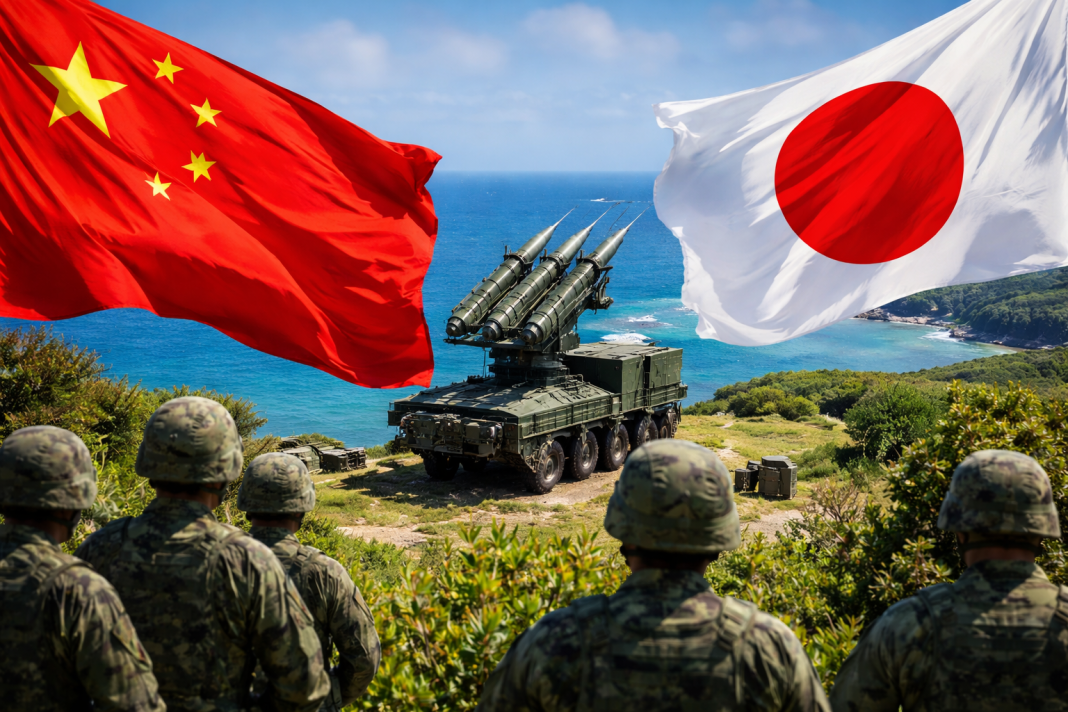

China and Japan are locked in a growing diplomatic clash. Tensions escalated after Tokyo announced plans to deploy missiles on Yonaguni Island, a tiny island near Taiwan. The dispute intensified months after Japanese Prime Minister Sanae Takaichi made remarks in support of Taiwan. Beijing viewed her comments as a direct challenge to its sovereignty.
China Imposes Export Controls on Japanese Companies
In the latest move, China’s Ministry of Commerce restricted exports to 40 Japanese companies. Beijing accused them of contributing to Japan’s “remilitarization.”China placed 20 Japanese companies on a strict export control list. It added another 20 to a watchlist that requires special permits for certain goods.
The restrictions target “dual-use” items. These are products that companies can use for both civilian and military purposes. China affected subsidiaries of Mitsubishi Heavy Industries, Kawasaki Heavy Industries, and Fujitsu. It added Subaru Corporation, Mitsubishi Materials Corporation, and the Institute of Science Tokyo to the watchlist.
Under the new measures, Chinese exporters must apply for individual export licenses for dual-use items sent to watchlisted companies. They must also submit risk assessment reports and provide written guarantees that Japan’s military will not use these items.
The Chinese Commerce Ministry stated the measures are “entirely legitimate, reasonable, and legal” and claimed that normal trade between China and Japan will continue for law-abiding businesses. Tokyo, however, strongly protested the step. Kei Sato, Japan’s deputy chief cabinet secretary, called the restrictions “deplorable” and urged China to lift them, saying Japan will take appropriate actions in response.
Japan Announces Missile Deployment on Yonaguni Island
Amid rising trade and diplomatic tensions with China, Japan has confirmed plans to deploy missiles on Yonaguni Island, a small island about 100 kilometers from Taiwan. The move highlights Tokyo’s focus on strengthening its defenses in a region of growing strategic importance.
Shinjiro Koizumi, Japan’s defense minister, said the island will host surface-to-air missiles capable of intercepting aircraft and ballistic missiles. These systems are expected to become operational by March 2031, adding a significant layer of security to Japan’s southwestern defenses.
Hostile patrols at Senkaku — China storms island waters moments after Japan’s Taiwan stand
Koizumi noted that the deployment timeline depends on preparing the necessary facilities on the island. Currently, Yonaguni already houses a Japan Self-Defense Forces (SDF) base, which will support the missile operations and other military activities.
The announcement comes after months of escalating tensions between Japan and China. Officials described the missile deployment as a step to enhance Japan’s regional defense capabilities, particularly given Yonaguni’s proximity to Taiwan and potential security risks in the area.
Background of China-Japan Tensions
The current diplomatic rift began in November 2025 when Prime Minister Sanae Takaichi responded to a question in parliament about “survival-threatening situations.” She cited a hypothetical scenario in which China could attempt to bring Taiwan completely under its control using military force. Takaichi said Japan might intervene militarily to help a nation closely tied to its own security in such a scenario.
Beijing reacted strongly, calling the remarks a direct challenge to China’s sovereignty. In retaliation, Japan returned its last two giant pandas to China in early 2026, and China reinstated bans on Japanese seafood imports. Travel warnings issued by Beijing caused nearly 500,000 flight bookings to be canceled, and Chinese tourist arrivals in Japan fell by 60.7% year-on-year in January 2026.
Trump urges Japan’s PM to dial back Taiwan remarks after fiery call with Xi — East Asia on edge
China also raised the issue at the United Nations, demanding an apology from Takaichi and calling on the Japanese government to retract her statements. These diplomatic tensions, combined with recent export restrictions and Japan’s missile deployment plans, have created a highly sensitive situation in East Asia.
The situation remains dynamic as both countries continue to take measures affecting trade, security, and diplomacy. The recent announcements underscore the fragile state of China-Japan relations and the potential for further escalation if disagreements over Taiwan and regional security persist.