
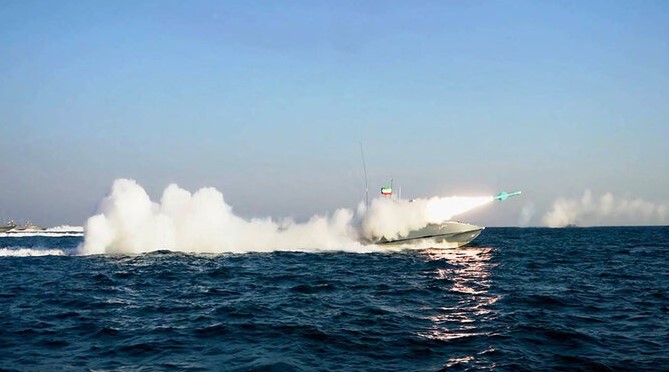

A major military drill in the Persian Gulf showcased the strength and coordination of the IRGC Navy, which carried out a series of missile tests using different long-range and short-range systems. During this exercise, several types of missiles were launched from deep inside the country and sent toward targets in the Sea of Oman. These missiles included the Qadr-110, Qadr-380, Qadir, and 303 ballistic missiles, all hitting their predetermined targets with high accuracy.
IRGC Navy Showcases Precision Missile Firings
The launch of all these missiles at the same time showed the teamwork and readiness of the IRGC Navy. Each missile followed a carefully planned path, showing that it can handle different weather conditions and avoid detection. Operators monitored the paths through command centers located both on land and at sea. This coordination made it clear that the systems can work together during real situations in which timing and accuracy matter.
Using different missile types in one drill showed how flexible the IRGC Navy missile program is. Some missiles traveled long distances to hit far-off targets, while others were designed for quicker, shorter-range strikes. Even though each missile has a different shape, size, and purpose, they all took part in a single combined mission, proving the strength of the overall system.
Qatar may host Iran’s hypersonic Fattah protection as lawmaker urges IRGC shield against Israel
IRGC Navy Adds Drone Strikes and Ship Defense to the Drill
At the same time as the missile launches, drones were sent out to attack simulated enemy bases. These drones flew to their targets and destroyed them successfully. This part of the drill showed how drones can carry out missions without risking pilots, and how well they work beside missiles during large-scale operations.
Along with drones, ships took part in practicing air defense. Vessels equipped with defensive systems tracked and engaged targets pretending to attack Iranian ships and coastal facilities. Since the Persian Gulf is a narrow and busy region, the IRGC Navy trains regularly to react quickly to sudden situations. This drill helped ship crews practice spotting and stopping incoming threats.
Turkey Cracks Down on Espionage, Arrests 5 with Alleged IRGC Ties
The drone and ship-defense activities showed how different parts of the IRGC Navy cooperate to create a layered defense system. Missiles can target distant threats, drones can strike smaller or hidden targets, and ships can defend both themselves and coastal positions. Together, these systems create a strong network of protection across sea and land.
Electronic Warfare and Strategic Locations Play Key Roles
The drill also included training under electronic warfare conditions. These conditions included radar jamming, communication delays, and attempts to disrupt missile or drone guidance systems. Practicing in these situations helps the IRGC Navy keep control of its systems even when technology is being interfered with by a simulated enemy.
This part of the exercise is important because modern conflicts often start with attempts to break communication lines or block radar signals. By including these challenges, operators learned how to stay steady, continue tracking targets, and solve unexpected problems quickly.
The entire drill took place in some of the most important waters in the region:
- The Persian Gulf
- The Strait of Hormuz
- The Nazeat Islands, including Abu Musa, Greater Tunb, Lesser Tunb, and Siri
These areas are used by many international ships and tankers, making them strategic for security and navigation. Training in these waters allows the IRGC Navy to operate in real-life conditions where islands, narrow routes, and heavy traffic must be considered.
IRGC Orders Halt to Communication Devices After Hezbollah Attacks
Throughout the exercise, the stability of missile systems, drone systems, and ship defenses was closely checked. This included repeated launches, long-distance tracking, and reaction drills. The training began the day before the missile launches and included communication checks between land, sea, and air units. It also included radar tracking, coastal monitoring, and emergency ship procedures.
By the end of the drill, all goals were reported as achieved. The exercise highlighted missile accuracy, drone performance, ship defense training, and preparation for electronic warfare situations. Through these activities, the IRGC Navy demonstrated its ability to coordinate multiple systems in a complex and simulated war environment.