


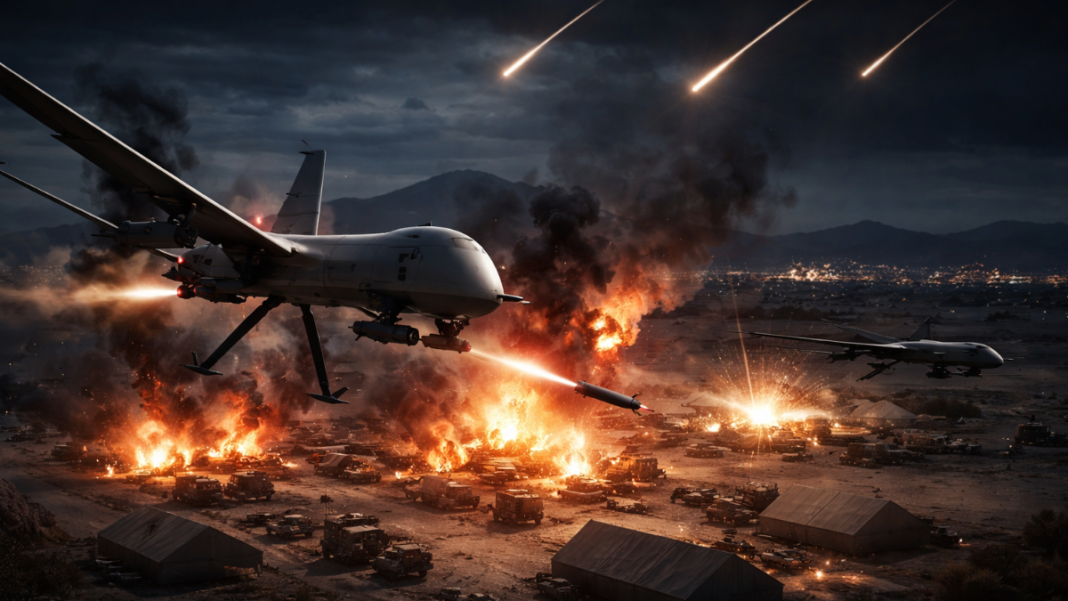


Drone and missile attacks have sharply escalated tensions across West Asia after a pro-Iran Iraqi resistance group claimed responsibility for the strikes. The group said it carried out 21 operations within 24 hours, targeting foreign military positions in Iraq and nearby regions. It presented these strikes as retaliation linked to ongoing regional hostilities, further straining an already fragile security environment.
The group also released visual footage showing drones striking what it described as strategic targets, raising concerns about the growing use of advanced warfare technology. The scale, speed, and coordination of these attacks have drawn attention, signaling a possible shift in how such conflicts are conducted. These developments have also triggered widespread discussion about the expanding role of unmanned systems in modern warfare.
Rising Drone and Missile Attacks Across Iraq and Multiple Targets
The resistance group claimed it directed the attacks at what it called “occupation bases,” referring to foreign military presence in Iraq and surrounding areas. It used drones and missiles in quick succession, showing a more aggressive and coordinated approach and suggesting careful planning behind each strike.
Experts say armed groups increasingly use drones in modern conflicts because they can travel long distances and strike with precision. Unlike traditional weapons, operators can deploy drones quickly and often at lower cost, making them an effective tool for repeated attacks. This allows armed groups to carry out operations more frequently and with greater impact.
US embassy in Baghdad warns Americans to leave Iraq as security fears grow
Some of the reported strikes were not limited to Iraq, indicating a wider operational reach. This has raised concerns that the conflict may extend beyond national borders, further increasing instability in the region. The ability to strike across borders suggests growing capabilities that could change the nature of regional conflicts.
The high number of attacks within a short time frame has also raised questions about the level of coordination involved. Carrying out multiple operations in a single day requires strong communication networks and access to resources, pointing to an organized and well-prepared structure behind the attacks.
Claims of Strategic Movements and Expanding Conflict
The group also claimed that foreign forces were withdrawing from some bases. It said they were moving toward neighboring regions. These claims remain unverified. They have increased uncertainty and speculation about possible strategic shifts.
Troop repositioning may indicate changing strategies. Forces may be trying to avoid further damage. They may also aim to protect personnel. Another reason could be regrouping in safer locations. If confirmed, these movements could show that the attacks are affecting military planning.
U.S. and Iraqi Officials Forge New Path at Pentagon for Coalition Against ISIS
The group also stated that it had detailed knowledge of these movements. This suggests a level of intelligence capability that could influence future operations. Access to such information could allow for more precise targeting, increasing the effectiveness of future strikes.
At the same time, the situation is becoming more complex as multiple actors remain involved in the region. Each action appears to trigger a response, creating a cycle of escalation. This makes it difficult to predict how events will unfold, as different groups continue to react to developments on the ground.
Threats to Energy Infrastructure Raise Global Concerns
A major point of concern is the warning issued about potential attacks on energy infrastructure across West Asia. The group indicated that oil and energy facilities could become targets if tensions continue to rise, especially in response to further military actions.
Energy infrastructure in the region is critical not only for local economies but also for global supply. Any disruption could lead to higher fuel prices, supply shortages, and economic uncertainty in many parts of the world. This makes such threats particularly serious, as their impact could extend far beyond the immediate conflict zone.
Iraq’s oil production collapses 70% as war tensions choke tanker traffic through Strait of Hormuz
Targeting these facilities would mark a significant escalation, shifting the focus from military operations to economic consequences. Energy sites are often seen as sensitive targets because of their importance to both national and global stability.
The warning has increased concerns among observers that the conflict could widen further. Any attack on energy networks could trigger additional reactions and deepen the crisis. The combination of ongoing strikes, claims of strategic movements, and threats to key infrastructure continues to keep the region in a state of heightened tension.