
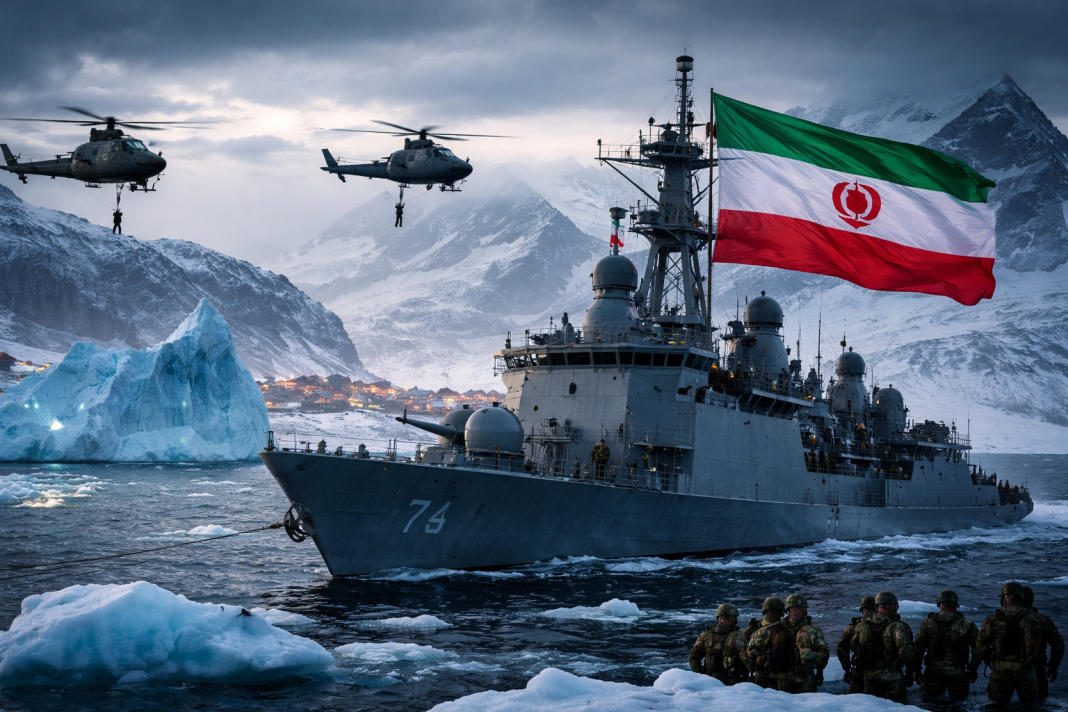

In a striking geopolitical twist, Iran has said it is ready to “protect” Greenland from the United States, directly responding to renewed remarks by Donald Trump about acquiring the Arctic territory. The statement comes at a time when Tehran is already engaged in heightened military tensions with both the US and Israel, adding a new and unexpected dimension to an increasingly volatile global landscape.
The comments were made by an Iranian spokesperson, who mocked Washington’s shifting stance toward Europe and NATO allies. “If you cannot keep your Greenland, just ask us — we will come to protect it,” the spokesperson said, in what analysts see as a mix of strategic messaging and political signalling aimed at Western audiences.
A war backdrop shaping rhetoric
Iran’s remarks arrive against the backdrop of an ongoing conflict in West Asia that has seen direct and indirect confrontations between Iranian forces and US-backed allies since late February. Tehran has faced sustained military pressure and has responded with counterstrikes targeting strategic assets across the region.
One of the most critical flashpoints has been the Strait of Hormuz, a narrow maritime corridor through which a significant share of global oil supplies passes. Iran has threatened to disrupt or shut down the route in retaliation for military actions against it, prompting urgent calls from Washington for allied support to secure shipping lanes.
Against this tense backdrop, Trump has stepped up his rhetoric, urging NATO and European Union members to align more closely with US objectives in the region. His warnings have included the possibility of severe retaliation if global energy routes are disrupted.
Donald Trump backs existing Greenland defense pact as sovereignty risks unsettle NATO and markets
Trump revives Greenland ambitions
At the same time, Donald Trump has reignited a controversial idea from his earlier political tenure — the acquisition of Greenland. Calling it a matter of “national security,” Trump has pushed for immediate negotiations, arguing that the Arctic territory holds strategic importance due to its location and natural resources.
The proposal has been firmly rejected by both Denmark and Greenland’s leadership. Officials have reiterated that Greenland is not for sale and have drawn a clear line on sovereignty. The island remains an autonomous territory within the Kingdom of Denmark, with its own government overseeing domestic affairs.
Greenland’s Prime Minister has also emphasised that any external attempt to control the territory would be unacceptable, reinforcing a long-standing position held by both Nuuk and Copenhagen.
Strains within Western alliances
Trump’s renewed push has not only drawn criticism from European leaders but has also created unease within NATO. Reports of potential tariffs on European goods — including those from Denmark, Norway, and Sweden — have further complicated relations between Washington and its allies.
Russia warns of military response if Greenland becomes heavily militarized
The suggestion that economic pressure could be used to force negotiations over Greenland has raised questions about the cohesion of Western alliances at a time when unity is seen as critical in addressing global security challenges.
Iran’s intervention in the debate, while largely rhetorical, underscores how geopolitical rivalries are increasingly overlapping. By inserting itself into the Greenland issue, Tehran appears to be highlighting divisions within the Western bloc while projecting confidence despite ongoing military pressure.
Symbolism and strategic messaging
Experts suggest that Iran’s statement is less about any real intention to engage in Arctic geopolitics and more about strategic communication. By framing itself as a potential “protector” of Greenland, Iran is attempting to challenge US narratives and portray Washington’s actions as overreach.
The remarks also serve to divert attention from the ongoing conflict in West Asia, where Iran continues to face military and economic challenges. At the same time, they reinforce Tehran’s broader messaging strategy of positioning itself as a counterweight to US influence.
A widening geopolitical theatre
The convergence of tensions in West Asia and the Arctic highlights how interconnected global politics has become. Issues that might once have remained regionally contained are now spilling into broader international discourse.
While there is no indication that Iran has any practical capability or intention to project power into the Arctic, its comments have added another layer of complexity to an already crowded geopolitical landscape.
For now, Greenland remains firmly under Danish sovereignty, and diplomatic channels continue to manage disagreements over its future. However, with war ongoing in one region and strategic competition intensifying in another, even rhetorical exchanges are taking on greater significance.
As global tensions rise, statements like these — whether symbolic or serious — reflect a world where geopolitical boundaries are increasingly fluid, and where conflicts in one region can quickly echo across the globe.