
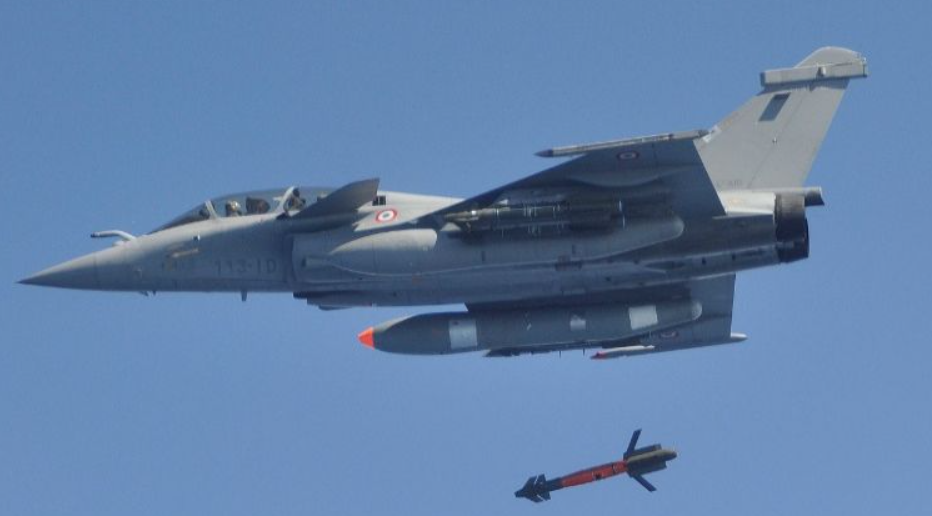

India and France are gearing up to sign a key MoU for the joint production of HAMMER missiles during the official three-day visit of the French President. The agreement will mark a significant step in defence cooperation between the two countries.
India to Produce HAMMER Missiles as Macron Visits
The Highly Agile Modular Munition Extended Range, or HAMMER missile, plays a key role on Rafale fighter jets. It is a smart, precision-guided weapon that strikes targets accurately on the ground. India has imported these missiles from France so far, but under a new agreement, Indian companies will produce them locally, strengthening defence manufacturing and boosting the country’s self-reliance in advanced weaponry.
French President Emmanuel Macron will arrive in Mumbai on February 16 and meet Indian leadership on February 17, the External Affairs Ministry announced. Officials view his visit as an important step to deepen defence cooperation between the two countries. They will focus discussions on enhancing joint defence projects and sharing technology.
France asks NATO to hold military exercise in Greenland to support allies amid US tensions
The talks will also cover the procurement and local production of 114 Rafale fighter jets. Indian manufacturers will build 96 jets, while Dassault Aviation will deliver the remaining aircraft ready-to-use. The agreement will improve India’s air combat readiness and support domestic defence industries through technology transfer and local manufacturing.
What is the HAMMER Missile?
The HAMMER missile is a precision-guided weapon designed to strike targets accurately on the ground. Its name reflects its purpose: delivering a “hammer strike” to destroy intended targets efficiently. It is equipped with smart guidance systems, allowing it to hit both stationary and moving targets.
The missile has a range of about 60 to 70 kilometres and is highly effective in mountainous regions and against fortified bunkers. It weighs around 330 kilograms and can operate in all weather conditions, during both day and night operations.
SAAB proposes Gripen E deal that could reshape India’s fighter fleet and aerospace base
HAMMER follows a “fire-and-forget” principle, meaning that once it is launched at a locked target, it does not need further guidance. This makes it safer for pilots and increases the chances of hitting the target accurately. The missile is modular, allowing different warhead options ranging from 125 kilograms to 1,000 kilograms. A single Rafale jet can carry up to six 250-kilogram HAMMER missiles, striking multiple targets simultaneously.
The missile was first displayed at the Paris Air Show in 2007 under the name AASM (Armement Air-Sol Modulaire). In 2011, it was renamed HAMMER. Today, it is considered a medium-range air-to-ground weapon and a proven system for precision strikes.
India-France Defence Cooperation
Under the proposed deal, India’s Bharat Electronics Limited will manufacture HAMMER missiles in partnership with the French company Safran Electronics & Defence. The 50-50 joint venture will allow technology transfer and faster production, reducing India’s reliance on imports and ensuring quicker supply for the Air Force. This step aligns with India’s “Make in India” initiative, promoting domestic defence manufacturing.
Alongside missile production, talks will cover the procurement of 114 Rafale fighter jets. Of these, 96 will be produced in India, while the remaining jets will be delivered ready-to-use by Dassault Aviation. This collaboration strengthens India’s air combat capabilities while building domestic expertise.
❗France breaks ranks with West—backs Palestinian state, sparks U.S.–Israel fury
The visit will also include the inauguration of a helicopter assembly line in Vemagal, Karnataka, a joint venture between Tata Advanced Systems and Airbus for H-125 helicopters.
HAMMER missiles are designed for modern combat, striking high-value targets with precision while keeping pilots safe. Their modular design and high accuracy make them a versatile weapon for Rafale jets. Local production is expected to speed up availability and support the Air Force more effectively. The initiative also represents a key step in India-France technological collaboration, giving India the know-how to produce and maintain advanced missile systems independently.