
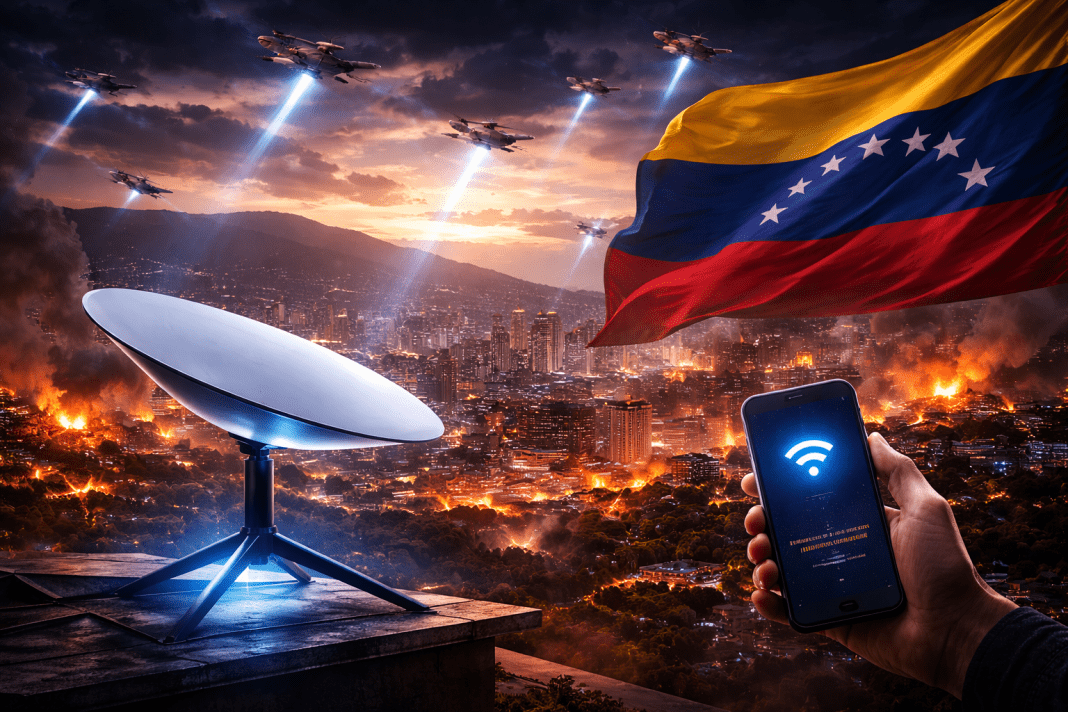

Billionaire entrepreneur Elon Musk has announced that SpaceX-owned Starlink will provide free satellite internet services to Venezuela for a limited period, positioning the move as a gesture of support for ordinary citizens amid one of the most dramatic political upheavals in the country’s modern history.
The announcement comes against the backdrop of rapidly unfolding events in Caracas following a U.S.-led operation that resulted in the capture of Venezuelan President Nicolás Maduro, triggering a sudden leadership vacuum and heightened international attention.
Starlink Steps In During Turbulence
In a post on social media platform X, Musk wrote, “In support of the people of Venezuela,” while resharing an official statement from Starlink. According to the company, Starlink will provide free broadband internet access across Venezuela until February 3, ensuring continued connectivity during a period of political uncertainty and administrative transition.
The company said the initiative is aimed at keeping Venezuelans connected to information, communication channels, and essential services at a time when disruptions are widely anticipated.
“Starlink is providing free broadband service to the people of Venezuela through February 3, ensuring continued connectivity,” the statement read.
The move has drawn immediate global attention, with analysts noting that internet access often becomes a critical tool during moments of political instability, particularly in countries where traditional telecommunications infrastructure has been strained by years of economic crisis and sanctions.
Capture of Maduro Sparks Shockwaves
The Starlink announcement followed confirmation from U.S. authorities that Venezuelan leader Nicolás Maduro had been taken into custody by U.S. forces. Footage released by American officials showed Maduro in handcuffs during what was described as a staged “perp walk.” In the video, Maduro appeared calm, addressing reporters and U.S. Drug Enforcement Administration agents, offering New Year greetings as he was escorted away.
The images quickly spread across social media and news networks, underscoring the extraordinary nature of the development. While Washington has framed the operation as necessary for regional stability and security, the move has triggered intense debate globally over sovereignty, intervention, and precedent.
Musk reacted openly to the development, posting in Spanish, “Venezuela ahora puede tener la prosperidad que merece,” which translates to, “Venezuela can now have the prosperity it deserves.” The comment was widely shared and interpreted as an endorsement of the political shift underway in the country.
Supreme Court Names Acting President
As uncertainty mounted, Venezuela’s Supreme Court moved swiftly to address the sudden leadership gap. In a ruling broadcast on state television channel VTV, the court declared that Maduro was in a “material and temporary impossibility to exercise his functions.”
The court ordered Vice President Delcy Rodríguez to assume the role of acting president, granting her full presidential powers to ensure continuity of governance.
Justice Tania D’Amelio, reading the ruling, said Rodríguez would “assume and exercise, as acting president, all the powers, duties, and faculties inherent to the office of president of the Bolivarian Republic of Venezuela, in order to guarantee administrative continuity and the comprehensive defense of the nation.”
The decision was based on provisions in Venezuela’s constitution, which stipulate that the vice president must take over in the event of a temporary or absolute absence of the president.
While the ruling was presented as a constitutional safeguard, political observers say the transition remains fraught with uncertainty, particularly given the unprecedented circumstances surrounding Maduro’s removal.
Connectivity as a Strategic Tool
Starlink’s intervention has added a technological dimension to the unfolding crisis. Venezuela has long struggled with unreliable internet and telecommunications services, problems that have intensified during periods of political unrest.
First U.S. strike on Venezuelan soil revealed as CIA destroys drug-linked port facility
Experts note that satellite-based internet access could play a significant role in shaping public discourse, enabling independent media reporting, and facilitating coordination among civil society groups. At the same time, the move has raised questions about the growing influence of private technology firms in geopolitical crises.
“Access to information can be as decisive as control of physical infrastructure during moments like this,” said a Latin America-focused technology policy analyst. “Starlink’s presence effectively bypasses domestic bottlenecks.”
Musk has previously positioned Starlink as a tool for maintaining connectivity in conflict zones and disaster-hit regions, including Ukraine and parts of the Middle East. Venezuela now joins a growing list of politically sensitive environments where the satellite network has been deployed during crises.
U.S. Background and Long-Running Plans
Additional context on the U.S. operation was provided by former National Security Advisor John Bolton, who told CNN that plans to remove Maduro had been discussed during President Donald Trump’s first term in office.
According to Bolton, the proposal failed to advance at the time because senior officials struggled to keep Trump “focused” on Venezuela for an extended period. The recent operation, however, suggests a renewed strategic prioritization of the country.
U.S. officials have not publicly detailed the full scope of the operation or outlined next steps, but the speed of developments has left little doubt that Washington intends to play a central role in shaping Venezuela’s immediate future.
Global Reactions and What Comes Next
International reactions to the developments have been mixed, with some governments welcoming what they see as an opportunity for political change in Venezuela, while others have expressed concern about the implications for international norms and regional stability.
Within Venezuela, the combination of a leadership transition, foreign involvement, and emergency measures such as Starlink’s free internet rollout has created an atmosphere of uncertainty and anticipation.
For ordinary Venezuelans, the promise of uninterrupted internet access may provide a rare sense of continuity amid turmoil. For the global community, the episode underscores how deeply intertwined politics, technology, and power have become in the modern era.
As events continue to unfold, the focus will remain on whether the interim leadership can stabilize the country, how long foreign involvement will persist, and what role private actors like Starlink will play in Venezuela’s path forward.