
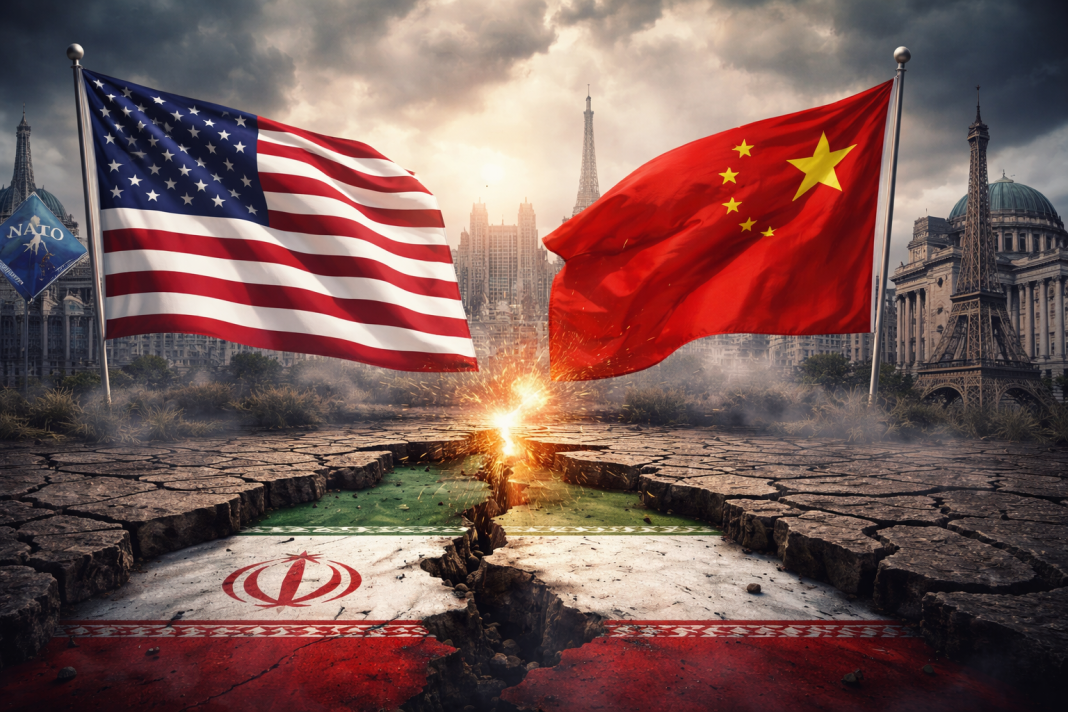

Tensions are rising globally as Donald Trump pressures allies to support the United States in its stance against Iran. Some nations say the crisis is not theirs. A new survey shows trust in the US may be declining across Western allies. Many now view China as a more reliable global partner. This reflects growing concern over America’s foreign policy direction.
Allies Push Back as Pressure Mounts
In recent weeks, President Trump has urged allied nations, especially those in NATO, to stand firmly with the United States amid tensions involving Iran. The situation has become more sensitive due to rising conflict risks in the Middle East, a region that plays a key role in global energy supply.
Trump’s message has been direct. He expects allies to take a stronger role in supporting US actions and securing important global routes. However, not all countries agree with this approach.
Trump warns NATO of consequences if allies don’t help reopen the Strait of Hormuz
Some officials and voices across allied nations have responded with a clear message: “This is not our war.” This reaction shows that many countries are cautious about getting involved in a conflict that may not directly affect their own national interests. This difference in opinion is not just happening among leaders. It is also being reflected in public opinion across several countries.
Survey Shows China Seen as More Reliable
A new international survey conducted by Politico in partnership with Public First has shed light on how people in key Western nations view global powers. The poll covered more than 2,000 respondents in each of five countries: the United States, Canada, the United Kingdom, France, and Germany. It was carried out over a short period between February 6 and 9, capturing public opinion during a time of rising global tensions.
Participants in the survey were asked a direct and simple question. They had to choose which country they consider more reliable—the United States under Donald Trump or China. The responses revealed a clear and noticeable shift in perception across multiple allied nations, especially in North America and Europe.
Donald Trump backs existing Greenland defense pact as sovereignty risks unsettle NATO and markets
In Canada, a strong majority of respondents, 57%, said China is more reliable, while only 23% chose the United States. Another 20% said they were unsure. A similar trend was visible in Europe. In Germany, 40% picked China compared to 24% for the US. In France, 34% selected China, while 25% supported the United States, showing a consistent gap in favor of China.
The United Kingdom showed a closer result but still leaned toward China. Around 42% of respondents chose China, compared with 34% who supported the US. These findings suggest that in several key allied countries, China is increasingly being seen as a more dependable global partner than the United States under Trump’s leadership.
Views on Future Power Also Shifting
The survey also asked people which country they think will be the world’s leading power in the next 10 years. Many respondents across Europe and Canada pointed to China. In Germany, 51% chose China over the United States at 33%. In Canada, 49% backed China, compared to 35% for the US.
France and the United Kingdom showed similar trends. In France, 48% picked China versus 36% for the US. In the UK, 45% chose China, while 41% supported the United States. These results suggest that many in allied nations see China as the future leading power.
However, opinions inside the United States were very different. Among Americans, 63% said the US would remain the top global power, while only 29% believed China would take the lead. This highlights a clear gap between domestic confidence and international perception.
According to Politico, this shift may reflect declining trust in the US rather than rising trust in China. Policies under Donald Trump, including pressure on NATO allies and withdrawal from bodies like the World Health Organization, have influenced views. The poll also found China is seen as strong in future technologies like AI, though Americans still believe the US leads today.