
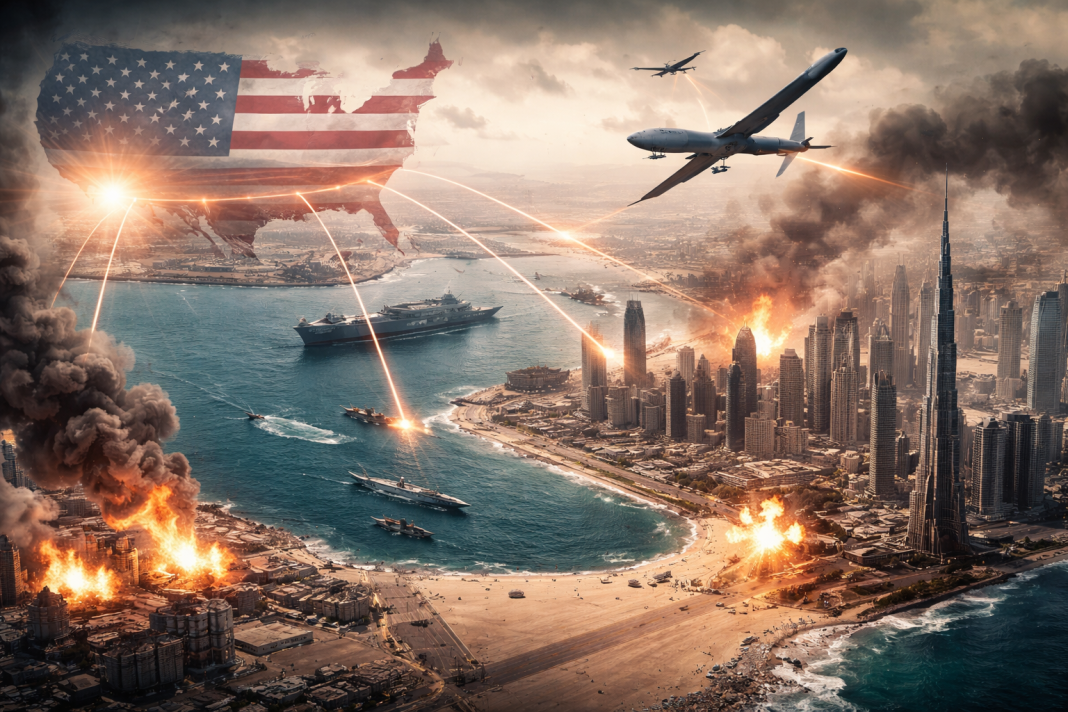

Tensions involving the United States, Israel, and Iran are now affecting countries beyond direct conflict zones. As a result, the United Arab Emirates (UAE) has become one of the most exposed countries in this situation.
Recent reports show that Iran has launched repeated aerial strikes. These include drones, ballistic missiles, and cruise missiles. Notably, the attacks have hit airports, oil facilities, commercial zones, and other critical infrastructure.
These are not random locations. Instead, they form the backbone of the country’s economy and daily operations. Airports support global travel, while oil facilities sustain energy supply. At the same time, commercial districts drive trade and business activity.
So, the scale of these attacks raises an important question. Why is the UAE being targeted so heavily when it is not directly at war?
At first glance, the presence of US military facilities in the UAE seems like a clear reason. However, this explanation does not fully explain the pattern or intensity of the strikes. Therefore, the reasons go beyond military positioning.
Strong Economic Ties With Washington
Over the years, the UAE has built strong economic ties with the United States. In fact, it has emerged as one of the largest foreign investors in the US economy.
The country has announced large investment commitments across sectors such as infrastructure, energy, and technology. Moreover, these investments are spread over several years and involve massive capital flows.
At the same time, Gulf countries contribute a major share of foreign investment into the United States. Among them, the UAE plays a leading role.
Because of this, a close economic link connects the two countries. However, this connection also creates a point of vulnerability.
When instability affects the UAE, the impact does not stay within its borders. For instance, investor confidence can weaken, and business activity can slow down. In addition, financial markets may react quickly to uncertainty.
As a result, disruptions in the UAE can indirectly affect the United States. The connection may be economic rather than military, but it remains strong and immediate.
4,000 km strike attempt? Iran’s missile launch toward Diego Garcia raises global alarm
The UAE’s Role as a Global Investment Hub
In recent years, the UAE has developed into a major global investment hub. To achieve this, the country introduced policy reforms, including allowing full foreign ownership in many sectors.
Consequently, foreign direct investment into the UAE has grown significantly. In fact, a large portion of investment entering West Asia now flows into the country.
Cities like Dubai now serve as key centers for global business activity. They attract projects in sectors such as technology, logistics, finance, and real estate. Furthermore, these projects continue to increase each year.
This rapid growth depends heavily on stability. Investors choose the UAE because they see it as safe, efficient, and predictable.
However, this reputation can change quickly. When disruptions occur, investors may become cautious. Similarly, companies may delay decisions, and economic activity may slow.
Because the UAE connects global markets, even small disruptions can create wider effects. Therefore, the impact extends beyond the region.
http://US may allow sale of stranded Iranian oil to address global supply shortage
Indirect Pressure Through Strategic Targeting
The pattern of attacks suggests a strategy focused on indirect pressure. Instead of targeting the United States directly, Iran appears to act through a close partner.
The UAE plays a key role in regional stability and global economic networks. It connects markets and supports international trade and investment. Therefore, any disruption in the UAE carries wider consequences.
By targeting the UAE, pressure reaches areas that matter economically and strategically. As a result, economic activity faces disruption, confidence declines, and partnerships come under strain.
At the same time, this approach avoids direct escalation. Instead, it creates measurable impact without triggering a larger confrontation.
Moreover, each strike affects perception. Stability depends not only on physical safety but also on trust. When repeated disruptions occur, that trust begins to weaken.
Over time, the UAE has built its position through reforms, infrastructure, and business-friendly policies. Consequently, its image as a stable hub has become central to its global role.
However, when that stability is challenged, the effects go beyond immediate damage. They extend into economic relationships and global confidence.
In this way, targeting the UAE reflects a broader strategy that focuses on influence, pressure, and interconnected economic systems.