
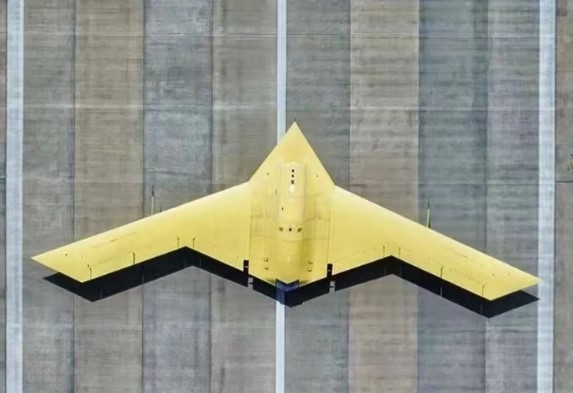

China reached a major aerospace milestone after the high-altitude CH-7 drone successfully completed its first flight at an airfield in Northwest China, confirming the aircraft’s transition from concept to operational testing. The brief mission showed that the unmanned drone’s systems and controls functioned as designed, placing the CH-7 among advanced platforms developed for long-duration, high-altitude surveillance and information-gathering tasks.
CH-7 Drone Reaches Major Milestone in Development
The first flight of the CH-7 drone is considered a key milestone because it confirms that the aircraft can leave the ground, stay stable in the air, and return safely. For any new aircraft, this stage is critical. Engineers used the maiden flight to check whether the design works as planned and whether the drone can handle real-world flying conditions.
During this initial flight, the drone carried out a series of basic but essential tests. These included autonomous taxiing on the runway, smooth takeoff, controlled flight, accurate tracking of its planned path, and safe landing. All of these tests were completed successfully, and the results matched earlier simulations and design expectations.
China’s new ‘Flying Halberd’ missile triggers regional panic with Mach-7 Japan-strike capability
The CH-7 uses a tailless flying-wing shape, which is very different from traditional aircraft with tails and vertical stabilizers. This type of design can improve stealth and efficiency, but it also brings challenges, especially in keeping the aircraft stable and properly controlled. The successful flight showed that these challenges were managed effectively during the test.
The drone has been displayed publicly at Airshow China in past years, where it drew attention for its unusual shape and advanced features. However, a public display is very different from real flight. The successful test confirmed that the CH-7 is not just a showpiece but a functioning aircraft capable of real operations.
Stealth-Focused Design and Advanced Features
One of the most striking features of the CH-7 drone is its flying-wing design. The aircraft has a high-aspect-ratio wing, meaning the wings are long and slender. This design helps the drone fly efficiently at high altitudes and stay in the air for long periods without needing frequent refueling or maintenance.
The CH-7 is built with stealth in mind. Its smooth, clean shape reduces radar reflections, making it harder to detect. The engine intake is mounted on the top of the aircraft, which helps shield it from radar systems below. The exhaust nozzle is partly concealed, further reducing its visibility.
Special materials and coatings are used across the drone’s surface. Radar-absorbing materials are placed along the leading edges of the wings, while stealth coatings cover much of the exterior. Even small parts, such as access panels, landing gear bays, weapon bays, and screws, are treated to reduce radar signals. These details work together to give the CH-7 a low-observable profile.
In addition to stealth, the drone is designed to carry advanced sensors. These include visible light and infrared systems that allow it to gather detailed information day and night. Such payloads enable the CH-7 to perform long-range reconnaissance missions and provide data support in challenging environments, including over land and sea.
Role of the CH-7 in High-Altitude Surveillance Missions
The CH-7 is designed mainly for reconnaissance and information-gathering tasks rather than direct combat. Its strength lies in its ability to fly high, stay airborne for extended periods, and operate with a reduced chance of detection. These qualities make it suitable for monitoring large areas and collecting important data without drawing attention.
The drone can support a wide range of missions. It can observe maritime regions, track activity over long distances, and send real-time information back to command centers. This data can help decision-makers understand situations on the ground or at sea more clearly.
Although the CH-7 does not match the speed of modern fighter jets, speed is not its primary purpose. Instead, its value comes from endurance and stealth. By staying in the air for long periods and avoiding detection, the drone can provide continuous situational awareness. This is especially useful in modern warfare environments, where information and timing are critical.
Chinese drone subs set to make first public appearance in Beijing parade
The CH-7 has been described as well-suited for informatized warfare, where advanced technology and data sharing play a central role. Its sensors can help identify targets and relay accurate information to other platforms, supporting coordinated operations without the drone needing to engage directly.
The successful first flight confirms that the CH-7’s systems work together as intended. Further testing will continue to examine flight performance, endurance, and payload operation, building on the results of this initial mission.