


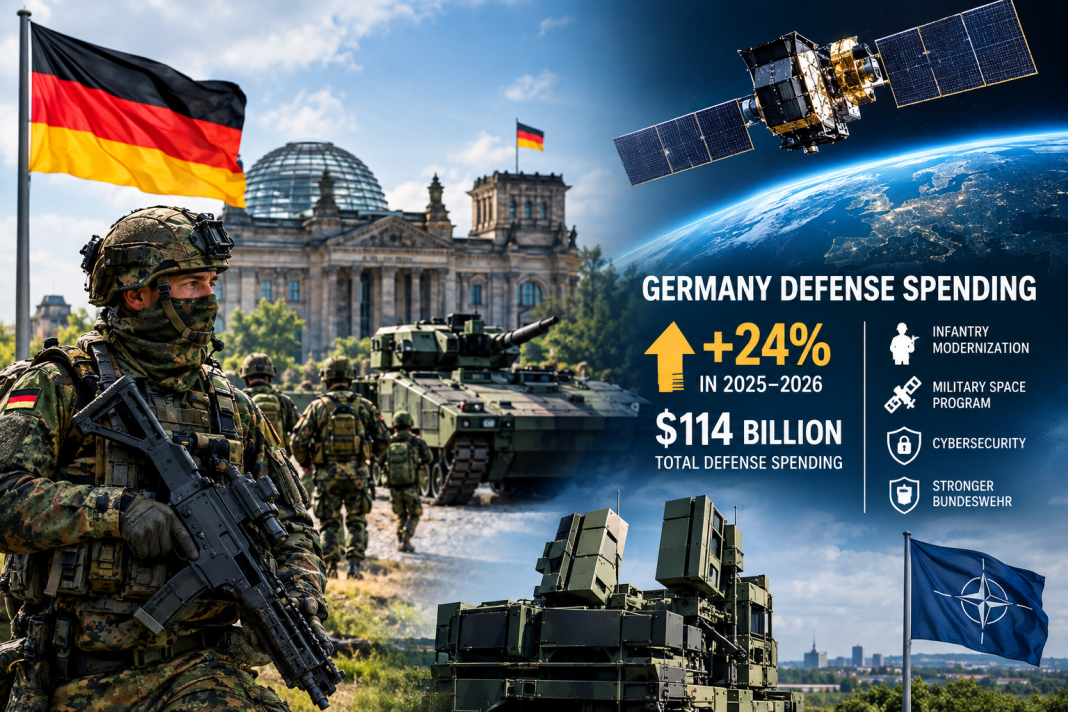


Germany is accelerating its military modernization. Defense spending has reached its highest level in decades. Berlin is putting more money into infantry equipment, military satellites, cybersecurity and advanced defense technology.
The buildup began after Russia invaded Ukraine in 2022. Germany has since committed billions of euros to strengthen the Bundeswehr. Defense Minister Boris Pistorius has outlined a long-term goal of creating the “strongest conventional army in Europe” by 2039.
Germany’s latest investments show how quickly its defense priorities are changing. The country is strengthening traditional military capabilities while also expanding into newer domains such as space and cyber warfare.
Germany Defense Spending Reaches Historic Levels
Germany has sharply increased its military expenditure. According to figures cited from the Stockholm International Peace Research Institute (SIPRI), German defense spending rose by about 24% between 2025 and 2026. It reached approximately $114 billion.
That figure represents the highest defense spending among European NATO members. It also marks an important milestone for Germany. Defense spending exceeded 2% of GDP for the first time since 1990.
The current buildup began in 2022. Then-Chancellor Olaf Scholz announced a €100 billion special fund for the Bundeswehr. The decision followed Russia’s invasion of Ukraine.
The fund marked a major shift in German defense policy. Germany had maintained relatively restrained military spending for decades. The war in Ukraine changed that approach.
Pistorius has since pushed for a broader military transformation. His goal is to significantly improve Germany’s military readiness, equipment and operational capabilities.
Europe’s Wider Military Spending Push
Germany’s military buildup forms part of a wider European trend. NATO members across Europe are increasing defense budgets. Governments are responding to the changing security environment created by Russia’s war in Ukraine.
SIPRI researcher Jade Guiberteau Ricard said European NATO military spending rose at its fastest pace since 1953 in 2025.
Several factors are driving the increase. European countries want greater defense self-reliance. They also face continued pressure from the United States to increase their contribution to NATO.
New NATO spending targets agreed upon in 2025 are adding to that pressure. However, higher spending does not automatically translate into greater military capability.
SIPRI has also warned about changes in how countries define defense and security-related spending. Broader definitions could make comparisons between countries more difficult.
Germany is already turning increased spending into major procurement programs. The country is buying new equipment and investing in emerging military technologies.
Germany Expands Its Military Space Program
Space has become another major priority for Germany. Berlin is building new military space capabilities to protect satellites and other critical systems.
The program covers several areas. These include cybersecurity, satellite constellations, early-warning systems and ground infrastructure.
Germany plans to invest about €35 billion in the program through 2030.
The move reflects the growing role of space in modern warfare. Military forces depend heavily on satellites for communications, navigation, intelligence and surveillance.
Those systems also face new threats. Electronic warfare can disrupt satellite signals. Cyberattacks can target ground systems. Adversaries can also attempt to interfere with satellite operations.
German aerospace company OHB is expected to play a role in the development of the country’s military satellite network. Major defense companies such as Airbus and Rheinmetall are also involved in Germany’s wider space and defense efforts.
Germany is also giving its military space operations greater independence. German Space Command is expected to operate its own satellite operations center.
Cybersecurity and Space Deterrence Gain Importance
Germany’s space strategy does not focus only on satellites. Berlin also wants to protect its space infrastructure from cyberattacks and other forms of disruption.
Pistorius has stressed the need to strengthen German systems against attacks. Cybersecurity will form an important part of the strategy.
Germany also plans to improve radar and telescope capabilities. Future sentinel satellites could provide additional monitoring and early-warning capabilities.
Recent conflicts have highlighted the importance of these technologies. Satellite communications now support many military operations. Drones, electronic warfare and cyber capabilities have also become increasingly important.
Germany wants to monitor these threats more effectively. It also wants greater control over its own space-based military systems.
This represents a broader change in German defense planning. Space is no longer viewed only as a supporting domain. It is becoming an important part of national and European security planning.
Rheinmetall Expands German Infantry Modernization
Germany is also investing heavily in its soldiers and ground forces. Defense contractor Rheinmetall is expanding the Bundeswehr’s “Infantry Soldier of the Future – Enhanced System,” known as IdZ-ES.
Rheinmetall will supply 237 additional platoon systems under the new agreement. The contract is worth approximately €1.04 billion.
Deliveries are scheduled between November 2027 and December 2029. Around 8,600 additional soldiers will receive the equipment.
The IdZ-ES system combines several types of military equipment. It includes advanced information technology, optics and optronics. Soldiers will also receive modern protective equipment, clothing and load-carrying systems.
Once the expansion is complete, the Bundeswehr will have 353 platoon systems. These systems will contain more than 12,000 individual equipment sets.
Rheinmetall will serve as the general contractor. More than 30 subcontractors will support the program.
The investment highlights Germany’s effort to modernize its infantry alongside larger weapons and technology programs.
Germany’s Long-Term Bundeswehr Transformation
Germany’s defense buildup extends well beyond its space and infantry programs. Since 2022, Germany has signed military equipment and weapons contracts worth around €111 billion, according to figures cited from German media.
The scale of procurement shows the extent of Germany’s defense transformation. Thousands of contracts have followed the 2022 policy shift.
Berlin wants to address equipment shortages. It also wants to improve military readiness and modernize its armed forces.
Higher defense spending now supports several priorities. These include conventional military equipment, infantry modernization, cybersecurity, satellite systems and other advanced technologies.
The next challenge will be turning this spending into sustainable military capabilities. Germany will need sufficient industrial capacity to deliver the equipment. It will also need efficient procurement systems and skilled personnel.
The Bundeswehr must then integrate these new systems across its armed forces.
Germany’s defense policy is changing significantly. The country is moving away from decades of relatively restrained military spending.
Its growing focus on conventional forces, infantry modernization, cybersecurity and military space capabilities points to a broader transformation of German defense policy.
The result is a Bundeswehr that is increasingly focused on readiness, technology and the ability to operate across multiple domains of modern warfare.