


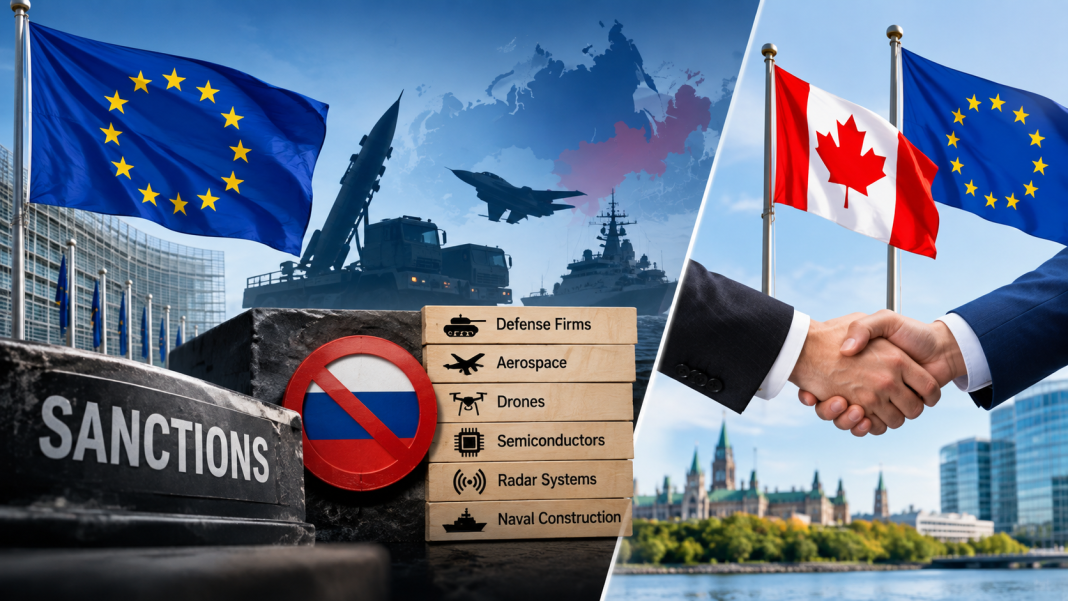


The European Union is preparing another round of sanctions against Russia, but this time the strategy looks different. Instead of introducing broad economic restrictions, Brussels is focusing on individuals and companies linked to Russia’s military sector. At the same time, discussions about closer relations between Canada and the EU have sparked debate across Europe.
EU Shifts Its Sanctions Strategy
EU ambassadors recently discussed a fresh sanctions package targeting Russia. The proposal is expected to be reviewed by foreign ministers in October. Unlike previous rounds, the new measures do not include major sector-wide restrictions on the Russian economy.
European officials believe this reflects the growing difficulty of securing unanimous support for tougher economic sanctions among all member states.
Focus Moves to Russia’s Defense Industry
The proposed package targets hundreds of entities and individuals connected to Russia’s military-industrial complex. According to reports, the list includes companies involved in missile technology, aerospace production, naval construction, drones, semiconductors, radar systems, and military equipment.
If approved, the sanctions would add more than 800 organizations and over 700 individuals to the EU blacklist. Most of the individuals are senior executives, engineers, and directors working in defense-related enterprises.
Major Russian Companies Under Scrutiny
Several important Russian defense firms appear in the proposal. These include Sevmash, known for submarine construction, and Zvezdochka, a company specializing in naval repair work.
Other organizations reportedly targeted include military design company KBM and drone manufacturer KT Unmanned Systems. The focus on military-linked firms signals the EU’s intention to increase pressure on Russia’s defense production capabilities.
Disagreements Over Oligarch Delistings
While new names are being added to sanctions lists, some EU countries are pushing to remove certain Russian oligarchs from existing restrictions.
Discussions surrounding businessmen Alisher Usmanov and Mikheil Fridman have created divisions among member states. Slovakia, France, and Luxembourg have expressed varying positions on the matter, while several other countries oppose removing them from the blacklist.
These disagreements have complicated negotiations and delayed decisions regarding the extension of current sanctions.
Canada’s Growing Connection With Europe
Another topic attracting attention in Brussels is the idea of a closer relationship between Canada and the European Union. The discussion gained momentum after comments made during the European Commission President’s annual address.
Some reports suggested the possibility of an “associate membership” arrangement for Canada. However, no formal EU framework currently exists for such a status.
European leaders are expected to continue discussing the concept, although no immediate decisions are anticipated.
What Could a Canada-EU Partnership Look Like?
Experts believe a full membership-style arrangement is unlikely. Canada would probably not accept a model requiring it to adopt large portions of EU legislation without voting rights.
Instead, a more practical option may involve expanding cooperation under the existing Comprehensive Economic and Trade Agreement (CETA). Future discussions could focus on areas such as artificial intelligence, digital services, space technology, research programs, and student exchanges.
While both sides remain interested in stronger ties, any major agreement would still require support from EU member states and their national parliaments.
Conclusion
The EU’s latest sanctions proposal highlights a shift toward targeting organizations and individuals linked to Russia’s military sector rather than introducing broader economic restrictions. At the same time, discussions about future Canada-EU cooperation demonstrate ongoing interest in exploring new forms of partnership. Both developments are expected to remain important subjects of policy discussion in Europe in the months ahead.