
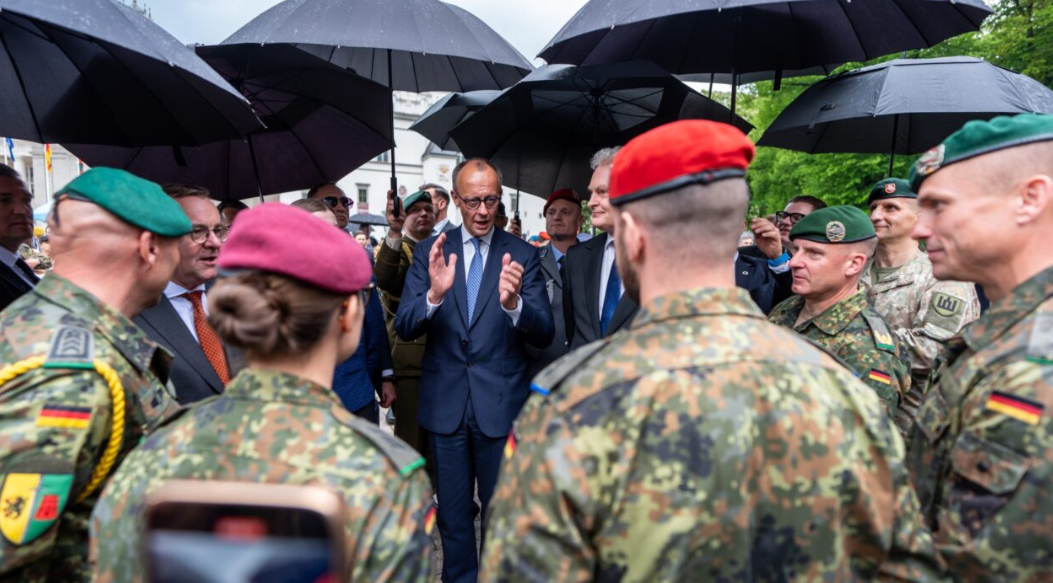

Europe is taking new steps to strengthen security along its eastern frontier. One of the most significant moves involves Germany expanding its military presence in Lithuania. The initiative, known as the Lithuania Brigade, is designed to improve NATO’s readiness in a region considered vulnerable to potential military threats.
Rapid Expansion of Germany’s Lithuania Brigade
Germany is rapidly expanding its military presence in Lithuania as part of the Lithuania Brigade. On February 5, 2026, two additional units — the 203rd Armoured Tank Battalion and the 122nd Armoured Infantry Battalion — were placed under the brigade’s command. This move increased the brigade’s size from about 500 soldiers to roughly 1,800 troops.
The expansion is expected to continue in the coming years. Plans aim to grow the force to around 4,800 soldiers and nearly 2,000 military vehicles permanently stationed in Lithuania by the end of 2027. The brigade will also include the Multinational Battlegroup Lithuania, supported by allied countries such as the Netherlands, Norway, and Luxembourg.
NATO’s eastern flank reinforced as Lithuania orders RBS-70 Bolide missiles through 2032
Lithuania is investing heavily to support the deployment, pledging up to 1.7 billion euros for infrastructure near the cities of Rūdninkai and Rukla. These facilities will support training and operations, marking one of Germany’s largest permanent military deployments abroad in recent decades.
Lithuania’s Strategic Importance on NATO’s Eastern Edge
Lithuania plays a key role in the security of northeastern Europe due to its strategic geographic position. The country lies between Russia and its Kaliningrad exclave, a heavily militarized Russian territory located on the Baltic Sea. Because of this location, Lithuania has become an important part of NATO’s defense planning. Any tension in this region could quickly affect the security of nearby countries and the wider European defense system.
One of the most sensitive locations in the area is the Suwałki Corridor. This narrow land route connects Lithuania and the Baltic states with Poland and the rest of NATO territory. At the same time, it separates Russia’s Kaliningrad region from Belarus. Because the corridor is relatively small and strategically located, military experts often describe it as a potential weak point in Europe’s security structure. If this route were disrupted or blocked, the Baltic states could become cut off from other NATO allies.
Lithuania redraws its defense map as NATO’s eastern border comes into sharper focus
Security concerns increased in late 2025 after several reports of drone activity and airspace violations in parts of Europe. Some of these incidents were reported near Lithuania and Poland, raising concerns about possible surveillance operations or hybrid warfare tactics aimed at testing regional defenses.
These developments have increased calls for stronger defense measures in the Baltic region. The Lithuania Brigade is intended to strengthen NATO’s rapid response capability by maintaining a permanent military presence and improving readiness in the area.
Europe’s Defense Cooperation and Military Spending
Germany’s growing military role in Lithuania reflects wider changes in European defense policy. In recent years, many European governments have increased defense spending and invested in stronger military capabilities. Germany’s defense budget for 2026 exceeds 108 billion euros, with funds aimed at strengthening equipment and closing long-standing capability gaps.
Much of the investment focuses on armored vehicles, drone systems, and modern combat gear for soldiers. Germany is also improving satellite communication systems to support military operations. In addition, strike drones worth more than 500 million euros have been ordered to support German brigades stationed in Lithuania.
Germany moves to consider more F35 jets as FCAS delays raise questions over European defence plans
Despite these investments, Europe’s defense system remains complex. European countries collectively spend hundreds of billions of euros on defense, but cooperation can still be difficult. Different equipment standards create challenges. National priorities also vary between countries, which often makes coordination harder. Germany’s strong focus on its domestic defense industry has also sparked debates about how military investments should be shared among allies.
Still, the Lithuania Brigade shows how multinational cooperation can work in practice. Units from several countries train together. They also operate together, improving coordination between allied forces. At the same time, NATO members are strengthening surveillance and counter-intelligence measures to address hybrid threats around military bases and exercises in the region.