

Summary
Minneapolis has entered a new phase of unrest after a federal immigration officer shot a Venezuelan man during a confrontation in North Minneapolis, just days after a separate fatal shooting involving an ICE officer. The incident has intensified protests, prompted emergency meetings, and triggered legal action by Minnesota officials seeking to halt what they describe as an unprecedented federal immigration operation. With thousands of agents deployed, rising arrests, and resignations within the U.S. attorney’s office, the city has become a national flashpoint in the debate over immigration enforcement, federal authority, and public safety.
Second federal shooting deepens unrest in Minneapolis as immigration crackdown escalates
Minneapolis is facing a rapidly escalating crisis after a federal immigration officer shot a Venezuelan man during a confrontation in North Minneapolis, marking the second federal shooting in the city within a week. The latest incident has intensified protests, strained relations between state and federal authorities, and placed the city at the center of a growing national debate over immigration enforcement, civil liberties, and the use of force.
The shooting occurred during what federal authorities described as a targeted traffic stop that quickly spiraled into a violent struggle. According to officials, the man fled the scene, crashed a vehicle, and later confronted an officer, leading to gunfire that left him hospitalized with what authorities say are non-life-threatening injuries. The man later barricaded himself inside a residence before being taken into custody.
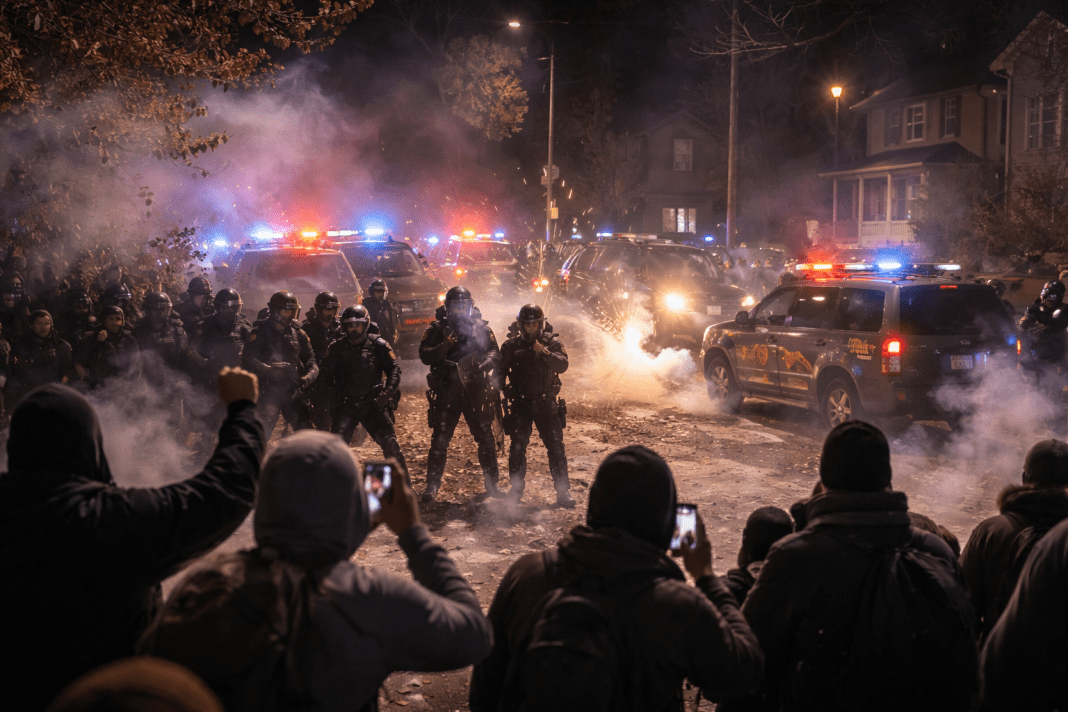
While investigations are still ongoing, the incident has already triggered widespread public anger. Crowds gathered within hours, protests spread through residential neighborhoods, and law enforcement deployed crowd-control measures including chemical irritants and flash-bang devices. City officials urged calm, warning that tensions were reaching a dangerous point.
A city already on edge
The shooting comes just days after a separate and far more fatal incident in which an Immigration and Customs Enforcement officer shot and killed Renee Good, a 37-year-old mother of three, during an enforcement operation in Minneapolis. That killing sparked days of protests and grief, with community leaders questioning both the tactics used by federal agents and the broader strategy behind the deployment.
Minneapolis videos raise questions about use of force in federal immigration shooting
Good’s family described her as a “beautiful light” who brought joy to those around her, while civil rights advocates demanded transparency and accountability. The emotional fallout from her death has not subsided, and the latest shooting has only intensified fears that Minneapolis is being pushed toward further unrest.
For many residents, the pattern feels deeply unsettling. Two federal shootings in one week, both tied to immigration enforcement, have raised urgent questions about oversight, escalation, and whether the city has become an experimental ground for aggressive federal tactics.
Unprecedented federal deployment
The Department of Homeland Security has described the current immigration operation in Minnesota as its largest to date. Since late November, more than 2,400 people have reportedly been arrested as part of the effort, and more than 2,000 federal agents have been deployed across the state.
Officials say the operation is focused on targeted enforcement against individuals allegedly in the country without legal status. Critics, however, argue that the scale and visibility of the deployment resemble an occupation rather than routine law enforcement, particularly as armored vehicles, heavily armed agents, and tactical gear have become common sights in residential areas.
More than 2,000 federal agents deployed as DHS carries out sweeping ICE operation in Minnesota
The heavy presence has had a chilling effect on immigrant and refugee communities, many of whom say they fear leaving their homes. Local leaders report disruptions to schools, workplaces, and essential services as families try to avoid encounters with federal agents.
Political backlash and legal resistance
Minnesota officials have taken the extraordinary step of suing the federal government to halt the deployment, arguing that it exceeds federal authority and undermines public safety. State leaders say the operation has inflamed tensions, increased the risk of violence, and damaged trust between communities and law enforcement.
The lawsuit reflects a broader political backlash that extends beyond Minnesota. Across the country, debates are intensifying over so-called “sanctuary” policies, with the federal government threatening to withhold funding from states and cities that limit cooperation with immigration enforcement.
Legal experts note that similar funding threats have faced significant court challenges in the past, with judges often ruling that the federal government cannot unilaterally coerce states in this manner. Still, the rhetoric alone has added to uncertainty and fear among local governments.
Resignations raise alarm
Adding to the controversy, six prosecutors from the U.S. attorney’s office in Minnesota have resigned, citing concerns about the direction of the investigation into Renee Good’s death. While details remain limited, the resignations have fueled speculation about internal disagreements and potential pressure within the federal justice system.
Such resignations are rare and have amplified calls for independent oversight. Civil rights attorneys argue that public confidence cannot be restored without a transparent investigation free from political influence.
The departures have also highlighted the strain placed on institutions when high-profile enforcement actions collide with public outrage and legal scrutiny.
Protests, policing, and public fear
As night fell after the latest shooting, protests intensified. Demonstrators shouted slogans, threw objects at police lines, and demanded an end to federal operations in the city. Law enforcement officials described the gatherings as unlawful and warned that further escalation could lead to more injuries.
The Minneapolis police chief publicly called on protesters to disperse, emphasizing that officers were facing a volatile situation. At the same time, city officials acknowledged the anger driving the protests, urging residents to remain peaceful while investigations proceed.
The scenes have drawn national attention, reviving memories of past unrest in Minneapolis and reinforcing the city’s symbolic role in broader conversations about policing, race, and state power.
A national flashpoint
What is unfolding in Minneapolis is no longer a local issue. It reflects deeper national tensions over immigration policy, federal authority, and the boundaries of law enforcement. Supporters of the crackdown argue that strict enforcement is necessary to uphold the rule of law, while opponents warn that aggressive tactics erode civil liberties and increase the risk of deadly encounters.
The involvement of multiple federal agencies, the scale of arrests, and the visible militarization of enforcement have all contributed to the sense that Minneapolis is being used as a testing ground for a harder line on immigration.
For residents caught in the middle, the cost is immediate and personal. Fear, uncertainty, and grief now coexist with an overwhelming law enforcement presence, reshaping daily life in ways that may linger long after the current operation ends.
What happens next
Investigations into both shootings are ongoing, with federal and state agencies processing evidence and reviewing body-camera footage. Legal battles over the deployment are expected to continue, and further protests are likely as community groups organize and national attention grows.
Whether the federal government scales back its operation or doubles down remains unclear. What is certain is that Minneapolis has become a defining battleground in the evolving story of immigration enforcement in the United States.
As events continue to unfold, the city’s experience may shape future policy decisions, court rulings, and public opinion far beyond Minnesota. For now, Minneapolis stands at the intersection of enforcement, resistance, and a national reckoning over how far the federal government can go — and at what cost.