
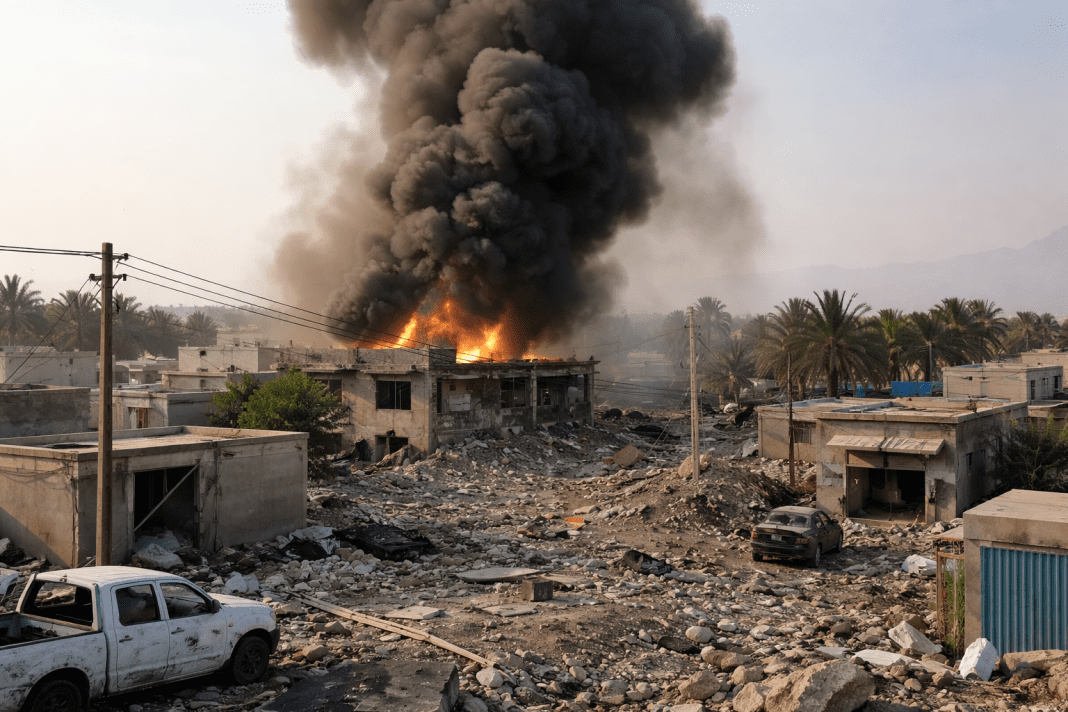

New video footage shows what experts say is a U.S. Tomahawk missile hitting a building near a school in southern Iran. Over 165 people were killed there in an earlier blast. The strike targeted a compound next to the school in Minab, Hormozgan Province.
Satellite images confirm the location, showing flat-roofed buildings and vehicles. Analysts say the missile is part of the U.S. arsenal. No other country in the conflict is known to use it, pointing to American involvement.
Video and Expert Analysis Reveal Key Details
The footage first circulated through Iranian media but was originally captured on the day of the strike. Experts say the video shows the missile hitting a building just meters away from the school. According to analysts, the school was likely not the intended target. It appears the missile was part of a rapid sequence of strikes on the nearby compound, which included a Revolutionary Guard base.
Satellite images of the area matched the visual features seen in the video, making it easier to confirm the strike’s location. The researchers used geolocation techniques to verify that someone filmed the video close to the school. Smoke rising from the school’s vicinity at the time of the video further supports these findings.
The identification of the Tomahawk missile is crucial because it connects the strike directly to U.S. forces. The United States mainly uses the Tomahawk, a long-range cruise missile, in military operations around the world. Its use in this case contrasts with claims that Iran could have fired the missile, as no evidence shows that the country possesses such weapons.
Trump Calls Tomahawk ‘Very Generic’
In the midst of growing evidence, former U.S. President Trump stated that the Tomahawk missile is “very generic” and suggested that other countries, including Iran, may have access to it. During a press conference, he said he did not have full information about the strike and would “live with whatever the report shows.”
Hormuz in Flames? US Demands China to Stop Blockade Shock!
Reporters asked whether the United States was responsible for the deadly school blast. He stated that he believed Iran may have carried out the blast, citing the country’s supposed inaccuracy with munitions. He also noted that the U.S. sells the Tomahawk missile to allies like Japan and Australia, but he provided no evidence that Iran has acquired the weapon.
Experts criticized his comments, emphasizing that even if attackers intended to target the neighboring military compound, hitting a school nearby violates international law. International law requires attackers to take all feasible measures to confirm they are striking military objectives and not civilian sites, a standard that experts say attackers likely breached in this incident.
Military and Legal Context
U.S. military sources confirmed that they used Tomahawk missiles in the region around the time of the strike. A photo released by the U.S. Central Command shows the USS Spruance, part of the Abraham Lincoln aircraft carrier group, firing a Tomahawk missile on February 28. The proximity of the ship to the school and the timing of the strike add to the evidence of U.S. involvement.
The location of the school, right next to the Revolutionary Guard base and naval barracks, is also important. Analysts note that U.S. military operations in the region have primarily focused on naval targets, while Israel has targeted areas closer to its own borders, far from the southern province where the school is located.
Donald Trump gives mixed signals on Iran war timeline as markets watch rising oil prices
The Pentagon reportedly initiated an assessment of the strike under its own rules for investigating civilian harm. Officials trigger such assessments when they believe U.S. forces may have caused civilian casualties. The lack of bomb fragment evidence and restricted access to the site during the ongoing conflict have complicated independent verification, but satellite imagery and video analysis remain key tools for investigators.
Experts in international law point out that attackers still commit a serious violation even if they misidentify the target, because they must take all feasible measures to confirm the status of potential targets. Meanwhile, some U.S. officials have emphasized the precision of their military campaign, framing it as a powerful but focused use of airstrikes.