
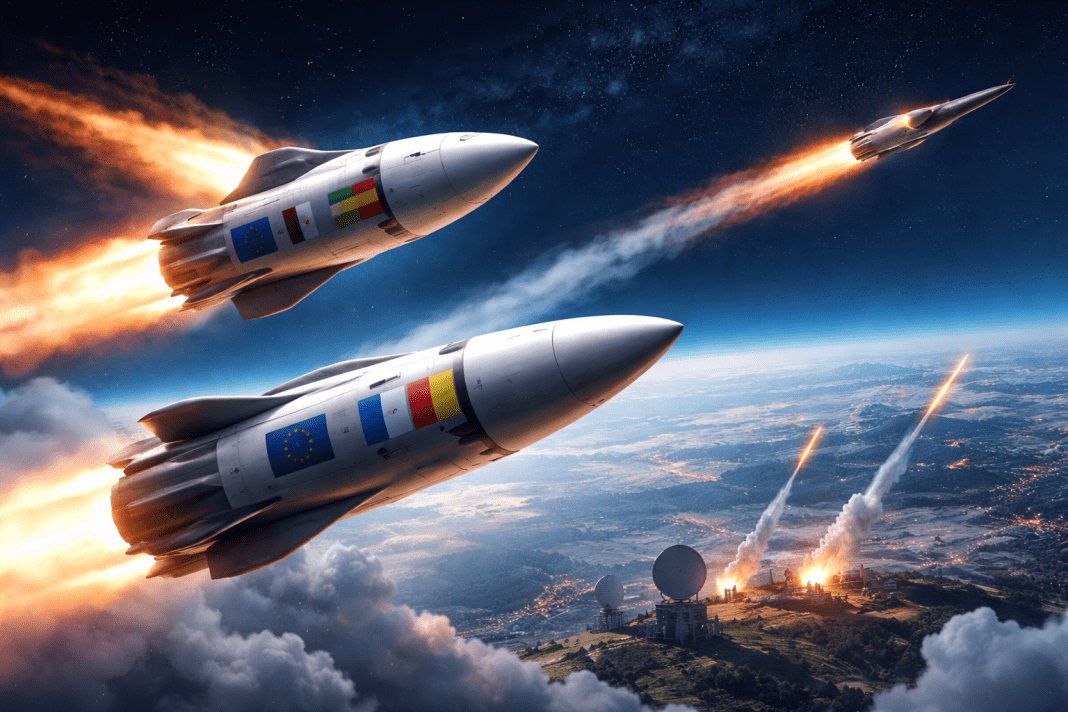

Europe is moving to strengthen its defenses against fast-moving missiles, but a long-standing rivalry between France and Germany is threatening to shape the future of this vital technology. The European Union (EU) plans to develop hypersonic missile interceptors, advanced missiles designed to shoot down extremely fast projectiles traveling at speeds greater than Mach 5. These systems are seen as essential to protecting Europe against emerging threats. However, deciding which company will lead this next-generation project has stirred tensions between two major European defense players.
Two Projects, One Goal
For several years, two separate projects have been running in parallel, each aiming to build Europe’s first hypersonic missile defense system. The first, called HYDEF, is led by Spain’s Sener group in partnership with German missile-maker Diehl. Launched in 2022, HYDEF’s mission is clear: intercept incoming hypersonic missiles before they reach their targets. Diehl oversees the technical side, coordinating the complex systems needed to track and neutralize threats traveling at extreme speeds.
The second project, HYDIS, is led by France’s MBDA and started a year later. France has long been a global leader in missile technology, and MBDA already manages several defense initiatives, including early-warning systems designed to detect hypersonic missile threats from space. The goal of HYDIS is similar to HYDEF: to protect Europe against ultra-fast missile attacks, though it follows its own technical approach and industrial leadership.
Germany and France sign landmark ODIN’S EYE agreement — Europe steps into a new defense era
Until now, these two hypersonic missile projects have coexisted, competing indirectly while developing similar capabilities. The EU allowed this dual-track approach to maintain industrial competition, reduce technical risks, and prevent reliance on a single supplier for such a critical technology. Both projects have also become symbols of national pride, with Germany and France keen to assert their influence in Europe’s missile defense landscape.
A High-Stakes Decision
The European Commission, which manages EU defense funding, now plans to support only one of these projects in its 2026 work program. This means that either HYDEF or HYDIS will receive crucial funding, while the other could face a major setback. The official decision is expected soon, creating uncertainty among the companies and countries involved.
If a merger occurs, the two projects would need to decide who leads the combined hypersonic missile program, a choice likely to reignite old industrial rivalries. Negotiations would involve dividing responsibilities, managing intellectual property, and agreeing on production leadership—a process that could prove tense and politically sensitive. If no merger occurs, only one consortium will win, and the other will lose its chance to shape Europe’s future hypersonic missile defense capabilities.
Germany and France Sound Aviation Alarm: “EU Tariffs Could Cripple Airbus-Boeing Supply Chain”
This rivalry mirrors other disputes that have already affected European defense programs. For instance, disagreements between French and German aviation companies have delayed a shared project to develop next-generation fighter jets. These examples highlight the challenges of collaboration in complex defense technology projects, especially when national interests and industrial leadership are at stake.
The Background of Hypersonic Missile Competition
The competition between HYDEF and HYDIS has deep roots. In 2022, when the European Commission first awarded a research contract for hypersonic missile defense, many expected MBDA, with its long-standing experience, to secure the funding. The European Commission chose the Sener–Diehl consortium, surprising both Brussels and Paris. MBDA questioned the decision and soon launched HYDIS to maintain its role in Europe’s emerging hypersonic missile defense efforts.
Putin warns of NATO troops in Ukraine as France and UK pledge long term security support
The EU temporarily funded two projects to encourage innovation, reduce risks, and ensure that Europe does not depend on a single supplier for strategic defense systems. The dual approach allowed both Germany and France to continue developing advanced technologies, keeping competition alive while preparing Europe for the challenges posed by ultra-fast missiles.
The coming months will be critical for the future of Europe’s hypersonic missile shield. Companies involved in HYDEF and HYDIS are now preparing for a pivotal decision that could define European missile defense capabilities for decades. Whether they merge or compete head-to-head, the outcome will influence industrial leadership, political dynamics, and Europe’s ability to respond to the fastest and most advanced missile threats.