
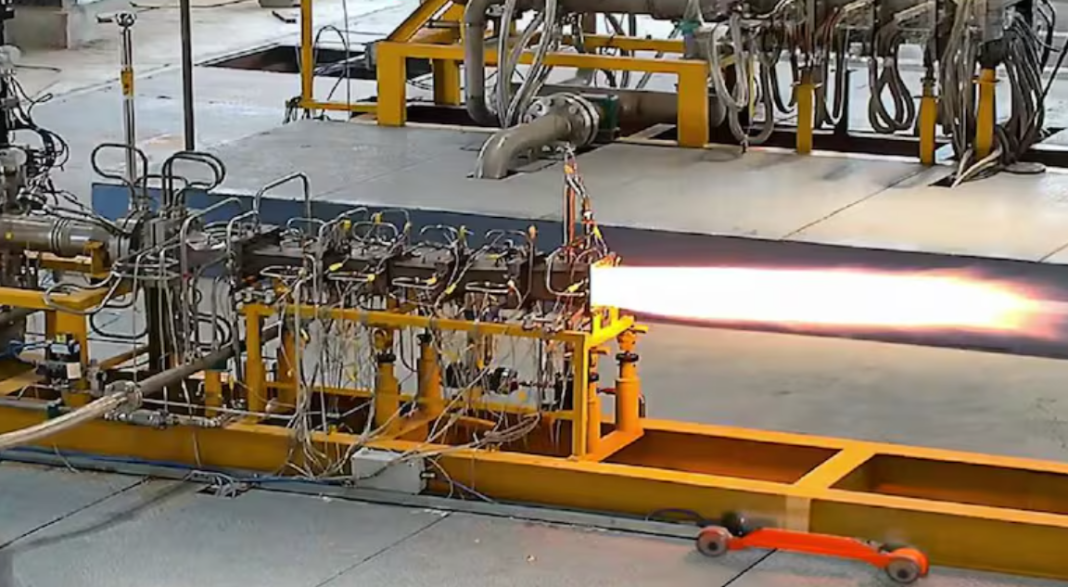

India has taken a major step in defence technology after DRDO successfully tested a full-scale scramjet engine in Hyderabad, running it for over 12 minutes at hypersonic conditions. This proves the engine can handle extreme heat and speed, bringing India closer to developing hypersonic cruise missiles that fly faster than five times the speed of sound and are hard to stop.
Understanding the Scramjet Engine Test and Why It Matters
A scramjet engine is a special engine designed to work at extremely high speeds. The word “scramjet” means “supersonic combustion ramjet,” which means air enters the engine at very high speed and the fuel burns while the air is still moving faster than sound. Unlike normal jet engines, a scramjet does not use heavy rotating parts like turbines. Instead, it uses the vehicle’s own speed to push air inside, making it lighter and better for very fast flight, but also much harder to design and control.
During hypersonic flight, the heat produced is so intense that it can damage normal materials. To handle this, the engine uses an active cooling system and special heat-resistant coatings that protect its parts from extreme temperatures.
India sends strategic signal with back-to-back Pralay missile launch from single platform
Scientists conducted the recent test on a full-size engine, not a small model, which proves the technology works in real conditions and not just in experiments. The engine ran for more than 12 minutes, showing it can operate for a long time without failing. The team also confirmed that the special test facility can correctly create the air and pressure conditions needed for hypersonic flight. In 2025, they tested a smaller version earlier, and this new success shows steady progress toward more advanced and practical systems.
How Hypersonic Cruise Missiles Change Modern Defence
Hypersonic cruise missiles are very different from traditional missiles because they can fly inside the atmosphere at extremely high speeds and also change their path during flight. This makes them much harder to detect and stop. Their biggest strength is speed, as flying at more than five times the speed of sound leaves very little time for any response.
The scramjet engine is the most important part of such a missile. It allows the missile to keep flying at hypersonic speed for a long time inside the atmosphere. The recent successful test shows that the engine can produce steady power and survive the extreme heat and pressure of such flight.
⚡ India’s hypersonic shockwave: Mach 10 missile shatters defense limits under Project Vishnu
At these very high speeds, even a small fault can cause serious failure, so reliability is critical. The long-duration test helped prove that the engine can work smoothly and safely for a long period. The test also showed progress in materials, cooling systems, and overall design, all of which are needed for hypersonic technology to work.
With this success, India has shown that it has strong capability in hypersonic propulsion technology, placing it among a small group of countries that have mastered this very complex and demanding field after years of careful research and testing.
What the Successful Test Confirms About India’s Capabilities
The recent scramjet engine test shows several important things about India’s technological strength. First, it proves that the country can design and build very advanced propulsion systems that need deep knowledge of science, materials, airflow, and heat control. Second, it shows that India has the right testing facilities to safely and accurately check such complex engines, which is essential for high-level research.
🛡️ India quietly tests ULPGM-V3 missile that could shift South Asian power dynamics
The test also highlights steady progress, as the programme has moved from smaller experiments to a full-scale, long-duration test, reducing risks and increasing confidence step by step. The engine was developed with support from Indian industry partners, showing that such advanced technology is being built through teamwork between scientific and industrial groups.
The results confirmed that the scramjet’s design works as planned and that its cooling system can handle extreme heat while keeping the engine stable at very high speeds. Together, these points show that the foundation for hypersonic cruise missile technology is becoming stronger. This success proves that many complex systems are now working together as expected and places India in a strong position in advanced aerospace and defence technology.