
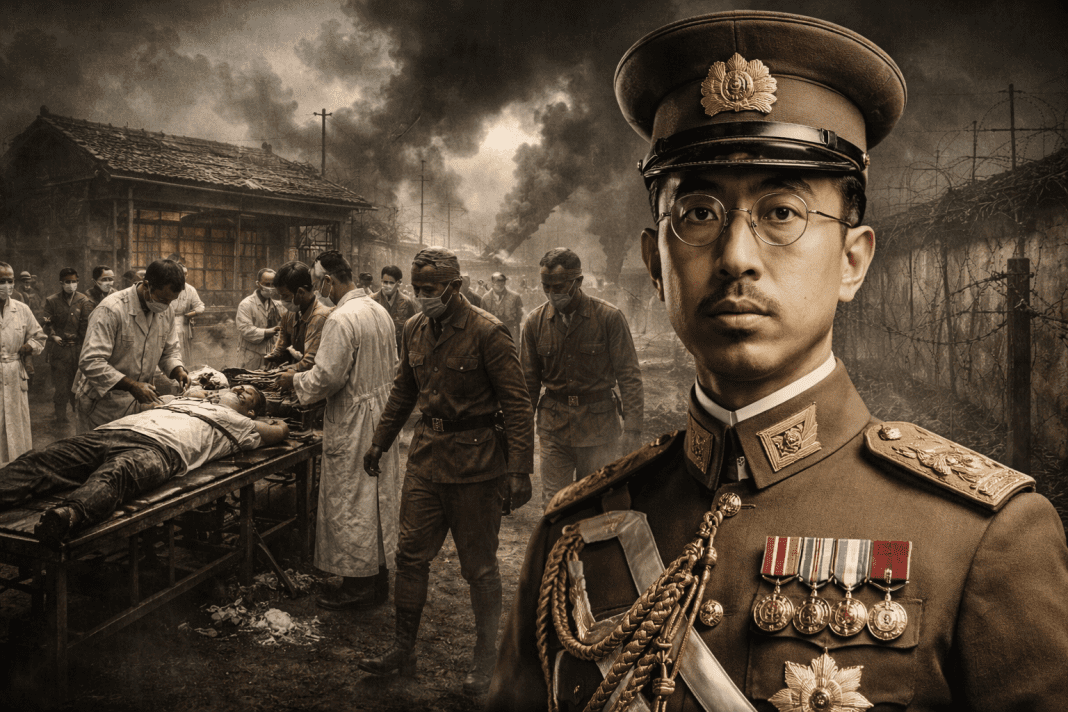

Chinese scholars are reigniting debate over Emperor Hirohito’s responsibility for Unit 731, a secret Japanese program that conducted brutal experiments and biological warfare in Asia. They argue that Hirohito himself authorised the programme and ordered evidence destroyed, yet avoided prosecution due to post-war US political decisions.
What Was Unit 731 and Why It Still Matters
Unit 731 was a secret branch of the Japanese Imperial Army based mainly in northeastern China, near the city of Harbin. It was officially created in 1936 by imperial order, according to Chinese historians. The unit carried out human experimentation, tested biological weapons, and spread deadly diseases such as plague and cholera.
Victims included Chinese civilians, prisoners of war, and people from other Asian countries. Many were infected with diseases on purpose, exposed to freezing temperatures, or subjected to surgical experiments without anesthesia. Scholars estimate that tens of thousands of people died because of Unit 731’s actions, either directly in laboratories or through biological attacks on towns and villages.
Zhou Donghua, a professor of contemporary history at Hangzhou Normal University, said the unit was not the work of rogue doctors acting alone. Instead, he described it as a state-backed programme that operated under military command and imperial approval. In a written statement dated December 14, Zhou said Unit 731 was created by order of Emperor Hirohito himself.
Before Japan surrendered in 1945, much of the evidence linked to Unit 731 was destroyed. Zhou said this destruction was carried out on instructions from the emperor, making it harder for investigators to gather proof after the war. Laboratories were blown up, documents were burned, and prisoners were killed to silence witnesses.
Chinese scholars argue that these actions show responsibility at the highest level of leadership. They say the crimes of Unit 731 meet the definition of crimes against humanity, similar to Nazi medical experiments that were later prosecuted in Europe.
Scholars Name Emperor Hirohito as a Key Figure
Many Chinese legal experts and historians are urging that Unit 731 face an international court. They often name Emperor Hirohito as a central figure.
Researcher Wang Xiaohua and colleagues from the Heilongjiang Provincial Institute of Cultural Relics and Archaeology argue that Unit 731’s actions were state crimes. They say responsibility extends beyond individual doctors to those who approved and expanded the programme, including Hirohito. Records show he ordered the unit’s expansion and relocation near Harbin. This, they argue, meets post-World War II legal standards like the Nuremberg Code.
Concerns grow over paid anti-China content appearing as public opinion in Japan
Despite the crimes, only 12 people linked to Unit 731 were tried in the 1949 Khabarovsk trials in the Soviet Union. In contrast, Nazi Germany faced dozens of trials and hundreds of convictions for similar war crimes. Scholars say Japan’s limited prosecutions reflect political choices rather than a lack of evidence.
Historians outside China also dispute the idea that Hirohito was just a figurehead. American historian Herbert Bix notes that he actively guided Japan’s military policies, including biological warfare. British historian Francis Pike reported that Hirohito awarded Unit 731 commander Shiro Ishii a special service medal.
This growing scholarly debate highlights calls for legal recognition of state-level responsibility for Unit 731’s atrocities.
US Policy and the Decision Not to Prosecute
After Japan surrendered in 1945, the United States took charge of the country’s occupation. It also shaped how war crimes would be handled. According to Chinese scholars, Washington decided not to prosecute Emperor Hirohito or many senior figures linked to Unit 731. This decision came despite the scale of Japan’s biological warfare crimes in China.
Historian Zhou Donghua wrote that US officials chose to protect the emperor in exchange for biological warfare data from Unit 731. During the early Cold War, this information was considered valuable. Rivalry with the Soviet Union was intensifying at the time. Shielding Hirohito was also seen as a way to maintain stability in Japan. It helped secure long-term US influence in the region.
In January 1946, General Douglas MacArthur, the Supreme Commander for the Allied Powers, sent a message to US Army chief Dwight Eisenhower. He said investigators had found no solid evidence directly linking the emperor to war crimes. MacArthur strongly advised against putting him on trial.
Declassified documents from the Foreign Relations of the United States archive show that MacArthur warned prosecuting the emperor would require major changes to occupation plans. He said it could trigger a “tremendous convulsion” among the Japanese public. MacArthur described Hirohito as a unifying symbol. He warned that indicting him might destabilise the country and weaken US control.
As a result, the Tokyo Trial focused on “crimes against peace” and charged 25 Japanese leaders. Biological warfare crimes were excluded, and no members of Unit 731 were tried. In 1949, a Soviet-backed proposal for a new tribunal failed due to Cold War tensions and US opposition.