
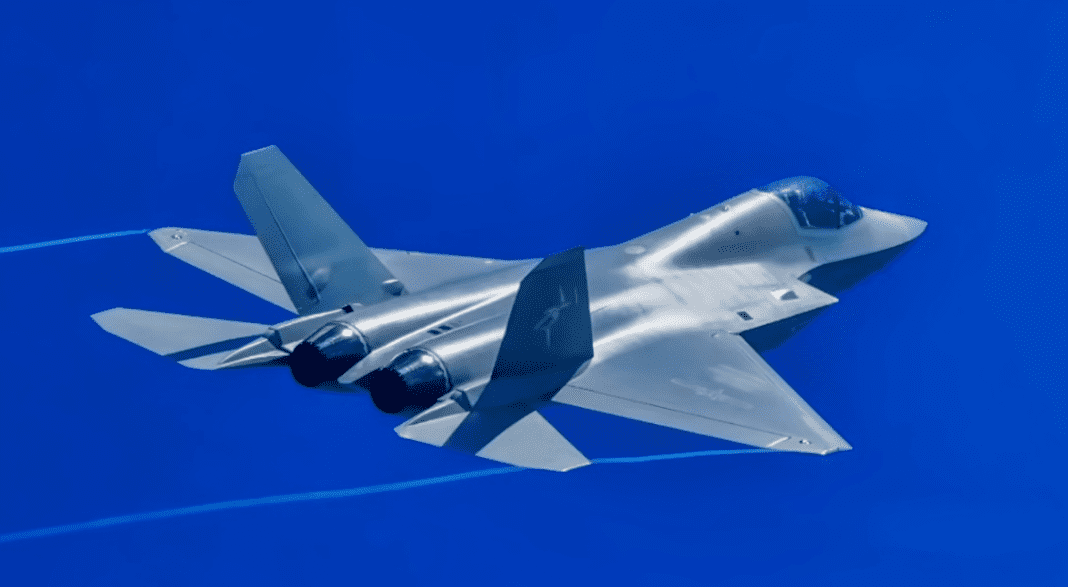

The Aviation Industry Corporation of China (AVIC) is creating a buzz at the Singapore Airshow with its latest J-35 stealth fighter. AVIC is displaying the aircraft as a massive full-scale mockup. The company is promoting it as a low-cost alternative to the Lockheed Martin F-35. AVIC’s exhibition chalet prominently features the J-35 branding. This draws attention from aviation enthusiasts, defense experts, and potential international buyers.
The J-35 is a fifth-generation fighter jet. The Chinese Navy and Air Force can use it. AVIC is marketing the aircraft as an affordable option for countries seeking advanced stealth capabilities. It offers these features without the high price tag of the F-35. AVIC’s presence at the airshow highlights China’s growing confidence in its domestic aerospace industry. It also shows the company’s ambition to expand into the global fighter jet market.
From FC-31 to J-35: Evolution of China’s Stealth Fighter
The journey of the J-35 began with the FC-31, a privately funded demonstrator intended for export markets. The first FC-31 took flight in October 2012, showcasing China’s developing stealth and aviation technology. Over the years, the aircraft underwent a major redesign to make it suitable for carrier operations, ultimately evolving into the J-35.
The naval version of the aircraft features twin nosewheels, larger wings, and reinforced landing gear, which are essential for safe takeoffs and landings on aircraft carriers. The naval prototype first flew in October 2021. In September 2025, the J-35 achieved a significant milestone when it became the first fifth-generation fighter to launch from a Chinese carrier using an electromagnetic launch system. The J-35 achieved this milestone during trials aboard the carrier Fujian.
Alongside the naval version, AVIC developed the J-35A for the People’s Liberation Army Air Force (PLAAF). This version has a single nosewheel and smaller wings that do not fold. The PLAAF began operating the first J-35As late last year, while the naval J-35s are expected to reach operational readiness soon.
Features and Capabilities That Rival the F-35
The J-35 series is designed to compete with some of the world’s top fighter jets. Its stealthy design allows it to evade radar detection, while its advanced sensor suite and electro-optical targeting system enable it to track multiple targets and engage enemies with high precision. These features make it comparable to the F-35 in terms of operational capability.
✈️ Game Over for Stealth? India’s Radar Detects F-35, China’s J-35 Faces Reality Check
The aircraft is powered by a pair of Guizhou WS-19 engines, each delivering around 25,000 to 26,000 pounds of thrust. This engine combination gives the aircraft high speed, agility, and the power needed for demanding carrier operations. Earlier prototypes tested a variety of engines, but the WS-19 now represents the jet’s final production configuration.
The J-35A also serves as the primary export version. Pakistan, for example, announced plans in June 2025 to acquire 40 aircraft under the FC-31 designation, highlighting international interest in this cost-effective stealth fighter. At the Singapore Airshow, AVIC emphasized both affordability and advanced combat capabilities, positioning the J-35 as a serious option for countries looking to upgrade their air forces with modern fighter jets.
Global Debut and Market Positioning
At the Singapore Airshow, AVIC’s J-35 mockup takes center stage in the exhibition hall. The aircraft’s sleek lines and modern design emphasize its advanced technology and engineering sophistication.
AVIC is showcasing the jet’s stealth capabilities, state-of-the-art sensor systems, and carrier compatibility. These features highlight that the J-35 can deliver high-performance operations while remaining more cost-effective than many competitors.
⚔️ U.S. Navy’s stealth reign ends — China’s J-35 fighter joins carrier fleet
By presenting a stealth-capable fighter at a fraction of the F-35’s cost, AVIC signals its intention to compete in the global military aviation market. The aircraft has evolved from the early FC-31 prototype through years of research, development, and testing into a fully operational fighter series.
With many countries seeking affordable yet capable fighter jets, the J-35 positions itself as a viable alternative to the F-35. Its presence at a major international airshow reflects China’s growing ambition to expand its aerospace technology and attract interest from global buyers.