
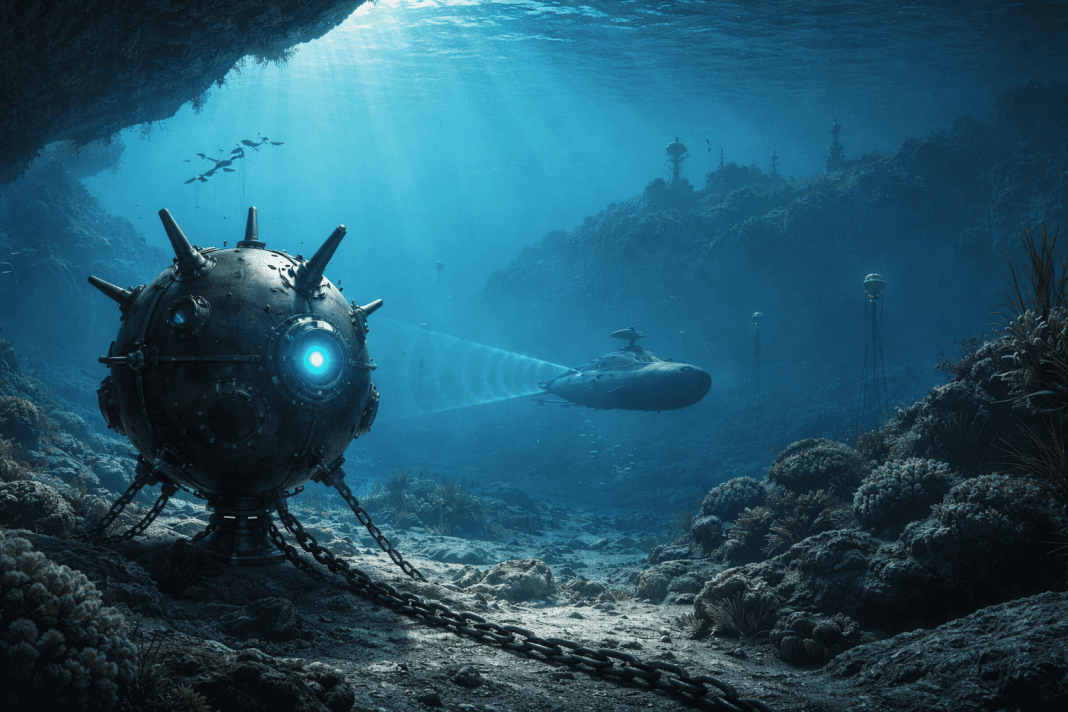

The underwater area around the Paracel Islands is becoming a focus of military competition. Researchers linked to the People’s Liberation Army Navy say the rugged seabed could hide AI-powered naval mines. These mines are still only a concept. They would sit in sound-blocked zones where sonar works poorly. The mines would remain inactive until a target is detected. This could make it harder for foreign submarines and ships to move freely.
Why the Paracel Islands Matter for Undersea Operations
The Paracel Islands occupy a strategic location in the northern South China Sea. They are close to China’s Hainan Island, which hosts major naval facilities, including bases used by nuclear-powered submarines. Because of this geography, control of the surrounding waters and seabed has a direct impact on naval movement and underwater surveillance across the region.
Several countries, including Vietnam and Taiwan, claim the Paracel Islands, but China maintains control and has steadily expanded its military presence. U.S. naval forces regularly operate in nearby waters to conduct freedom of navigation missions. These patrols aim to challenge maritime claims and keep sea routes open under international law. For the U.S. Navy, the area is important for intelligence collection and monitoring submarine activity.
Recent satellite images show China has upgraded military facilities on the islands, including radar systems, helipads, and docking areas. Analysts note that the rugged seabed adds another defensive layer, as distorted sonar conditions can help conceal underwater threats.
How AI-Enabled Naval Mines Could Work
Naval mines are among the oldest sea weapons, yet they remain effective because they are difficult to detect and remove. China is believed to possess tens of thousands of naval mines, ranging from simple contact types to advanced versions that react to sound, magnetic fields, or pressure changes in the water.
Chinese researchers are now studying ways to add artificial intelligence to these systems. Traditional mines operate on fixed triggers, such as a specific noise or movement. AI-intelligentized mines would go further by gathering data from multiple sensors, including acoustic and magnetic inputs, and using that information to judge whether an object is a real target.
US.–China rivalry ignites at Panama Canal as billionaires and governments clash over strategic ports
In simple terms, such mines could tell the difference between civilian vessels and foreign submarines. They could stay inactive when harmless activity is detected and activate only against selected targets. Some concepts suggest these systems could also learn from past detections, refining their responses over time.
When placed in acoustic shadow zones around the Paracel Islands, these mines would be harder to locate with standard sonar. This could force ships and submarines to slow down, reroute, or use extra resources to reduce risk.
Impact on U.S. Subsea Access and Naval Movement
The increasing focus on the seabed around the Paracel Islands has serious implications for U.S. naval operations. Submarines rely on clear underwater routes and accurate sonar to move safely and remain undetected. When natural sound distortions and hidden threats exist, underwater awareness becomes harder to maintain.
Military planners warn this could restrict freedom of movement below the surface. Submarines may be forced to slow down, change routes, or use countermeasures to avoid possible minefields. These actions raise operational risks and place extra strain on crews and equipment. Over time, areas with high risk can function like controlled zones, even without direct conflict.
Pentagon names Alibaba and BYD as China military-linked firms weeks before Trump-Xi summit
The Paracels also form part of a broader Chinese monitoring system that links underwater sensors with surface stations, aircraft, and satellites. This layered network is designed to track activity across the region. Naval mines with advanced sensing features could support this system by acting as both defensive weapons and detection tools.
Although AI-enabled naval mines remain unconfirmed, existing Chinese mine systems already allow flexible deployment. Some can move short distances and process limited data, suggesting future upgrades could expand their capabilities. Together, these developments show how the seabed is becoming an increasingly contested military space.