
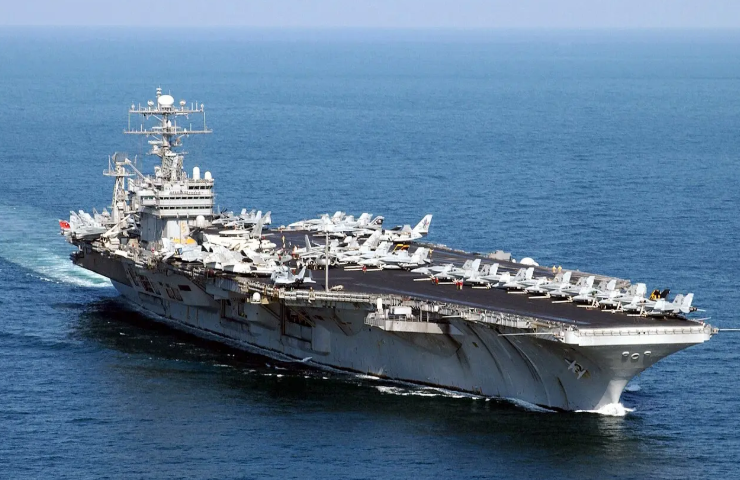

For decades, stories about invisible warships have captured public imagination. One of the most famous is the so-called Philadelphia Experiment of 1943, a legend that claims the US Navy made a ship vanish using secret technology. Today, similar questions are being asked again. With the USS Abraham Lincoln operating in West Asia, many wonder whether modern technology can truly hide such a massive aircraft carrier from Iranian radar systems.
The Philadelphia Experiment Legend That Refuses to Fade
The Philadelphia Experiment is a famous legend from World War II. According to the story, a US Navy destroyer was used in a secret test to make it invisible to enemy detection. The aim was supposedly to hide the ship from radar and even from the human eye.
Over time, the story became more dramatic. Some versions claim the ship vanished completely in a strange green fog. Others say it briefly appeared hundreds of kilometers away before returning to its original location. Darker claims later emerged, suggesting crew members suffered severe side effects or disappeared after the test.
However, no official records support these claims. The US Navy has repeatedly denied that any experiment involving invisibility or teleportation ever took place. Still, the legend continued to spread, fueled by wartime secrecy and public imagination.
In reality, the events were likely linked to degaussing technology. During the war, ships were fitted with electrical cables to reduce their magnetic signature and avoid triggering naval mines. To untrained observers, this equipment may have looked mysterious and sparked rumors.
Despite clear explanations, the Philadelphia Experiment remains popular today and is often referred to as “Philadelphia Experiment 2.0.”
A Modern Giant That Cannot Simply Disappear
The USS Abraham Lincoln is not a small wartime destroyer. It is a Nimitz-class aircraft carrier, one of the largest warships ever built. The ship is more than 330 meters long and weighs over 100,000 tons when fully loaded. It carries aircraft, crew facilities, radar systems, and defensive weapons, making it a floating city at sea.
Because of its enormous size, physically hiding the USS Abraham Lincoln is impossible with today’s technology. It cannot be made invisible to the human eye, satellites, or basic optical sensors. From space, such a carrier is easy to spot due to its size, movement, and the wake it leaves in the water.
Venezuela blasts U.S. flotilla as “cannon diplomacy” with warships at its doorstep
The ship also produces heat and noise. Engines, aircraft operations, and onboard systems generate strong thermal and sound signatures. These can be detected by infrared sensors, drones, and other monitoring tools that do not rely on radar alone.
This reality is important when discussing claims about hiding the carrier from Iranian radars. The ship does not vanish. It does not teleport. It does not become invisible like something from a movie. Instead, the focus is on confusing enemy systems rather than disappearing from the world.
Electronic Warfare and the Reality of Radar Confusion
Modern naval operations rely heavily on electronic warfare. This is where the idea of “electronic invisibility” comes from. Instead of hiding a ship physically, modern systems are designed to confuse or disrupt enemy radar and tracking equipment.
The USS Abraham Lincoln uses advanced electronic warfare systems that can detect hostile radar signals and respond instantly. These systems send out jamming signals that interfere with radar waves. When radar is jammed, screens may show false targets, unclear images, or no useful data at all.
As a result, enemy radar operators may struggle to locate the aircraft carrier accurately. On radar screens, the massive ship may appear smaller, distorted, or mixed with background noise. The goal is not to disappear completely, but to make targeting extremely difficult.
The carrier strike group also includes aircraft built specifically for electronic attack. These aircraft can fly ahead of the fleet and send powerful jamming signals toward land-based radar systems. This creates zones where radar performance is reduced, helping protect nearby ships.
Iran operates various radar and air defense systems, some more vulnerable to jamming than others. In narrow waters, detection becomes more complex due to geography, ship traffic, and multiple sensor types.
Because of this, modern naval strategy focuses on confusion and information control, not invisibility. The USS Abraham Lincoln is not hidden from reality, but shielded by technology that makes accurate detection far more challenging.