
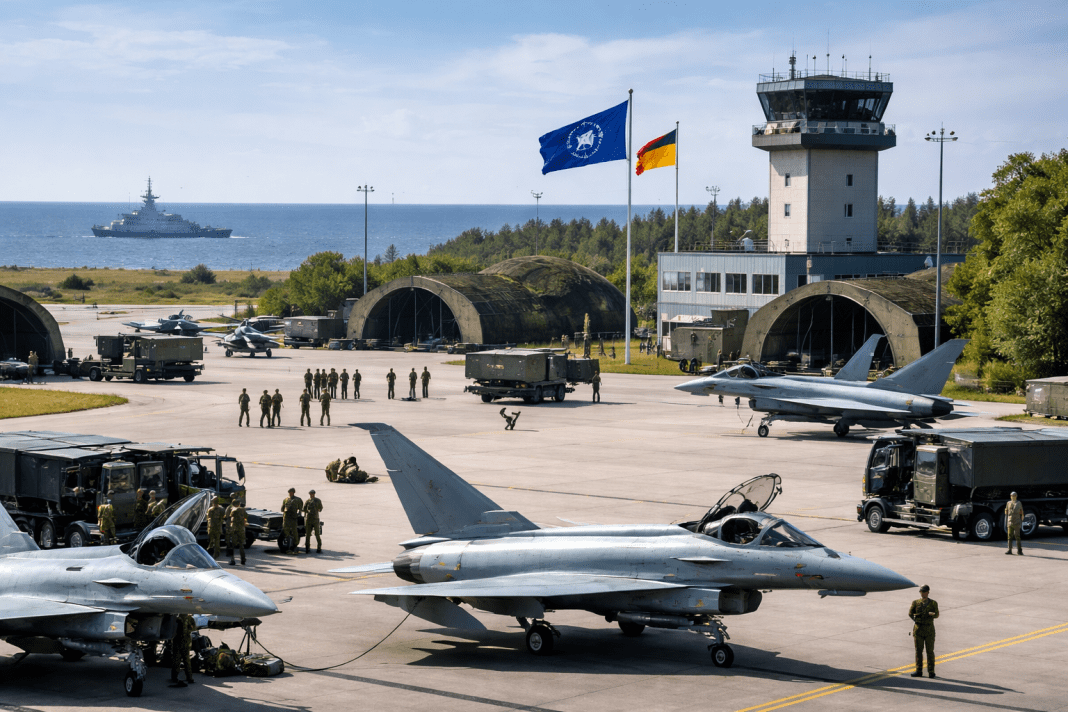

Since 2024, Germany’s northern airspace has undergone a major shift as a regional civilian airport near the Baltic Sea is being repurposed into a military facility linked to NATO planning. German defence officials say the move is intended to strengthen readiness close to Russia and integrate the site into a wider Baltic air-and-sea defence network, but critics warn it marks a deeper militarisation of civilian infrastructure in Germany. The transition threatens civilian air traffic, tourism, and local jobs, while raising legal and security concerns as infrastructure once used for regional travel increasingly takes on the role of a frontline military airport.
From civilian travel hub to strategic military airport
The airport has mainly operated as a civilian facility since the 1990s, even though it borders an active military air base. It handles limited regional and seasonal flights and supports tourism, airport services, and nearby businesses. These civilian activities now face uncertainty as plans move forward to convert the site into a military airport.
Since mid-December, the armed forces have reviewed whether to take control of the airport, citing a changed security situation that requires more personnel, equipment, and infrastructure. While similar reviews are happening elsewhere, this site stands out due to its location and close ties to an existing base.
Germany risks €164bn gold fortune by keeping it in US, critics warn
The neighboring base already plays a major role in national defense, hosting modern fighter jets, military personnel, and pilot training. Its Baltic coast location allows rapid regional access for NATO missions. Officials reportedly plan to invest around one billion euros in upgrades, which would further strengthen the airport’s role as a fortified military airport, even if some civilian use continues for now.
A key link in NATO’s Baltic defense network
The air base expansion is part of a broader NATO plan to strengthen a connected defense system along its eastern flank. In northern Germany, the base will work closely with a nearby NATO maritime command. Together, they will form a digitally linked air and sea defense network across the Baltic region.
Within this network, planners expect the site to serve as a central military airport for rapid deployments. Military planners want air defense, naval operations, and troop movements to function as a single system, supported by secure digital links and reliable infrastructure.
Germany and France sign landmark ODIN’S EYE agreement — Europe steps into a new defense era
As a result, authorities increasingly treat airports, ports, railways, and communication systems as military logistics assets. Germany has also introduced a national plan that assigns civilian infrastructure a role during military emergencies.
Military exercises have already tested this approach, including fighter jets landing at civilian airports. This means civilian sites could become targets during conflict, raising concerns in northern Germany, where tourism and regional airports support local jobs and businesses.
Economic impact, legal concerns, and political debate
Local airport operators and workers were caught off guard by the speed and scale of the military review. Until recently, civilian management and the air force worked together on shared investments, such as navigation systems and staffing. The possibility of losing civilian status has raised concerns about job losses in air traffic control, ground services, tourism, and related businesses as the airport shifts toward a permanent military airport role.
Regional political leaders have mainly warned about economic damage. They argue that ending civilian flights would hurt the local economy and weaken regional connections. Their criticism has focused on financial losses rather than on the wider impact of transforming the site into a long-term military airport.
At the national level, debate continues over rising military spending and the use of civilian infrastructure. Large funding packages have been approved to support defense expansion, including projects linked to military aviation. Even parties that publicly question rearmament have backed key measures that support the development of a larger network of military airport facilities.
Germany warns Arctic security must be handled through NATO, not unilateral action
Legal concerns have also emerged. The air base lies in former East German territory, where post-reunification agreements restrict the presence of foreign armed forces and certain weapons. Increased NATO activity connected to the military airport plans has drawn attention to these limits.
Despite objections, planning continues. The site is becoming a key part of Europe’s wider rearmament, with the transformation into a military airport affecting jobs, civil aviation, legal agreements, and regional security.