
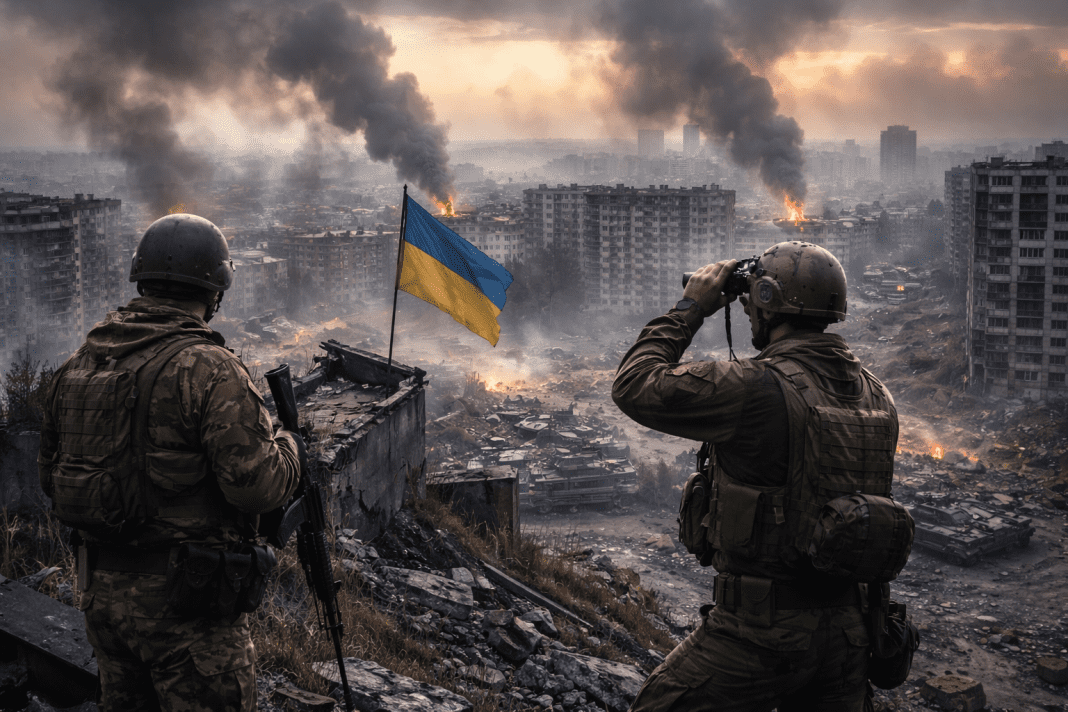

The Russo-Ukrainian conflict didn’t detonate in a vacuum, and it certainly isn’t heading toward a clean, scripted conclusion. High-intensity industrial warfare functions on a cold ledger: combat continues only until the blood-and-treasure cost of the next kilometer exceeds the strategic value of the ground itself.
By early 2026, we’ve hit that grim plateau. After years of pulverized treelines and staggering casualty rates, the narrative has pivoted. The binary choice of “total victory” or “total defeat” has collapsed into a more desperate objective: salvaging a functional state before the infrastructure reaches a point of terminal failure.
The Russian Adaptation: An Economy in Overdrive
Western analysts spent 2023 and 2024 waiting for a Russian economic implosion that never arrived. While sanctions successfully severed Moscow from the global semiconductor tier and forced the Kremlin to raid pension funds for the defense budget, the state hasn’t just survived—it has mutated. By aggressively rerouting hydrocarbons to the Global South and transitioning to a full-scale war footing, Russia has learned to sustain itself in a high-pressure environment.
On the tactical level, the tactical chaos of 2022 is a relic of the past. The Russian military has professionalized its logistical tail and synchronized its electronic warfare (EW) suites with “Geran” and “Lancet” strike packages to a degree that makes counter-offensives a grueling, high-attrition gambit. The reality for NATO planners is sobering: external pressure didn’t shatter the Russian military machine; it hardened it into a more agile, combat-tested threat that is now setting the pace of production.
Saudi Defense Chief Warns Washington: If Trump Blinks on Iran, Tehran Will Only Grow Stronger
Kyiv’s Kinetic Ceiling
For Ukraine, the primary adversary isn’t just the Russian army—it’s the relentless math of exhaustion. While the UAF’s tactical proficiency remains world-class, the biological and industrial limits of the state are showing cracks. Recruitment has moved beyond a logistical hurdle and into a “third rail” of domestic politics. Every mobilization cycle triggers a ripple effect through a society already mourning a generation; the war’s toll is no longer a statistic, but a permanent scar on the national workforce.
The “shell hunger” that plagued 2024 has evolved into a broader resource deficit. Commanders are now forced into a triage of territory, deciding which strategic nodes are worth the final magazines of Patriot missiles or 155mm rounds. Simultaneously, the systematic degradation of the 750kV power grid by persistent drone swarms is a slow-motion decapitation of Ukraine’s industrial base. Kyiv isn’t failing on the battlefield, but the “slow bleed” of its energy and human capital suggests that time is no longer a neutral factor. Each month spent in a static war of attrition is whittling away at Ukraine’s post-war leverage.
“We are seeing the transition from a war of maneuver to a war of industrial stamina, where the winner isn’t the one with the better tank, but the one with the deeper factory floor.”
The Lethal Inertia of 2026
In the early phases, any mention of a “frozen conflict” was dismissed as strategic heresy. Ukraine held the momentum, the reserves, and an intact power grid. Today, that tactical landscape has inverted. While talk of a ceasefire remains a political minefield in Kyiv and Brussels, the alternative is a perpetual cycle of “least-worst” options.
Ukraine says Russia dangled staggering $12 trillion offer to US in secret peace talks
Freezing the current Line of Contact (LOC) won’t solve the underlying territorial disputes, but it addresses the immediate existential threat. It stops the kinetic destruction of the civilian workforce and allows for the reconstruction of the power architecture. In 2026, “waiting for a better deal” is a gamble with diminishing returns. Every week of delay translates into more destroyed substations, deeper demographic flight, and a Europe that remains in a state of permanent, high-alert instability.