
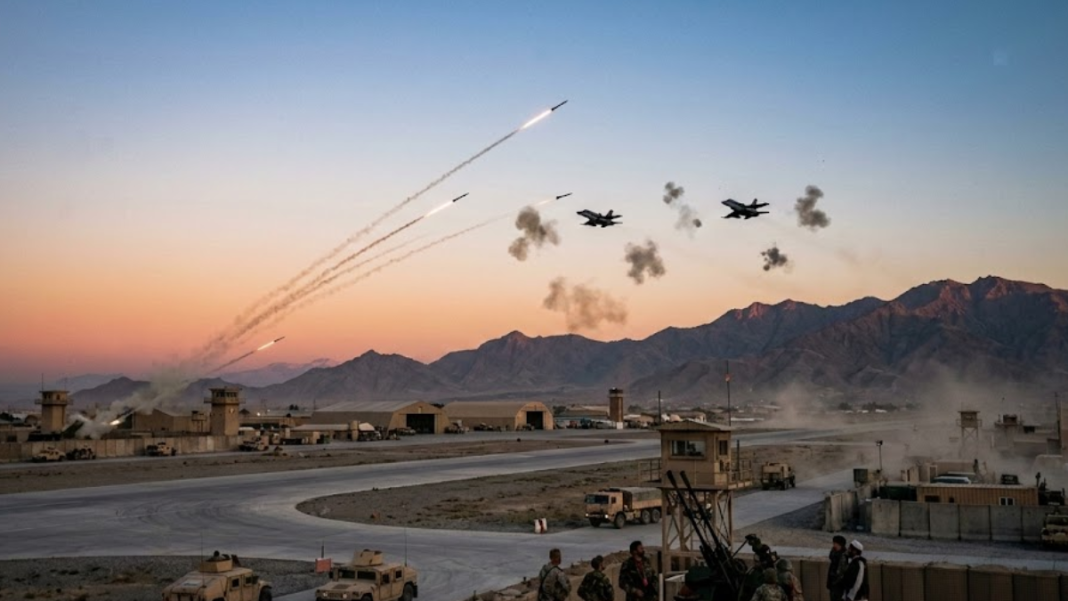

Tensions between Afghanistan and Pakistan have sharply increased after Afghan authorities said they blocked attempted Pakistani airstrikes on Bagram airbase. The claim came as cross-border fighting entered its fourth day, with both sides reporting heavy clashes and rising casualties.
The violence, which began on Thursday, has spread across several border provinces. Each government has accused the other of starting the attacks. Casualty figures shared by both sides differ widely, and independent confirmation remains difficult due to limited access to the conflict zones.
Afghan officials said Pakistani military jets entered Afghan airspace early Sunday morning and attempted to bomb Bagram airbase around 5 a.m. They stated that Afghan forces responded using anti-aircraft and missile defense systems and prevented the strike from causing damage.
There has been no immediate public reaction from Pakistan specifically addressing the claim about Bagram. However, Pakistan has acknowledged conducting air operations inside Afghanistan in recent days.
Pakistan launches Operation Ghazab lil-Haq after accusing India of backing deadly border attacks
Bagram airfield, located north of Kabul, is one of the country’s most important military facilities. It was once the largest United States base in Afghanistan and remains strategically significant because of its infrastructure and location.
The escalation marks a noticeable shift. Analysts have observed that this is the first time Pakistan has directed airstrikes toward Afghan government-linked facilities rather than focusing only on suspected militant hideouts.
Pakistan confirmed that it carried out strikes on Friday in major cities, including Kabul and Kandahar. Kandahar holds political and symbolic importance within Afghanistan.
Civilian and Military Casualty Claims Clash
As the conflict intensifies, both governments have released sharply different casualty numbers.
Taliban government deputy spokesperson Hamdullah Fitrat said Pakistani shelling had killed 36 civilians across several Afghan provinces since Thursday. He described the deaths as the result of cross-border fire. Pakistan has not directly commented on these specific claims.
On the other side, Pakistan’s information minister, Attaullah Tarar, said that Pakistani forces had struck 46 locations inside Afghanistan since the start of the operation. He stated that 415 Afghan soldiers were killed. Pakistan also reported that 12 of its own soldiers died in the fighting.
Afghan authorities provided a different account. They claimed more than 80 Pakistani soldiers were killed and that 27 Pakistani military posts were captured. Afghanistan earlier reported that 13 of its own troops had died.
Taliban signals Afghans could stand with Iran if US launches strike
Because journalists and independent observers have limited access to the areas where fighting is taking place, these figures cannot be independently verified.
Clashes were reported in several provinces, including areas near the border. Residents described hearing heavy gunfire and explosions. In eastern regions, sporadic fighting continued through Sunday afternoon.
At the Torkham border crossing, overnight fighting was reported. This crossing is a key route for trade and travel between the two countries. Disruptions there can affect families and businesses on both sides of the border.
Militant Groups and Security Concerns Add Pressure
The broader security situation has intensified the confrontation. Militant groups such as al-Qaeda and Islamic State operate in parts of eastern Afghanistan and continue efforts to maintain or rebuild their presence in the region.
Pakistan has repeatedly accused Afghanistan of failing to act against militant groups that carry out attacks inside Pakistan. Afghan authorities have rejected these accusations.
Tehreek-e-Taliban Pakistan, also known as TTP, has claimed many recent attacks in Pakistan. The group has increased its activities since 2021, when Taliban authorities returned to power in Kabul. Pakistan says it is conducting its current operations to target militant threats rather than civilians.
Security measures have tightened in Kabul amid the rising tensions. On Sunday, additional checkpoints were visible in parts of the capital, and security forces were deployed in greater numbers than usual.
Diplomatic efforts involving regional countries such as Saudi Arabia and Qatar have been underway to reduce tensions, but fighting has continued across multiple provinces.
Both governments continue to stand by their versions of events. Each side accuses the other of aggression while reporting higher enemy casualties. As exchanges of fire persist along the frontier and in key areas, the situation remains highly strained, with military activity reported from border zones to major cities.