
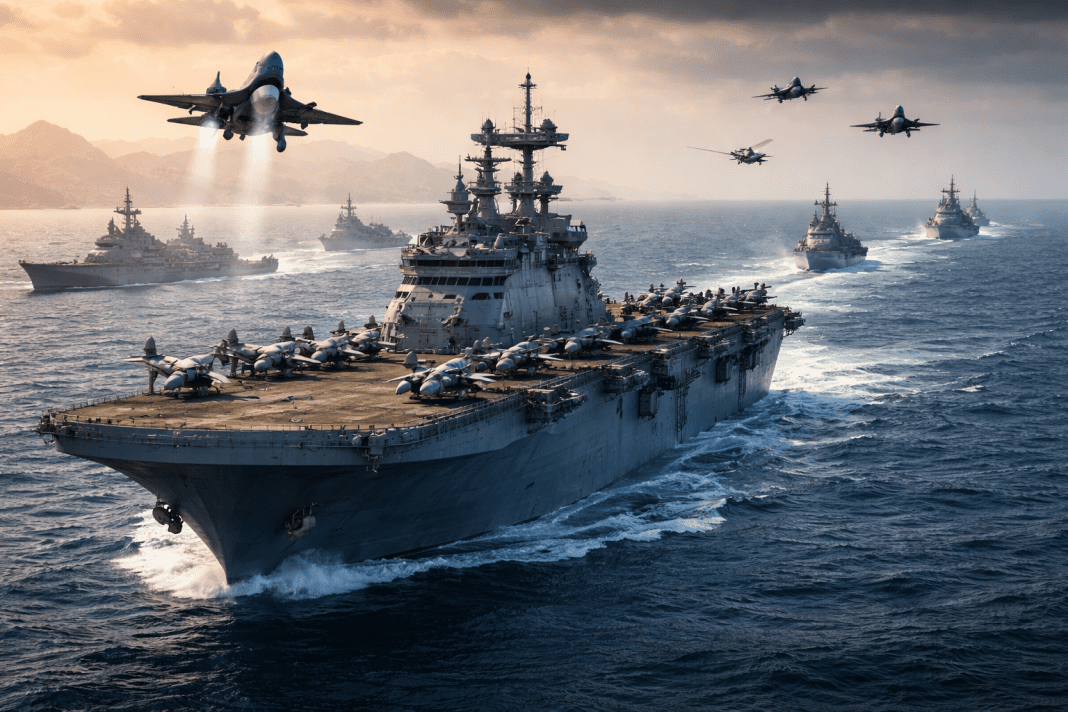

The United States has deployed around 15 warships. They are enforcing a naval blockade in the Strait of Hormuz. This is a key route for global oil and gas. The operation is supported by advanced aircraft, including F-35B Lightning II jets. It could impact fuel prices and supply chains worldwide.
Massive Naval Deployment with F-35B Jets in a Critical Region
The United States has deployed a powerful naval force to enforce the blockade, led by the amphibious assault ship USS Tripoli (LHA-7). This vessel is designed to handle both sea and air operations, effectively functioning as a floating airbase in the region. Its ability to launch and recover aircraft without a traditional runway allows it to operate flexibly in tense and confined maritime zones.
A key asset onboard is the F-35B Lightning II fighter jet. These jets are equipped with advanced stealth technology, making them difficult to detect on radar. They are capable of carrying out precision air strikes, real-time surveillance, and defensive missions. During peak operations, the USS Tripoli can support more than 20 F-35B jets, significantly strengthening aerial dominance.
No deal on Iran talks: Trump moves on the Strait of Hormuz as oil hits $100
The ship also carries MV-22 Osprey aircraft, which combine helicopter-style takeoff with airplane-like speed and range. This makes them ideal for quickly transporting troops, equipment, and supplies. Supporting warships, including destroyers and logistics vessels, are equipped with advanced radar and missile systems, forming a coordinated and powerful military network.
How the Blockade Is Being Enforced
The blockade applies specifically to ships entering or leaving Iranian ports, while vessels traveling to or from other countries are allowed to pass freely. Despite this limited scope, the situation remains tightly controlled. Any ship entering the restricted zone without approval risks being stopped, redirected, or even seized, creating a tense and high-risk environment for commercial shipping near Iranian waters.
Advanced surveillance systems play a central role in enforcing these restrictions. Warships and aircraft are continuously monitoring the area to track vessel movements. The F-35B Lightning II jets provide aerial surveillance, while naval ships rely on radar and communication systems to identify and verify passing vessels in real time.
Iran moves to tighten control over Strait of Hormuz after conflict, alarming energy markets
Early signs of disruption have already appeared. Reports indicate that at least two ships turned back soon after the blockade was enforced, showing how quickly maritime traffic has been affected and how seriously shipping operators are responding to the new restrictions.
Amphibious ships such as USS Tripoli (LHA-7) add operational flexibility by deploying troops, aircraft, and landing craft when required. Meanwhile, MV-22 Osprey aircraft enhance rapid response by transporting personnel and supplies efficiently across the region.
Why the Strait of Hormuz Matters So Much
The Strait of Hormuz is one of the busiest and most important shipping routes in the world. Nearly 20 percent of global oil and liquefied natural gas (LNG) passes through this narrow waterway every day. Because of this, even a small disruption in the area can directly affect global energy markets, leading to rising fuel prices and possible supply shortages for countries that depend on imports.
The blockade is aimed at limiting Iran’s economic benefit from this route. By controlling ship movements near Iranian ports, the United States is trying to reduce revenue linked to maritime traffic. At the same time, tensions in the region have already been rising, making the situation more sensitive.
Tehran rejects a temporary ceasefire deal and refuses to reopen the Strait of Hormuz
The deployment of advanced military assets adds to the seriousness of the situation. Warships, surveillance systems, and fighter aircraft like the F-35B Lightning II create a strong and visible military presence. These stealth jets are built for modern combat and can operate in complex conditions, showing a high level of readiness.
With at least 15 warships in place, the scale of the blockade is significant. The United States has established a firm control zone in and around the Strait of Hormuz. As forces continue to monitor and enforce the blockade, ships passing through the region must follow strict guidelines to avoid any confrontation.