
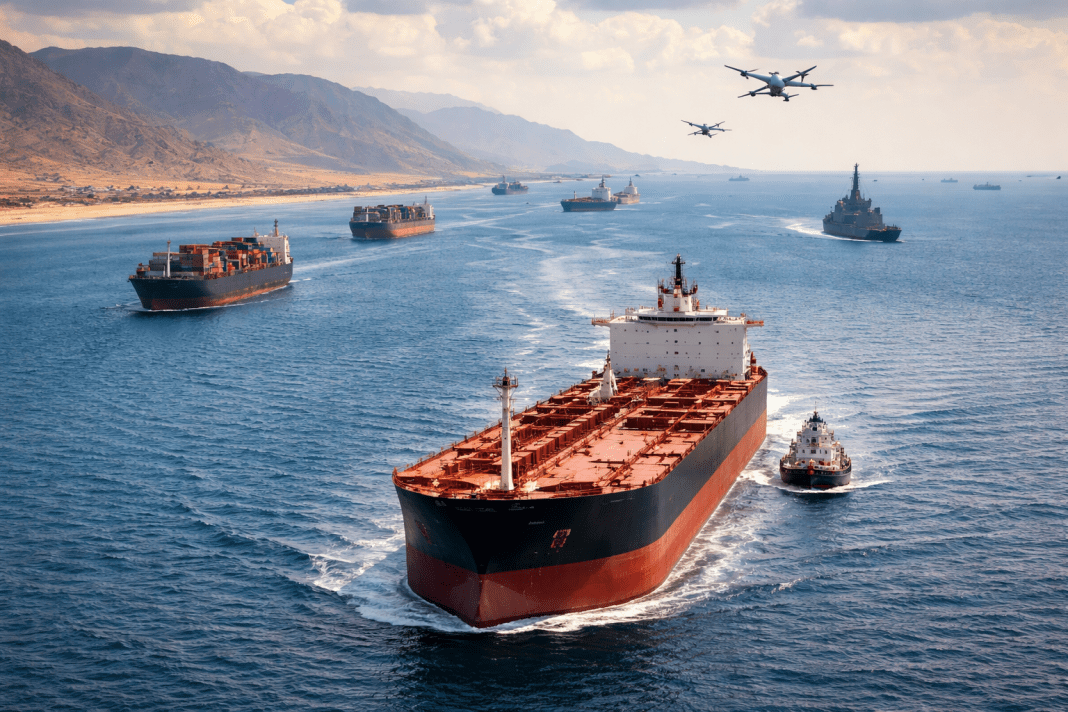

Global shipping routes are under renewed concern as tensions rise around key maritime chokepoints. The Bab el-Mandeb Strait, linking the Red Sea and Gulf of Aden, is especially critical for global trade and energy flows. Any disruption here can quickly affect shipping, costs, and supply chains worldwide.
Rising Tensions Over Bab el-Mandeb Strait Signal Expanding Maritime Pressure
Tensions in global shipping routes have risen after signals from Iran’s political leadership suggested a possible expansion of maritime pressure beyond the Strait of Hormuz toward the Bab el-Mandeb Strait. This comes as the Strait of Hormuz already faces disruptions affecting global trade and energy flows.
The Bab el-Mandeb Strait lies between the Arabian Peninsula and the Horn of Africa, linking the Red Sea with the Gulf of Aden and serving as a key gateway to the Suez Canal route. Recent statements from Iran’s political circles have raised concerns about global dependence on this narrow passage, through which large volumes of oil, gas, food grains, and industrial goods move daily.
Meanwhile, maritime routes in nearby waters remain strained due to ongoing regional conflicts. Armed groups in Yemen have previously targeted commercial ships, increasing risks for shipping companies and insurers operating in the region.
What Makes the Bab el-Mandeb Strait a Critical Global Shipping Route
The Bab el-Mandeb Strait is often called the “Gate of Tears” because of its narrow shape and difficult navigation conditions. Despite being a small stretch of water, it plays a massive role in global trade.
This strait connects two major seas, the Red Sea and the Gulf of Aden. From here, ships travel toward the Suez Canal, which is the fastest route between Asia and Europe. Without this passage, ships would need to travel around the southern tip of Africa, making journeys much longer and more expensive.
Around 10 to 12 percent of global maritime trade passes through this route. This includes oil shipments, liquefied natural gas, fertilizers used in farming, wheat and rice for food supply, and various manufactured goods. Even a small disruption can create delays that spread across global supply chains.
The strait is also narrow, making it easier to monitor and, in conflict situations, easier to block or disrupt. It lies near politically sensitive regions, including Yemen and parts of East Africa, where armed groups have previously demonstrated the ability to target ships using drones and missiles. These attacks have already forced several shipping companies to change routes in recent years.
Because of its position, Bab el-Mandeb works like a key checkpoint for global shipping. Any instability in this area directly affects the flow of goods between continents.
How Disruptions Affect Global Energy, Trade, and India
Global energy and trade routes depend heavily on the smooth movement through two key chokepoints: the Strait of Hormuz and the Bab el-Mandeb Strait. While Hormuz carries a major share of the world’s oil exports, Bab el-Mandeb connects the Red Sea to the Gulf of Aden and forms a crucial passage toward the Suez Canal route leading to Europe and other global markets. Disruptions in either route can quickly affect international shipping and energy supply chains.
Even small delays in these waterways can raise global costs. Longer shipping routes increase fuel consumption, while insurance and freight charges also rise. These added costs are usually passed on to consumers through higher prices for fuel, transport, and essential goods.
Georgia Meloni makes an unannounced visit to the Gulf as energy tensions rise
The Bab el-Mandeb Strait is also important for global food movement. Large volumes of wheat, rice, fertilizers, and other agricultural goods travel through this corridor between Asia, Africa, and Europe. Any disruption can slow deliveries and affect supply availability in different regions.
India is closely tied to this maritime route through trade with Europe and West Asia. Major exports like pharmaceuticals, textiles, engineering goods, and chemicals pass through the Suez Canal corridor, making it vulnerable to delays. India also relies on these routes for energy imports, so disruptions can affect fuel prices and supply chains. Bab el-Mandeb remains a key global chokepoint due to its strategic position in international trade.