
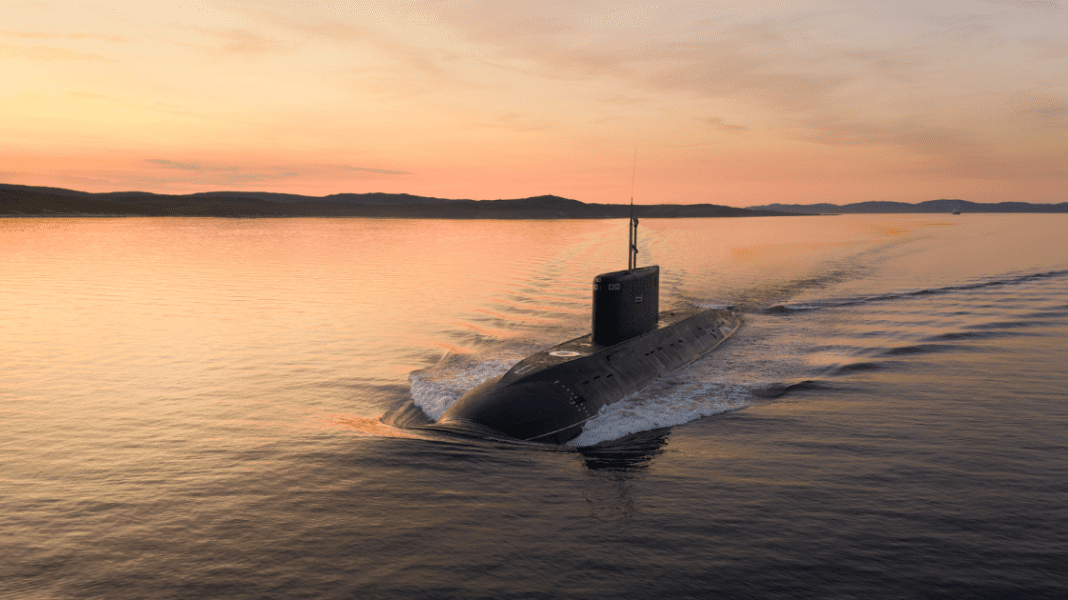

China is developing a new gravity-based sensor to detect hidden submarines instead of relying on traditional methods like sonar. By measuring tiny changes in Earth’s gravitational field, this technology could offer a new approach to tracking underwater objects that are otherwise difficult to find.
A New Way to Find What Cannot Be Seen
China has developed a new sensor that could change how submarines are detected by using gravity instead of traditional methods like sonar or radar. The system is designed to detect tiny changes in Earth’s gravitational field caused by large objects such as submarines.
Submarines are built to remain hidden by using stealth and staying quiet underwater. However, this new method focuses on mass, which cannot be concealed. Any large object, including an 18,000-ton nuclear submarine, creates small but measurable changes in gravity.
The rare U.S. move to return a drug fugitive to China signals a shift in cooperation
The device is based on a superconducting quantum interference device (SQUID), a highly sensitive instrument capable of detecting extremely small physical changes. This makes it suitable for identifying subtle shifts in gravity.
Originally developed for scientific research and resource exploration, the technology is now gaining attention for potential military use due to its ability to detect objects that are otherwise difficult to find.
How the Gravity Sensor Works
The working principle of this device may sound complex, but it can be understood in simple terms. The system uses a small object that is suspended in a nearly frictionless state. This means the object can move very freely, without being affected much by outside forces.
To achieve this, the device uses a special scientific phenomenon called the Meissner Effect. When certain materials are cooled to extremely low temperatures, they push away magnetic fields. This allows magnets to float, or levitate, above these materials.
By using this effect, the sensor creates a setup where a small mass floats in place with almost no friction. This floating mass becomes highly sensitive to any tiny movement. Even the smallest change in gravity can cause it to shift slightly.
In a major shift, survey finds citizens of key Western allies now trust China over the United States
When a large object like a submarine moves nearby, it changes the local gravity just a tiny bit. For example, Earth’s gravity might normally read something like 9.800000000. When a submarine passes, it could change to 9.800000002. This difference is extremely small, but the sensor is designed to detect it.
What makes this system special is that it does not just measure gravity itself. It measures something called a gravity gradient. This means it can detect differences in gravity across space, making it even more precise.
Because of this high sensitivity, the device acts like one of the most accurate “weighing scales” ever created, even though it is not weighing objects directly.
Challenges and Real-World Testing
The technology is still in an early experimental stage and faces several important challenges before it can be used in real-world situations. One of the biggest problems is environmental noise. Because the sensor is extremely sensitive, it can pick up very small disturbances caused by everyday activities such as footsteps, moving vehicles, wind, ocean waves, and even minor earthquakes.
These unwanted signals make it difficult to clearly identify the presence of a submarine. The device must separate the actual signal of a large underwater object from constant background interference. Even slight vibrations or movements in the surrounding environment can affect the readings and reduce the system’s overall accuracy.
The rapid expansion of China’s underwater fleet aims for 80 submarines by 2035
To deal with this issue, scientists have started testing the device outside controlled laboratory environments. Real-world conditions are far more complex and unpredictable. Early tests suggest the system can function in such “noisy” settings, but it still has limitations. Improving precision and reducing interference remain key priorities.
One major advantage of this approach is that gravity cannot be hidden or turned off. Unlike sonar, which can sometimes be avoided, a submarine’s mass will always create a gravitational effect. While not yet ready for deployment, the technology shows strong potential for future use.