
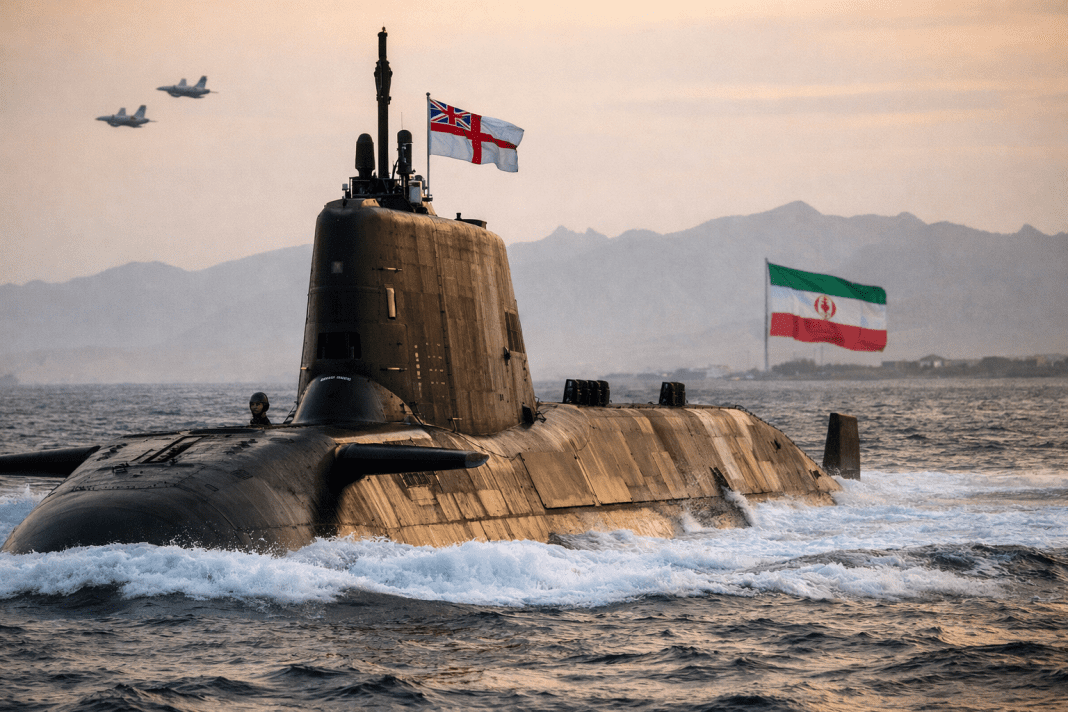

The United Kingdom has reportedly deployed its advanced nuclear-powered submarine, HMS Anson, to the northern Arabian Sea amid rising hostilities involving Iran, the United States, and Israel, according to a report by the Daily Mail. The move comes as British Prime Minister Keir Starmer approved the use of key UK-linked military bases, including RAF Fairford and Diego Garcia, for potential US strikes targeting Iranian missile infrastructure.
Submarine deployment signals strategic escalation
If confirmed, the positioning of HMS Anson — a stealth-capable Astute-class submarine armed with Tomahawk cruise missiles — significantly enhances Britain’s ability to conduct long-range precision strikes. Operating beneath the surface, the submarine provides both deterrence and operational flexibility, especially in a region critical to global energy flows.
The northern Arabian Sea is strategically vital due to its proximity to the Strait of Hormuz, a narrow maritime passage through which a substantial portion of the world’s oil supply transits. Recent Iranian missile activity targeting shipping lanes in this corridor has heightened concerns among Western allies.
Military sources cited in the report suggest that HMS Anson departed from Perth on March 6 and is now operating within strike range. The submarine reportedly surfaces periodically to communicate with the UK’s Permanent Joint Headquarters in London.
Starmer shifts stance amid Iranian strikes
Prime Minister Keir Starmer initially resisted US requests to use British bases for offensive operations, citing the need for legal clarity and proportionality. However, that stance evolved following Iranian strikes on Western-aligned assets across the Middle East.
Kuwaiti oil refinery hit by Iran as Israeli strikes cause explosions in Tehran
The UK government has since authorised US forces to utilise RAF Fairford — a key base for American strategic bombers — and Diego Garcia, a highly strategic joint UK-US military installation in the Indian Ocean.
This shift reflects growing Western alignment as tensions with Iran deepen, particularly after Tehran escalated attacks targeting shipping and military-linked infrastructure.
Diego Garcia targeted in long-range strike attempt
In a significant development, Iran reportedly launched missiles toward Diego Garcia — located roughly 4,000 kilometres away — marking a notable extension of its strike range capabilities. Although the missiles failed to hit the island, the attempt has raised serious concerns among defence analysts.
Experts suggest two possibilities: either Iran possesses longer-range missile systems than previously disclosed, or it may have adapted space-launch technology for military use. Either scenario represents a potential shift in the strategic balance.
A British defence source indicated that the attempted strike occurred prior to the UK formally authorising US access to its bases, suggesting a rapidly evolving operational environment.
4,000 km strike attempt? Iran’s missile launch toward Diego Garcia raises global alarm
Regional and global implications
The deployment of HMS Anson and the authorisation of US base usage underscore the increasing militarisation of the conflict zone. The Arabian Sea, once primarily a commercial shipping route, is now emerging as a key theatre in a broader geopolitical confrontation.
The risk of escalation is particularly high given the number of actors involved and the strategic assets at stake. Submarines like HMS Anson are designed for stealth and precision, but their deployment also signals readiness for high-intensity conflict.
Meanwhile, Israeli military officials have warned that Iran’s missile capabilities could extend beyond the Middle East. Israeli Chief of Staff Eyal Zamir stated that major European cities such as Berlin, Paris, and Rome could fall within range — a claim that, if accurate, would significantly widen the scope of the threat.
A conflict nearing a tipping point
While diplomatic channels remain open, the rapid movement of military assets suggests that key players are preparing for a possible escalation. The presence of a nuclear-powered submarine equipped with cruise missiles adds a new dimension to the conflict, increasing both deterrence and risk.
For now, the situation remains fluid. But with Iran demonstrating extended strike capabilities, and Western forces repositioning for rapid response, the Arabian Sea is fast becoming one of the most closely watched flashpoints in global security.