
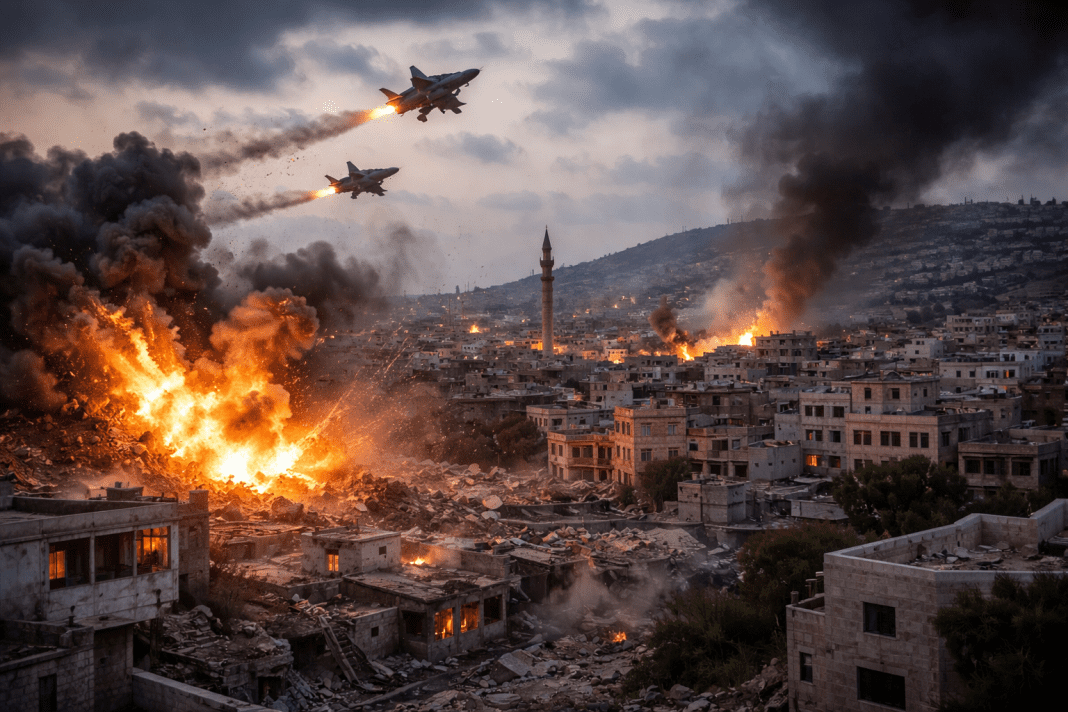

Israel carried out airstrikes inside Syria, targeting a military “commander centre” and several weapons depots. It launched the operation in response to recent violence reported in southern Syria.
Officials said the strikes focused on infrastructure linked to Syrian forces. These included facilities used for coordination and weapons storage. Israel aimed at specific sites instead of wider areas and described the operation as precise.
The strikes followed developments in Sweida, a region in southern Syria that has recently seen unrest. This area has a large Druze population, which makes the situation more sensitive. Syria’s state media did not immediately confirm the attack or provide details about damage. Early reports remained limited, and authorities did not release clear information about casualties.
Reports of Violence in Sweida
The Israeli strikes came after reports of attacks on the Druze population in Sweida. This area has long served as one of the main centres of the Druze community in Syria.
The Druze are a small religious and ethnic group living in Syria, Lebanon, and Israel. In Sweida, they form a major part of the population. The region has often remained more stable compared to other parts of Syria, which makes recent violence more notable.
Reports indicated that members of the Druze community were affected by the attacks. These developments quickly drew attention because of the community involved and the location of the incidents.
Israel linked its military action directly to these reports. It said the strikes responded to the attacks on the Druze population and tied the operation to events on the ground.
Indian companies face scrutiny over alleged links to Israel’s defence network
Military Targets and Nature of the Operation
Israel targeted specific military-related sites during the strikes. These included a command centre and weapons storage facilities. Such locations play a key role in planning and supporting military operations.
By focusing on these targets, Israel kept the operation limited and controlled. Officials said the goal was to address infrastructure connected to the situation instead of carrying out broader attacks.
Israel has conducted similar strikes inside Syria in the past. Earlier operations targeted military installations, transport routes, and storage sites linked to security concerns.
This incident stands out because it directly connects cross-border military action with reported violence in Sweida. The link between local unrest and the strikes adds a new dimension to the situation.
Authorities did not release detailed updates about the impact of the strikes. Information about damage and casualties remained unclear in the initial hours after the operation.
Trump says Israel won’t strike Iran gas field again, distances US and Qatar from attack
Rising Tensions Across the Region
The development comes at a time of heightened tension in the region. Israel continues to face ongoing security challenges, including tensions involving Iran and allied groups.
Syria still deals with instability after years of internal conflict. Different groups control different areas, which often leads to sudden clashes and changing conditions on the ground.
Events in Sweida have added a new point of concern. Reports of violence in the region, followed by airstrikes, have brought fresh attention to the situation.
Cross-border military actions increase pressure in an already sensitive environment. Developments in Syria remain closely watched because of the country’s connections with other regional powers.
The situation highlights how quickly local incidents can expand into wider tensions. In regions where multiple conflicts overlap, even limited developments can draw broader attention and response.