
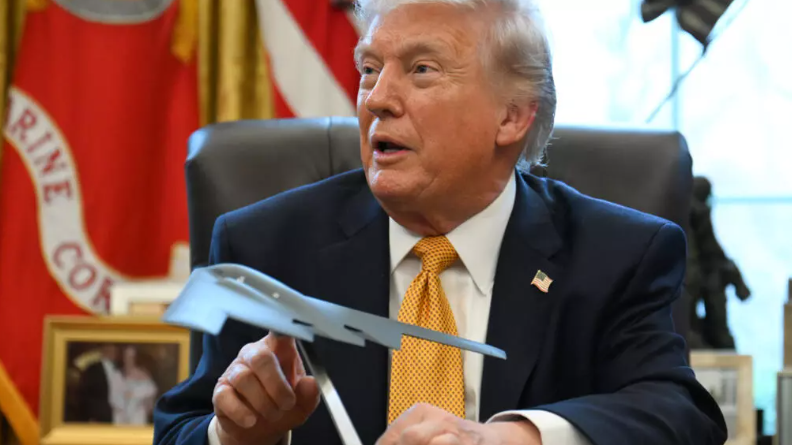

US President Donald Trump has sharply criticised NATO allies. He accused them of hesitating to support the United States in its ongoing conflict with Iran. He called their stance a “very foolish mistake.” Speaking at the White House, Trump made these remarks during a discussion with Irish Prime Minister Micheal Martin. He said that NATO countries supported US actions in words. However, they failed to provide practical assistance.
Trump Boasts US Strikes Weakened Iran, NATO Offered Only Words
President Donald Trump accused NATO allies of backing US military action against Iran in words but not in action. Speaking at the White House, he said alliance members supported the strikes in principle but did not commit troops or resources. “All of our NATO allies were very much in favour of what we did. They thought it was very important,” Trump said, pointing to a gap between their approval and actual involvement.
Trump stressed that the main objective of the US strikes was to eliminate Iran’s nuclear threat. He described the operations as strong, precise, and necessary to prevent Iran from advancing its nuclear capabilities. According to him, the action was carried out with significant force and effectiveness.
Trump warns NATO of consequences if allies don’t help reopen the Strait of Hormuz
He also claimed that the strikes caused major damage to Iran’s military strength. Trump said the country’s air force, navy, and radar systems had been “wiped out” or “decimated,” highlighting the scale of the impact on Iran’s defence infrastructure.
Trump Questions NATO’s Reliability Amid Iran Conflict
President Donald Trump said that even though the United States has the ability to act on its own, he was disappointed by NATO’s response during the ongoing conflict with Iran. He noted that while alliance members agreed with the importance of the US action, they did not step forward with real support. Trump described this as surprising, especially given the seriousness of the situation.
He openly questioned whether NATO can be relied upon in times of major global crises. Trump pointed out that this situation serves as a “test” for the alliance. According to him, even if the US does not need help, its allies should still stand beside it during critical moments to show unity and strength.
Trump further argued that NATO’s hesitation reflects a lack of commitment. He said that acknowledging a threat but refusing to act against it sends the wrong message. In his view, such a stance weakens the credibility of the alliance and raises concerns about its future role in global security.
The US President also compared the situation to America’s past support for Ukraine. He criticised former President Joe Biden and NATO allies, saying the US had provided strong assistance when others needed it. “We helped them, and they didn’t help us,” Trump said, highlighting what he sees as an imbalance in mutual support.
Strong Support From Middle East Partners and Israel
While NATO allies showed reluctance, Trump praised support from Middle Eastern countries during the conflict. He specifically mentioned Qatar, the United Arab Emirates, Saudi Arabia, and Bahrain, saying these nations had provided “significant support” to US operations. Trump also emphasised close coordination with Israel, calling it a “very strong collaboration” in ongoing military actions.
“We’ve had great support from the Middle East. Qatar has been great. The UAE has been absolutely great. Saudi Arabia’s been terrific. Bahrain has been very good. The Middle Eastern countries have been very strong in their support. Of course, Israel has been our partner. Israel’s been very, very strong, along with us. It’s been a very strong collaboration,” he stated.
Germany rejects Trump’s call for NATO to secure the Strait of Hormuz
These remarks come amid escalating tensions in the Middle East that began on February 28 following joint US-Israeli strikes that killed Iran’s Supreme Leader, Ayatollah Ali Khamenei. In retaliation, Iran targeted US and Israeli assets across several Gulf nations, disrupting the region’s waterways and impacting international energy markets.
The conflict has led to severe disruption in the Strait of Hormuz, a critical route for global oil and energy supplies. Following Ali Khamenei’s death, his son Mojtaba Khamenei was appointed as the new Supreme Leader of Iran, marking a significant leadership transition in the country during the crisis.