
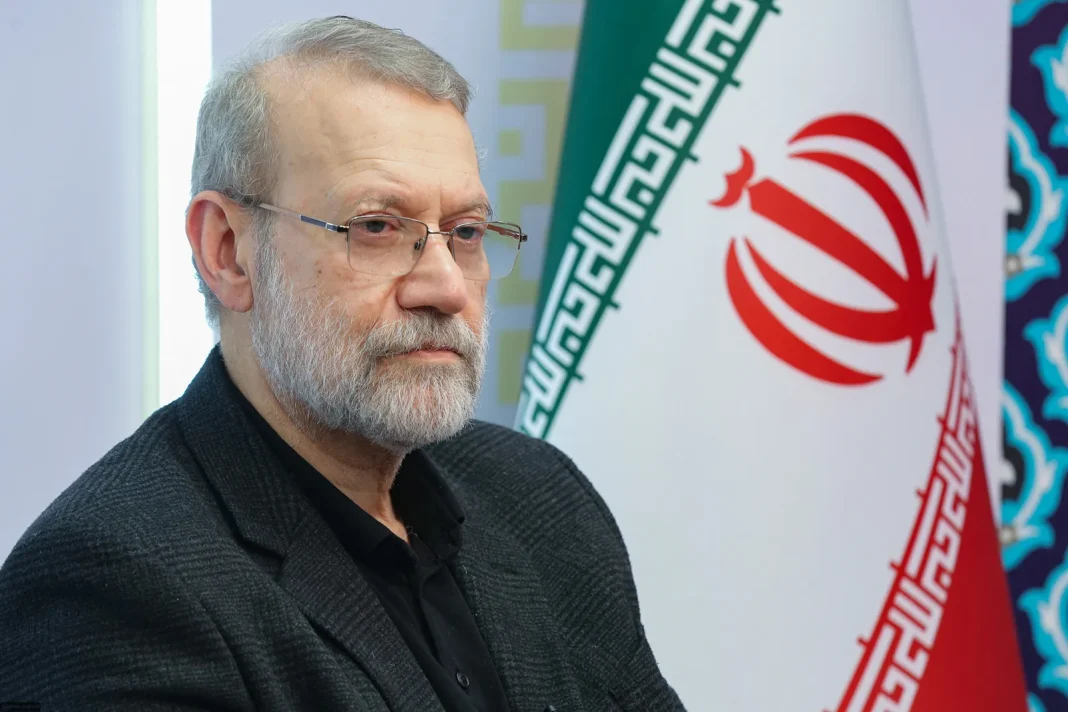

As tensions in the Middle East remain high, a senior Iranian official has made a dramatic allegation that has quickly drawn international attention. Ali Larijani, a top security figure in Tehran, claimed that individuals linked to the network of disgraced financier Jeffrey Epstein could be planning a “9/11-style” attack that would later be blamed on Iran.
The statement was made in a post on the social media platform X, where Larijani said he had heard that “remaining members of Epstein’s network have devised a conspiracy to create an incident similar to 9/11 and blame Iran for it.”
His remarks come at a time of growing geopolitical friction in the Middle East and heightened rhetoric between Tehran, Washington, and Israel. While Larijani did not provide evidence to support the claim, the allegation has added another layer of intrigue and controversy to an already volatile regional situation.
Tehran denies targeting Americans
In the same statement, Larijani sought to distance Iran from any acts of terrorism against civilians in the United States. He emphasized that Tehran’s conflict is with governments it sees as hostile, not with ordinary Americans.
“Iran fundamentally opposes such terrorist schemes and has no war with the American people,” he wrote.
Iranian officials have frequently tried to frame their position in international messaging by highlighting that their disputes with Washington relate to political and military policies rather than the American public. The latest statement appears to follow that pattern, while also raising a dramatic warning about what Tehran claims could be a staged provocation.
Shadow of the 9/11 attacks
Larijani’s reference to a “9/11-style” attack invokes the memory of the devastating September 11 attacks, one of the deadliest acts of terrorism in modern history.
Five U.S. aircraft reportedly damaged in Saudi Arabia as Iranian strikes expand across the Gulf
On September 11, 2001, 19 hijackers associated with the extremist group Al-Qaeda seized four commercial airplanes in the United States. Two of those planes were flown into the twin towers of the World Trade Center in New York City, causing massive explosions and fires that ultimately led to the collapse of both towers.
Another hijacked aircraft crashed into the Pentagon in Arlington, Virginia, the headquarters of the U.S. military. A fourth plane went down in a field near Shanksville, Pennsylvania, after passengers fought back against the hijackers in an attempt to stop another potential strike.
Nearly 3,000 people were killed in the attacks, which transformed global security policies and triggered the United States’ long-running “war on terror.”
Epstein connections remain controversial
Larijani’s claim also revives longstanding controversy surrounding the network and associates of Epstein, who died in a U.S. jail in 2019 while awaiting trial on sex trafficking charges. Epstein had connections with numerous political figures, business leaders, and celebrities across several countries, many of whom later faced public scrutiny over their associations.
Iranian state media and officials have periodically highlighted those connections to argue that powerful Western elites were linked to Epstein’s social circle. In the latest statement, Larijani suggested that individuals tied to that network could attempt to manipulate global events to shift blame onto Iran.
Iran launches seventh missile wave since midnight as Israel investigates use of cluster munitions
However, there has been no independent verification of the allegation.
Political context in Washington
The claim also indirectly touches on U.S. politics. Epstein’s relationships with several prominent figures have been widely reported over the years, including photographs taken with former U.S. President Donald Trump before Epstein’s legal troubles became widely known.
Trump later distanced himself from Epstein and publicly described him as a “creep.” The former president has repeatedly said he cut ties with the financier years before the scandal erupted.
Despite this, Epstein’s past connections with influential individuals have remained a recurring topic in global political debates, conspiracy theories, and media coverage.
No evidence presented
So far, Larijani’s claim has not been accompanied by intelligence reports, documents, or other proof. Western officials have not publicly responded to the allegation, and analysts say it may reflect the intense information warfare that often accompanies geopolitical crises.
Experts note that during periods of conflict, governments frequently use public messaging to shape narratives, warn adversaries, or rally domestic support.
Iran launches seventh missile wave since midnight as Israel investigates use of cluster munitions
For now, the allegation remains an unverified claim circulating amid an already tense international environment. But by invoking the memory of the 9/11 attacks and linking them to a controversial global network, Tehran’s statement has ensured that the issue will likely spark debate across diplomatic, intelligence, and media circles in the days ahead.