
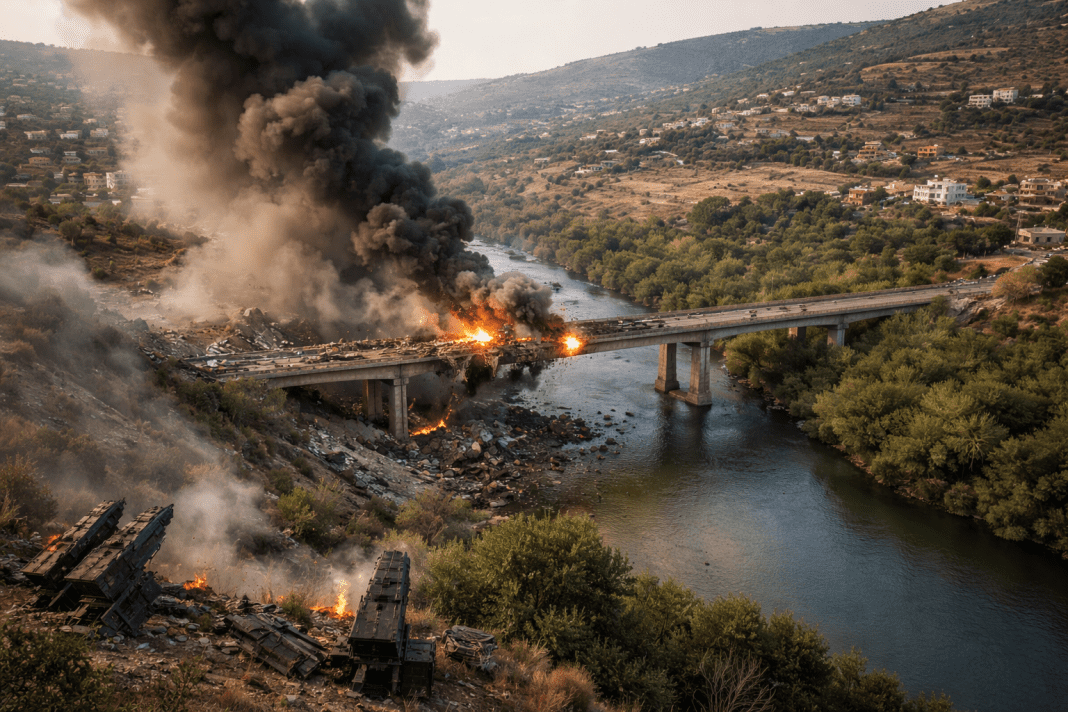

The Middle East conflict escalated sharply on Day 13 of the US–Israel–Iran war. Airstrikes, military operations, and drone attacks are spreading across Israel, Lebanon, and Iran, displacing civilians and raising tensions. Recent strikes on the Zrariyeh Bridge and Tehran highlight the growing scale and intensity of the conflict.
Hezbollah Targeted: Zrariyeh Bridge Hit
The ongoing US–Israel–Iran conflict reached a dramatic stage on Day 13, with fresh military strikes and rising tensions across the Middle East. The Israeli military confirmed it had carried out an airstrike on the Zrariyeh Bridge, a key crossing over the Litani River in southern Lebanon.
According to the Israeli army, Hezbollah fighters had recently used the bridge to move personnel and equipment. Officials also said that missile launchers were stationed near the bridge, making it a strategic target in the ongoing conflict.
Oman dragged into Middle East war as drones strike Salalah port, Iran denies role
The strike is part of a larger series of Israeli operations targeting Hezbollah positions in southern Lebanon. Military officials described the Zrariyeh Bridge as a “central crossing” for the group in recent days, underlining its importance.
Following the attack, local authorities issued forced evacuation orders for nearby areas, including regions near Beirut, Lebanon’s capital. These measures aim to protect civilians as military activity in the region intensifies.
Israel Launches New ‘Extensive Wave’ of Airstrikes on Tehran
In another major development, the Israeli military announced the start of a new “extensive wave” of airstrikes targeting Tehran, the capital city of Iran. This marks a clear escalation of the conflict, extending beyond Israel and Lebanon and raising concerns about a broader regional war.
According to military sources, the strikes were based on intelligence reports of Iranian strategic military positions in Tehran and other key locations. The Israeli army emphasized that these operations are part of its ongoing efforts to counter threats from Iran-backed groups and prevent further attacks on Israeli and allied targets.
Iran detains dozens of alleged spies linked to US and Israel amid ongoing regional tensions
During this period, Iran’s newly appointed Supreme Leader issued his first statement since taking office. He warned that countries hosting American military bases in the region should close them immediately. He also indicated that attacks could continue if these bases remained operational. This statement underscores Iran’s strong opposition to ongoing military actions and reflects the deepening tensions across the Middle East.
The renewed airstrikes and political statements signal that both sides are intensifying operations. The situation continues to unfold rapidly, with military actions taking place across multiple countries in the region.
Rising Humanitarian Crisis and Military Casualties
The impact of the conflict on civilians and military personnel has been severe. The United Nations High Commissioner for Refugees (UNHCR) reported that over 3.2 million people have been displaced in Iran since the war began on February 28. Families have fled cities and towns due to bombings, airstrikes, and fears of further attacks. This mass displacement highlights the escalating humanitarian crisis as the war enters its second week.
Meanwhile, Saudi Arabia announced that its air defense systems intercepted and destroyed eight drones over its central and eastern regions, including the capital city of Riyadh. The drone interceptions were conducted to prevent potential attacks and illustrate the increasing security risks in the region.
Military reports also reveal that an Iranian attack on a US base in Kuwait injured over 100 US soldiers. Injured personnel were airlifted to military hospitals, including locations in the United States and the Landstuhl Regional Medical Center in Germany, with some suffering severe injuries, including cases requiring amputation. The full extent of the casualties has raised questions about transparency regarding the reporting of injuries and military operations.
IDF releases bodycam footage of night operations targeting Hezbollah sites in Lebanon
In addition, the President of the United States commented on the situation, stating that the war in Iran is “coming along very well.” His remarks came while military operations and retaliatory attacks continue across multiple fronts, highlighting the ongoing intensity of the conflict.
The Day 13 developments indicate that the conflict is escalating in multiple countries, including Israel, Lebanon, Iran, and Saudi Arabia. The combination of airstrikes, drone interceptions, and large-scale civilian displacement demonstrates the severe humanitarian and military toll of the war. The situation in the Middle East remains highly volatile, with both strategic and human consequences unfolding rapidly.