
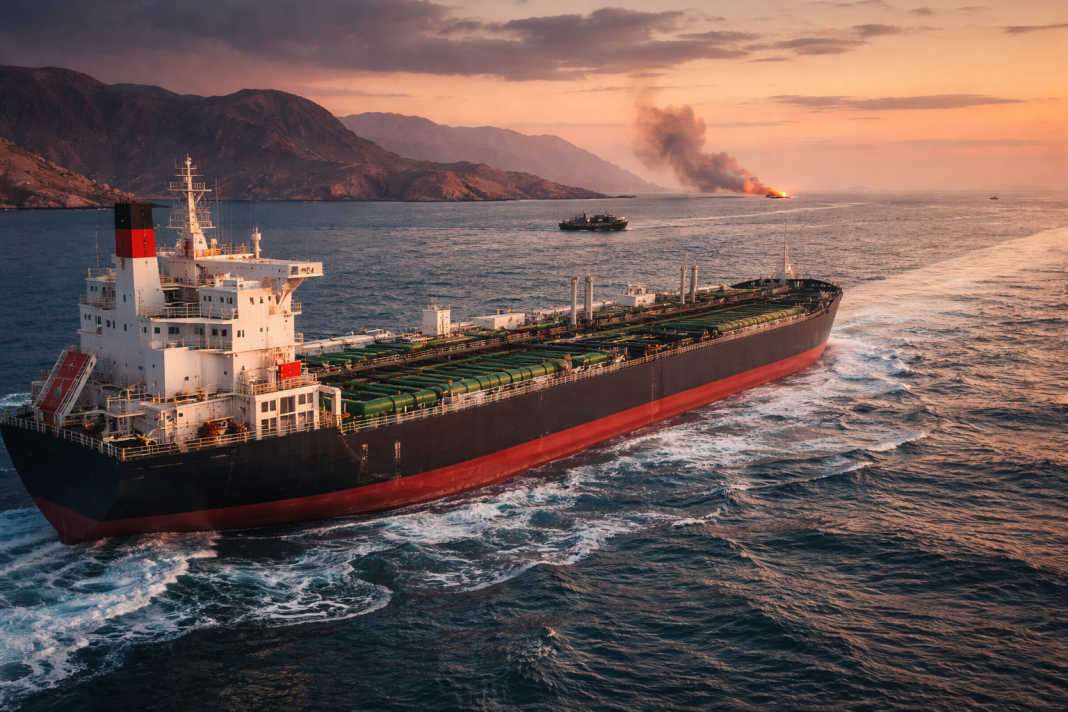

A major oil tanker bound for India has successfully completed a high-risk journey through one of the world’s most dangerous waterways. The Shenlong Suezmax, carrying Saudi crude, navigated the conflict-hit Strait of Hormuz while temporarily going “dark” to avoid detection, marking a rare safe transit amid rising military tensions in the region.
Oil Tanker Navigates Strait of Hormuz Safely Amid Conflict
A tense journey across one of the world’s most dangerous waterways ended safely for an oil tanker bound for India. The Liberia-flagged Shenlong Suezmax, carrying Saudi crude, navigated the conflict-hit Strait of Hormuz while briefly going “dark” to avoid detection. It became the first India-bound vessel to safely pass through the strategic waterway since fighting erupted last month between the United States, Israel, and Iran.
Commanded by an Indian captain, the tanker docked at Mumbai Port on Wednesday evening. Officials confirmed that the tanker carries 1,35,335 metric tonnes of crude oil and will unload it at the Jawahar Dweep Terminal, supplying refineries in eastern Mumbai. They expect the unloading process to take around 36 hours.
India reports 37 oil and LPG tankers stranded near Strait of Hormuz as fuel shipments delayed
Maritime experts say such voyages require meticulous planning and precise navigation. In conflict zones like the Strait of Hormuz, even small errors can be catastrophic, highlighting the risks crews face while transporting vital oil supplies through volatile waters.
How “Going Dark” Helped the Tanker Avoid Danger
Experts explain that “going dark” refers to a ship temporarily switching off its Automatic Identification System (AIS). AIS is a device that continuously broadcasts a vessel’s identity, location, speed, and course to other ships and monitoring authorities. The system is designed to improve maritime safety, prevent collisions, and allow authorities to track the movement of vessels across oceans.
However, in high-risk zones such as the Strait of Hormuz, especially during ongoing conflicts, ships may choose to temporarily turn off their AIS. Doing so makes the vessel harder to detect by hostile forces, reducing the risk of being targeted by missile strikes, electronic attacks, or surveillance.
US urges Israel to pause strikes on Iran oil infrastructure citing risks to global energy supply
In the case of the Shenlong, tracking data showed the vessel’s last AIS signal inside the strait on March 8, after which it disappeared from monitoring systems. It reappeared the following day after safely navigating the dangerous waters. This indicates that the crew deliberately switched off the AIS to move discreetly through the conflict zone.
Although rare, this measure has become an important tactic for ships navigating regions with active military threats. It allows vessels to follow international maritime rules while also protecting the crew and cargo from being targeted. The success of Shenlong’s voyage highlights how effective such strategies can be when executed carefully.
Risks and Threats in the Strait of Hormuz
The Strait of Hormuz is a narrow but crucial shipping lane connecting the Persian Gulf with the Arabian Sea. Over 20 million barrels of oil pass through it daily, making it one of the world’s most important waterways for energy. In recent weeks, however, it has become highly dangerous due to missile attacks, military patrols, and rising regional tensions.
Not all ships have been as fortunate as the Shenlong Suezmax. Projectiles struck the Thai bulk carrier Mayuree Naree shortly after it left the United Arab Emirates. The fire engulfed the vessel, and three crew members went missing, while the navies of Thailand and Oman rescued 20 others. These incidents have forced many ships to delay entry, queue outside the strait, or take longer alternative routes to ensure safety.
India seeks safe passage for oil tankers through Strait of Hormuz amid rising Middle East tensions
The Shenlong’s crew ensured a safe passage through careful planning, their multinational expertise, and by temporarily turning off the ship’s Automatic Identification System (AIS) to go “dark.” Managed by an Athens-based company, the tanker carried 29 crew members, including Indians, Pakistanis, and Filipinos.
Its successful journey highlights both the perils of navigating conflict zones and the extraordinary precautions vessels must take. The safe arrival of the Shenlong at Mumbai serves as a rare example of a ship completing a perilous transit through one of the world’s most dangerous waterways without incident.