
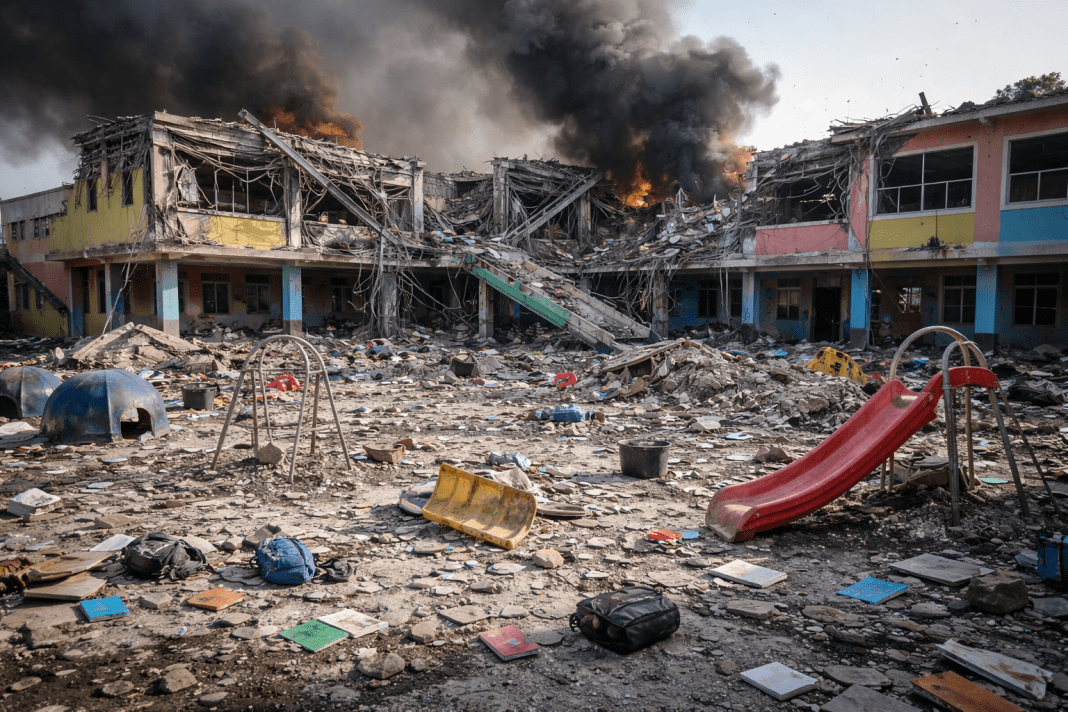

On February 28, a missile struck Shajarah Tayyebeh Elementary School in Minab, southern Iran, killing around 170 people, most of them children. The attack shocked the region and quickly became one of the conflict’s most talked-about incidents. A preliminary U.S. military investigation indicates that an intelligence failure may have caused the strike, raising serious questions about why military planners mistakenly targeted the school.
What Happened in the School Strike?
On the morning of February 28, missiles struck multiple sites in the Iranian city of Minab. One of the explosives landed on the Shajarah Tayyebeh Elementary School, which according to Iranian state media was full of students and teachers during their school day. Iranian reports say that over 165 people were killed, most of them young children, with dozens more injured.
The school was close to a military compound used by Iran’s Islamic Revolutionary Guard Corps (IRGC) navy. At first, neither the United States nor Israel officially confirmed who fired the missile that hit the school. However, many experts and investigators have pointed to evidence suggesting an American Tomahawk cruise missile was involved — a weapon type only the United States is widely known to use in the conflict.
US urges Israel to pause strikes on Iran oil infrastructure citing risks to global energy supply
Satellite imagery and videos released after the strike show buildings in the area damaged in a way that matches precise guided missiles, which makes some analysts believe this was part of a planned military operation rather than a random accident.
New Details from the Investigation
In the weeks after the strike, a U.S. military investigation began to look into what happened. The early findings from this probe have raised a troubling possibility: the strike on the school may have been the result of outdated intelligence data.
According to officials familiar with the probe, military planners were targeting a nearby Iranian military facility belonging to the Revolutionary Guard’s naval forces. To plan the strike, officers used latitude and longitude coordinates from older reports that mistakenly showed the school building as part of the military base.
Iran detains dozens of alleged spies linked to US and Israel amid ongoing regional tensions
This information came from the Defense Intelligence Agency (DIA), which maintains large amounts of data about possible military targets. Military planners should not have included the school on a target list because they knew that years earlier it had separated from the military compound, and barriers and walls clearly marked it as a civilian educational site.
Over time, the school added its own playground and painted bright colours typical of a place for children, which satellite photos clearly showed. Despite these visible changes, planners may have relied on outdated data and assumed the building was still part of military operations.
Officials monitoring the investigation have specifically asked why military planners did not check the strike coordinates against newer satellite images or other updated intelligence sources, as Pentagon targeting rules normally require.
Reactions and Questions Raised
The missile strike on Shajarah Tayyebeh Elementary School in Minab, southern Iran, shocked the nation and drew global outrage. Iranian media showed emotional scenes of funerals, with families mourning children killed in the attack. Iranian leaders blamed the U.S. and Israel, though Israel denied any involvement.
U.S. officials have not publicly confirmed responsibility. Some leaders appeared uncertain or said they were unaware of the investigation’s early findings, with one official simply stating, “I don’t know about it.” The use of a Tomahawk missile, however, points strongly to U.S. forces.
US and Israel signal diverging war aims in Iran conflict as strikes expand beyond nuclear targets
In Washington, the strike has raised urgent questions. Over 45 lawmakers have demanded answers from top defense officials, asking how military planners selected the target and whether they used accurate intelligence. They have also raised concerns about cuts to programs meant to protect civilians during military operations.
Preliminary findings suggest that outdated intelligence caused the tragedy. Military planners apparently used old coordinates for a building that had been converted into a school years earlier, resulting in the deadly strike. While the investigation continues and officials have not confirmed all details, early reports show that serious errors in intelligence use put civilian safety at risk and exposed flaws in the processes guiding military targeting decisions.