
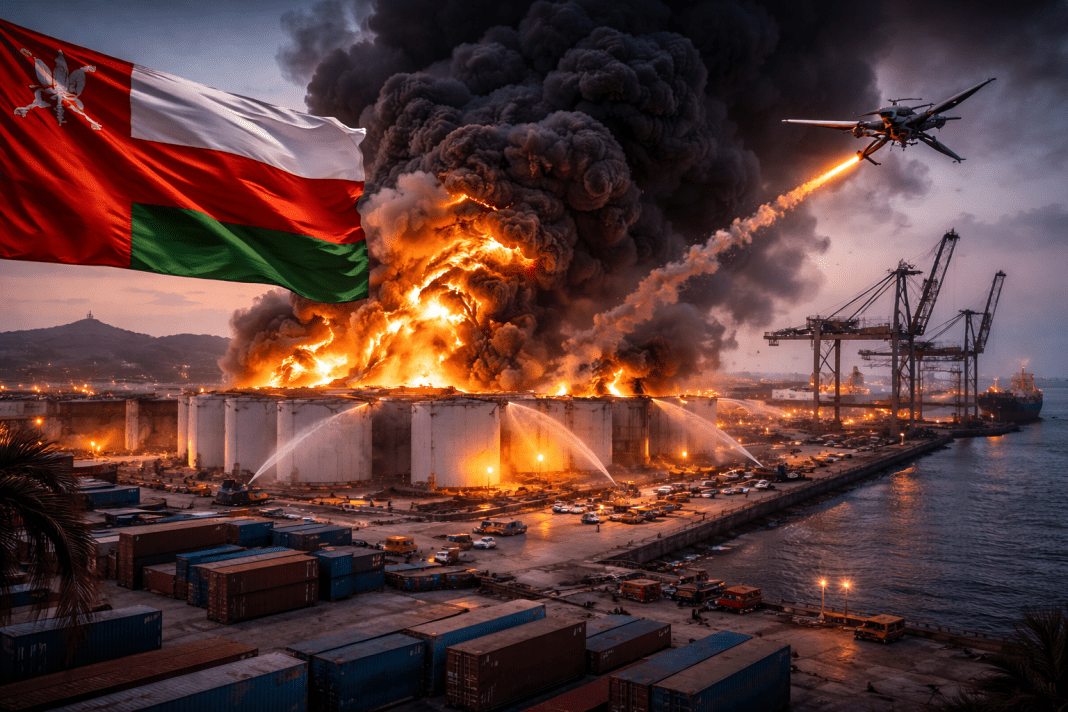

Explosions and towering flames erupted at one of the Middle East’s most important maritime gateways after multiple drones struck fuel storage tanks at the Port of Salalah in Oman on March 11, triggering fires and raising alarm across global shipping and energy markets.
The attack, which took place amid the intensifying conflict involving Iran, the United States, and Israel, has heightened fears that the war is spreading beyond traditional battle zones and increasingly targeting the region’s vital economic infrastructure.
Authorities in Oman confirmed that several unmanned aerial vehicles were detected approaching the port’s oil storage facilities. While air defence systems managed to intercept a number of the drones, at least one managed to penetrate the protective perimeter and strike fuel tanks within the port’s storage complex, setting off large fires.
Emergency responders rushed to the site shortly after the explosions were reported. Thick plumes of smoke rose above the port’s industrial zone as firefighters battled to contain the blaze.
Officials said that despite the scale of the fires, no casualties were reported among port employees or residents living nearby. Merchant vessels docked at the port during the incident were also not damaged.
Strategic shipping hub suddenly under threat
The Port of Salalah is one of the most strategically significant maritime hubs in the Arabian Sea. Located in Oman’s southern Dhofar region, the port serves as a key logistics center connecting shipping routes between Asia, Europe, and Africa.
U.S.–Iran talks resume in Oman as missile dispute threatens fragile nuclear diplomacy
It handles a combination of container cargo, fuel storage, and bunkering operations that supply vessels traveling along some of the world’s busiest sea lanes.
The drone strike immediately disrupted operations at the port. Shipping companies began reassessing safety conditions in the surrounding waters as authorities temporarily paused activities at parts of the facility.
One of the port’s major terminal operators confirmed that container operations were halted as a precaution while security agencies reviewed the situation and ensured the area was secure.
Global shipping company Maersk also suspended activities at the port following the attack, citing security concerns linked to the damaged fuel infrastructure.
The decision highlights how even a limited strike on a single energy facility can disrupt international logistics networks. The Gulf region handles a large share of the world’s oil exports and container shipping traffic, making any threat to its ports a matter of global economic concern.
Fires erupt at fuel storage tanks
Images and videos circulating online showed flames engulfing sections of the fuel storage depot inside the port complex. Witnesses reported hearing loud explosions shortly before the fires broke out.
According to officials, the drones appeared to target fuel storage tanks used to supply marine vessels and support the port’s energy operations.
Emergency crews worked through the night to bring the fires under control and prevent them from spreading to nearby storage units.
Iran deploys elite black-clad NOPO commandos to guard new supreme leader Mojtaba Khamenei
Security forces were also deployed around the facility as authorities continued to monitor the skies for additional drones.
The incident underscores growing concerns about the vulnerability of energy infrastructure in the Gulf, particularly as drone warfare becomes a more common tactic in regional conflicts.
Part of a broader wave of attacks
The Salalah incident is the latest in a series of strikes targeting ports, energy depots, and maritime assets across the region since the outbreak of the Iran–US–Israel war on February 28, 2026.
In recent weeks, multiple Gulf facilities have faced drone or missile threats.
Earlier in March, drones struck fuel storage tanks at Oman’s Port of Duqm, damaging infrastructure and injuring a foreign worker. In another incident, an oil tanker near Oman’s coastline was attacked during the escalation.
Several Gulf states hosting United States military assets have also reported aerial threats or interceptions of incoming drones and missiles.
These incidents have heightened fears among regional governments and energy companies that economic infrastructure is becoming a central target in the conflict.
Analysts say such attacks carry strategic significance because they can disrupt global trade routes without directly striking military installations.
Iran denies responsibility
Tehran has denied any involvement in the Salalah drone strike and suggested the possibility of a “false flag” operation.
A statement attributed to Iran’s Khatam al-Anbiya Central Headquarters, which coordinates the country’s armed forces, described the attack as suspicious and said Iranian authorities were examining the circumstances surrounding the incident.
Iranian officials emphasized that Oman has long been considered a friendly neighbour and that the Islamic Republic has no interest in targeting Omani territory.
Tehran also warned that rival actors could stage attacks on regional infrastructure in order to blame Iran and widen the conflict across the Gulf.
According to the statement, such actions could involve strikes on diplomatic facilities or strategic infrastructure in neighbouring countries designed to damage Iran’s reputation and draw additional states into the confrontation.
Why Oman’s role matters
The strike has drawn particular attention because Oman has historically maintained a neutral position in regional disputes.
China’s Spies Bug British Pubs: Parliament’s Backyard Turns Into Espionage Hotspot
For decades, the Sultanate has played the role of mediator between rival powers in the Middle East. It has maintained diplomatic relations with both Iran and Western nations, including the United States.
Oman was instrumental in facilitating back-channel negotiations that eventually led to the 2015 nuclear agreement between Iran and world powers.
Because of this diplomatic balancing act, the country has largely managed to avoid becoming directly involved in regional conflicts.
The drone attack on Salalah, however, suggests that the expanding war may now be reaching countries that have traditionally remained outside the battlefield.
Security analysts say targeting infrastructure in neutral states could be intended to send strategic signals or create pressure across the wider Gulf region.
Growing fears for global energy markets
The strike has intensified concerns among energy traders and shipping companies about the security of oil infrastructure across the Gulf.
The region hosts some of the world’s most important energy facilities, including major export terminals, refineries, and storage hubs.
Even limited disruptions to these facilities can affect global energy markets because a large portion of the world’s crude oil and liquefied natural gas passes through Gulf shipping routes.
Experts warn that continued attacks on ports and fuel depots could lead to several ripple effects, including supply disruptions, increased fuel prices, higher shipping insurance costs, and the rerouting of tankers away from conflict zones.
Drone warfare reshaping the battlefield
The Salalah strike also highlights the growing role of drones in modern conflict.
Compared with traditional missiles or air strikes, drones are cheaper to deploy, more difficult to detect, and capable of traveling long distances to strike infrastructure targets.
Many of the systems used in Middle Eastern conflicts resemble loitering munitions, often referred to as “kamikaze drones,” which circle an area before diving into a target.
Their increasing use has made ports, refineries, airports, and logistics hubs more vulnerable than ever before.
A dangerous new phase in the conflict
As the Iran–US–Israel war continues to escalate, attacks on infrastructure such as the Port of Salalah demonstrate how the conflict is spreading beyond military bases and into the economic arteries of the region.
For Oman, a nation long known for its diplomatic neutrality, the incident represents a troubling development.
For the global economy, it signals that key trade routes and energy supply chains may increasingly become part of the battlefield.
If strikes on ports and fuel depots continue, the consequences could extend far beyond the Middle East—affecting energy prices, shipping networks, and economic stability worldwide.