
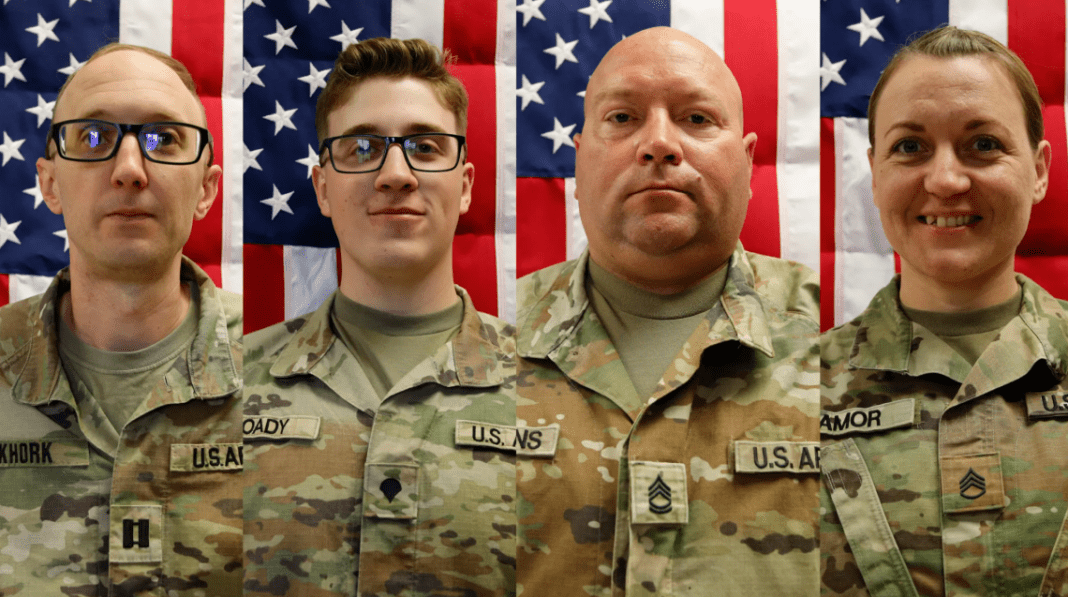

The U.S. Department of Defense has identified four of the six American service members killed in an Iranian drone attack on March 1 in Port Shuaiba, Kuwait, in retaliation for recent U.S. and Israeli strikes. The fallen soldiers—Capt. Cody A. Khork, Sgt. 1st Class Noah L. Tietjens, Sgt. 1st Class Nicole M. Amor, and Sgt. Declan J. Coady—were all assigned to the 103rd Sustainment Command in Des Moines, Iowa. The names of the other two have not yet been released.
Lt. Gen. Robert Harter honored the troops, saying they served “fearlessly and selflessly.” Officials confirmed the strike was carried out by Iran in retaliation for recent U.S. and Israeli attacks. The incident remains under investigation.
Deadly Drone Attack in Kuwait
The drone attack happened at Port Shuaiba in Kuwait, where U.S. forces were stationed, and authorities say it was a calculated retaliation. U.S. Central Command (CENTCOM) first reported that three American service members were killed and several others wounded. A day later, officials confirmed a fourth had died from injuries and that two previously unaccounted troops were also among the fallen in the same retaliation strike.
Defense Secretary Pete Hegseth said the weapon used in the retaliation was able to penetrate U.S. air defense systems. His comments raised concerns about how the drone managed to bypass protective measures in place at the base during the retaliation attack.
It was reported that the troops were inside a makeshift tactical operations center that may not have had enough protection. However, Pentagon spokesman Sean Parnell disputed that claim, saying the structure was fortified with 6-foot walls. Air Force Gen. Dan Caine added that the threat from Iranian drones remains persistent and dangerous amid ongoing retaliation actions.
U.S. and Iran Escalate Retaliation Strikes
The drone attack followed U.S. and Israeli strikes on Iranian targets under Operation Epic Fury, prompting swift retaliation from Tehran. U.S. Central Command (CENTCOM) said the operation has hit more than 1,700 targets since Saturday using aircraft, ships, and missile systems. Iran responded with further retaliation by launching attacks on U.S. military bases across the Middle East.
Adm. Brad Cooper, head of CENTCOM, said the damage to American bases from Iran’s retaliation has been “minimal” so far. However, officials have not shared details about which specific bases were targeted or the full extent of the damage caused during the retaliation strikes.
Gen. Dan Caine, chairman of the Joint Chiefs of Staff, said U.S. ships and ground-based missile defenses have intercepted hundreds of ballistic missiles during the retaliation exchange. These defenses include Patriot and THAAD systems designed to stop incoming threats before impact.
The United States had increased its military presence in the region weeks earlier in anticipation of possible retaliation. Aircraft carriers USS Gerald R. Ford and USS Abraham Lincoln, along with multiple fighter jet squadrons including F-15s, F-16s, F-22s, and F-35s, are now supporting ongoing operations in the CENTCOM area.
New Drone System Used in Combat
During Operation Epic Fury, the U.S. military also used a new drone system in combat for the first time. The system is called the Low-cost Unmanned Combat Attack System, or LUCAS.
The LUCAS drones were deployed on Saturday. However, defense officials have not said which targets the drones attacked or how widely they were used in response to the retaliation cycle.
These drones are described as low-cost, one-way attack drones designed to detonate on impact. Moreover, they are modeled after Iran’s Shahed-136 drones, which have been widely used in regional conflicts.
Investigations into the March 1 retaliation attack in Port Shuaiba are ongoing, as tensions between the United States and Iran continue to rise. Consequently, the identification of four of the six U.S. soldiers killed in the Iran retaliation marks a somber moment for the U.S. military and the families of the fallen. Their deaths come amid a rapidly escalating conflict, as both sides continue to exchange military strikes across the Middle East.