
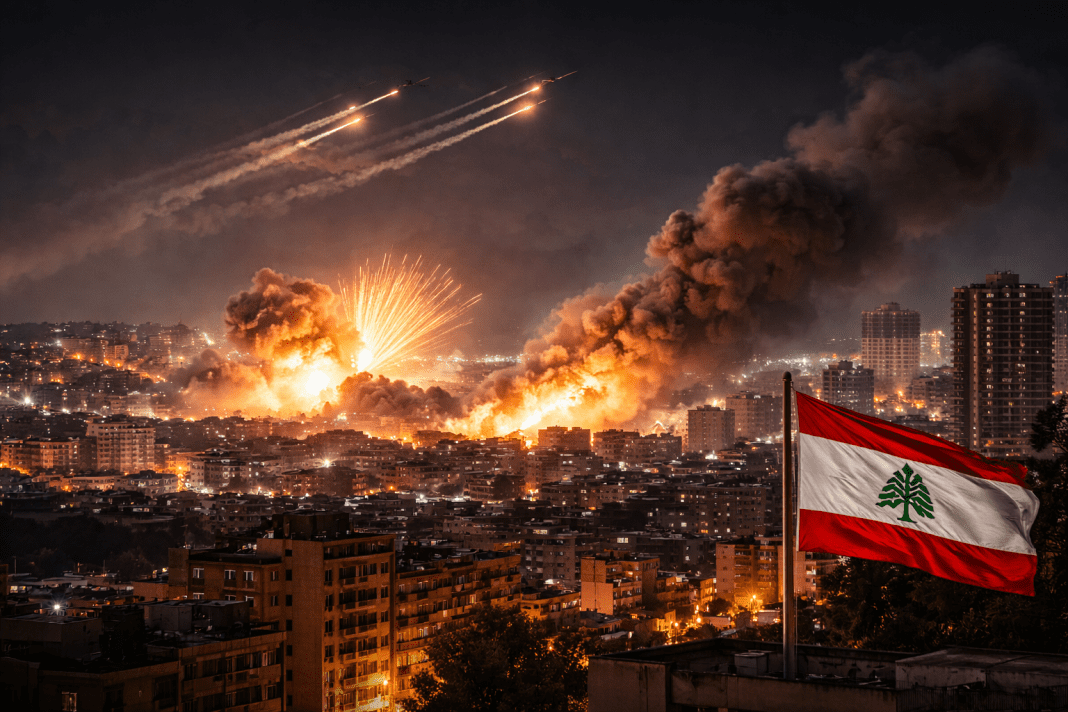

Israeli military forces carried out airstrikes in the vicinity of Beirut, Lebanon, marking a significant geographic expansion of the current Middle East conflict. The strikes follow days of intense military operations across the region under “Operation Epic Fury,” a joint US–Israel campaign targeting Iranian leadership figures and strategic assets.
By striking near the Lebanese capital, Israel has opened a new front in an already volatile regional crisis. The move signals that the conflict is no longer confined to direct Israel–Iran exchanges but is now extending into the Levant.
Explosions reported near Lebanese capital
Witnesses in Beirut reported hearing heavy explosions and seeing plumes of smoke rise from targeted areas on Monday morning. Security presence increased rapidly across diplomatic districts and sensitive residential zones in the capital.
Lebanese authorities condemned the strikes and described them as a violation of national sovereignty. Officials called for urgent international diplomatic engagement to prevent further escalation and to stop Beirut from being drawn into a wider war.
Israel Blasts Hezbollah’s Missile Cache in Beirut Strike — Lebanese President Fumes!
Beirut sits at the center of Lebanon’s political and economic system. Any military action near the capital carries serious symbolic and strategic consequences. The city has historically been a flashpoint during previous Israel–Lebanon confrontations.
Strategic message to Hezbollah
Military analysts assess that the strikes were likely aimed at disrupting logistics and communication networks associated with Hezbollah. The armed group maintains a strong presence in areas around Beirut and southern Lebanon.
Israel has repeatedly stated that it views Hezbollah as a major security threat due to its missile capabilities and regional alignment with Iran. By conducting strikes near Beirut, Israel appears to be signaling its willingness to act against perceived proxy threats even in politically sensitive locations.
The timing is important. The strikes come while Iranian command structures are reported to be under significant operational pressure following earlier phases of “Operation Epic Fury.” Targeting proxy networks during this period could be part of a broader strategy to weaken Iran’s regional influence.
Levant becomes central theatre
The Levant region — including Lebanon, Syria, and Israel — is increasingly becoming a central theater in the evolving Middle East crisis. Escalation near Beirut increases the risk of multi-front confrontation.
IRGC chief Pakpour and Iran Defense Minister Amir Hatami killed as Israel strikes deep inside Iran
Southern Lebanon has long been a zone of military tension between Israel and Hezbollah. However, operations near the capital represent a higher level of escalation. Beirut hosts diplomatic missions, financial institutions, and key infrastructure. Any sustained campaign in this area could destabilize Lebanon’s already fragile political and economic environment.
Regional observers note that Lebanon is facing economic challenges and internal political strain. A widening conflict could further complicate governance and security stability.
Wider Middle East already under strain
The Beirut strikes come amid rising tensions across the broader Middle East. In recent days, strategic infrastructure and transit hubs in the Gulf have faced security concerns due to missile and drone threats.
Dubai International Airport, one of the region’s busiest aviation hubs, has heightened security monitoring amid the broader escalation environment. Energy infrastructure across the Gulf region also remains under close protection as states seek to prevent spillover disruptions.
This wider regional pressure increases the stakes of any Israeli–Lebanese escalation. A localized exchange could quickly impact maritime routes, aviation corridors, and energy supply chains.
Risk of further escalation
The key question now is whether the strikes will trigger a direct Lebanese military response or remain limited to targeted exchanges. Diplomatic channels are reportedly active, though no formal ceasefire framework has been announced.
International actors are closely monitoring developments. Any sustained escalation near Beirut could reshape the security landscape of the Eastern Mediterranean.
For Israel, the strikes reinforce a doctrine of preemptive action against perceived threats. For Lebanon, the priority remains preventing the capital from becoming a sustained battlefield.
The coming days will determine whether the Beirut strikes remain a limited tactical move or mark the beginning of a broader Israel–Lebanon confrontation within the expanding Middle East conflict.