
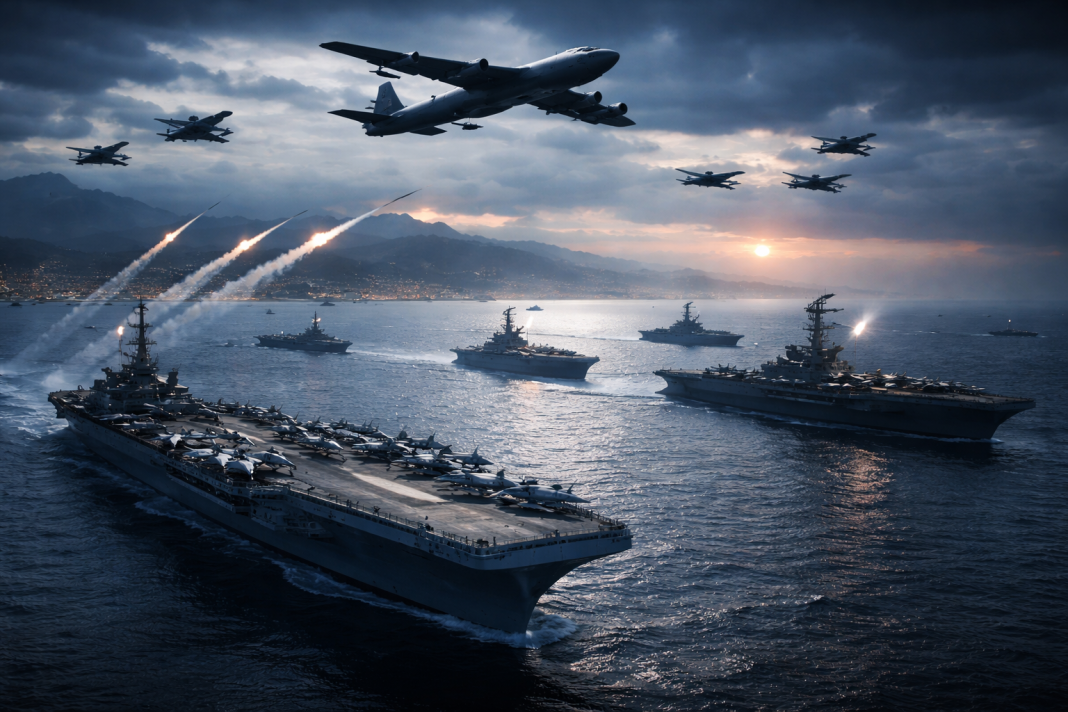

Rising tensions between the United States and Iran have drawn global attention. Retired Admiral James Stavridis, former Supreme Allied Commander of NATO, compared the current US military buildup in the Middle East to “Dante’s Inferno.” He described it as a layered ring of increasing military pressure. Speaking to CNN, Stavridis said the deployment resembles preparations seen before the Persian Gulf War, when US-led forces assembled massive firepower ahead of military operations.
A Layered Military Presence Explained Like ‘Dante’s Inferno’
Admiral James Stavridis used simple imagery to explain how US forces are positioned across the region. He compared the deployment to concentric circles descending inward, similar to Dante Alighieri’s Inferno. The outer layer includes long-range strategic bombers that can operate from distant bases, including the United States and allied territories, allowing strikes without entering high-risk zones.
Moving closer to the center are aircraft carrier strike groups. Stavridis said two US carriers are positioned in key locations, one in the northern Indian Ocean and another near Israel, creating what he described as two axes of pressure. Each carrier carries around 80 combat aircraft, including advanced F-35 jets and F/A-18 Hornets designed for air superiority and precision missions.
Inside these layers, US forces can launch Tomahawk cruise missiles, deploy drones, conduct cyber operations, and use land-based aircraft from regional bases. Stavridis said the entire structure appears focused on Iran’s leadership, including Supreme Leader Ali Khamenei.
Military Buildup Fuels Growing Tensions Between Washington and Tehran
The military buildup comes amid increasingly tense relations between Washington and Tehran. US President Donald Trump has expressed strong frustration toward Iran’s leadership and has reportedly considered the possibility of limited military strikes as the military buildup continues across the region.
At the same time, diplomatic activity continues. Another round of talks between American and Iranian representatives is scheduled to take place in Geneva, indicating that negotiations remain active even as military preparations intensify alongside the ongoing military buildup.
Taliban signals Afghans could stand with Iran if US launches strike
US officials have also taken precautionary steps across the region. The State Department ordered the departure of nonessential diplomatic staff and family members from Lebanon following a security review. Officials described the move as preventive, citing growing risks linked to potential military escalation.
These measures reflect concerns that any confrontation could quickly spread beyond a single country and affect multiple parts of the Middle East. Iranian authorities responded strongly to reports of possible US strikes, warning that Tehran would retaliate “ferociously” if attacked and cautioning that military action could trigger a wider regional conflict. Iranian statements emphasized that retaliation would not be limited to a single battlefield.
Military Capabilities and Regional Security Concerns
Stavridis’ comments highlighted the scale and complexity of modern military deployments. Unlike past conflicts involving a single front line, today’s operations combine air, sea, cyber, and unmanned technologies.
Strategic bombers provide long-distance reach. Aircraft carriers serve as mobile airbases capable of launching sustained operations. Cruise missiles allow precision targeting from hundreds of kilometers away, while drones add surveillance and strike flexibility. Cyber capabilities introduce a non-traditional battlefield where communications and infrastructure can become targets.
The admiral stressed that the current positioning mirrors large-scale preparations seen before earlier conflicts, particularly the early 1990s Gulf War buildup. During that period, coalition forces assembled overwhelming military strength before initiating operations against Iraq.
The comparison has drawn attention because it suggests the current deployment is not symbolic but operationally significant. Analysts note that such layered positioning allows commanders to increase or decrease pressure without immediately launching attacks.
Meanwhile, diplomatic developments continue alongside military movements. US officials say negotiations remain possible, while Iran insists it will respond strongly to any aggression. Both sides have issued statements reflecting sharply different interpretations of the situation.
As tensions rise, the region remains on heightened alert, with military forces positioned across airbases, naval routes, and allied territories surrounding Iran. The combination of diplomacy, warnings, and visible military power has created an atmosphere of uncertainty across the Middle East.