
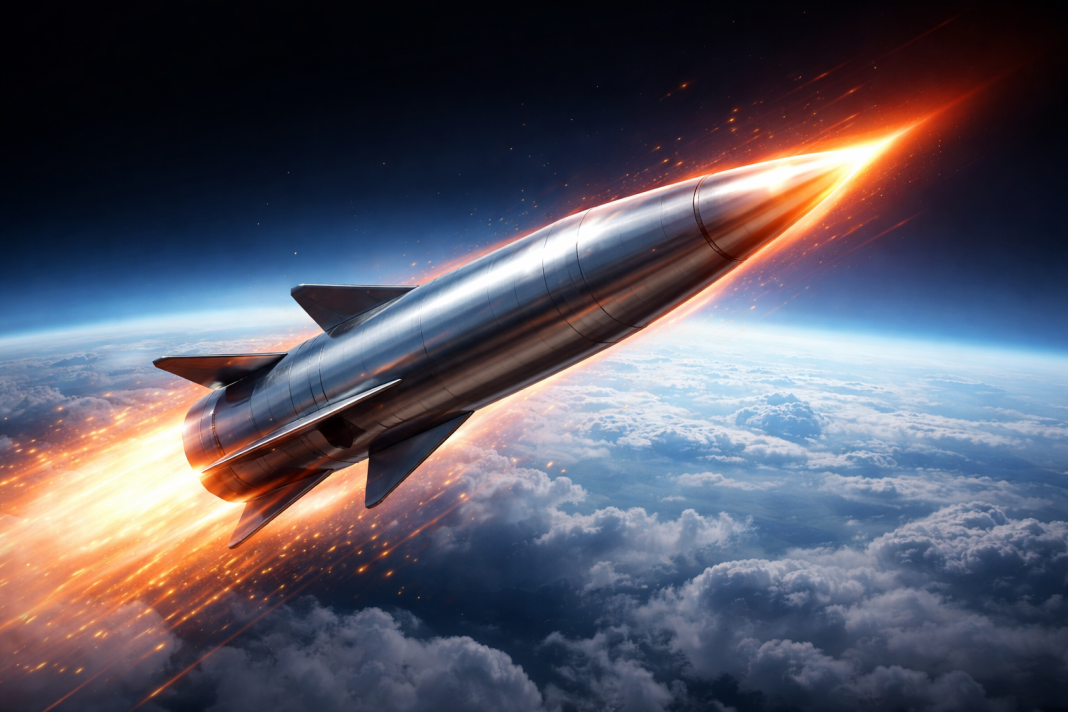

Hypersonic weapons are gaining global attention. Reports suggest China may be using advanced stainless steel alloys in missile components instead of costly aerospace materials. These missiles travel faster than Mach 5. Such speeds create extreme heat and pressure. New advances in metallurgy show that specially engineered steel may survive these harsh hypersonic conditions.
How Materials Handle Hypersonic Speeds and Extreme Heat
Materials are critical in hypersonic flight because objects moving at extremely high speeds compress the air around them, creating temperatures that can reach thousands of degrees Celsius. Under such heat, ordinary metals can soften, melt, or deform, causing structural damage and system failure. To handle these conditions, aerospace engineers have traditionally relied on lightweight titanium alloys, ceramic composites, and specially designed heat-resistant materials.
While effective, these advanced materials are expensive and difficult to manufacture, often requiring complex production methods and specialized facilities. This has made hypersonic systems costly and harder to produce at scale.
Undersea power shift as China overtakes U.S. in nuclear submarine launches
Recent reports suggest that specially engineered stainless steel alloys could offer an alternative. Though commonly associated with everyday durability and rust resistance, new formulations can withstand higher temperatures and stress. Advances in metallurgy allow scientists to adjust carbon levels, add elements like nickel and chromium, and refine metal structures, improving strength and heat resistance for use in extreme aerospace environments.
Why Stainless Steel Could Change Cost and Production
One major reason this development is attracting attention is cost efficiency. Traditional hypersonic materials are expensive and difficult to produce in large quantities, while stainless steel is widely available and easier to manufacture using existing industrial systems. If advanced stainless steel alloys can be used in hypersonic components, production could become faster and more affordable, as factories working with steel may need fewer adjustments than those handling rare aerospace materials.
Durability is another advantage. Certain stainless steel variants can retain strength even after repeated heating and cooling cycles. Hypersonic vehicles face rapid temperature changes during flight, especially when moving through different atmospheric layers, so materials that tolerate thermal stress are essential for maintaining stability.
US.–China rivalry ignites at Panama Canal as billionaires and governments clash over strategic ports
Engineers also value materials that simplify repair and maintenance. Stainless steel is easier to machine, weld, and replace, which can improve efficiency during assembly and testing.
However, technical details remain limited because hypersonic technologies are closely protected for security reasons. Much of the available information is partial and difficult to verify independently. The discussion nevertheless shows how advances in metal processing and alloy design can improve familiar materials for advanced aerospace applications.
Rethinking Material Science in Modern Aerospace Engineering
The reported use of stainless steel alloys challenges a long-held belief in aerospace engineering that only ultra-light or highly advanced materials can survive hypersonic conditions. Engineers are now focusing on how structural design, cooling techniques, and material treatment work together instead of depending on a single ideal material.
A material does not always need to be the lightest to perform well. Slightly heavier metals can still succeed if they manage heat efficiently and resist cracking under extreme stress. Factors such as strength, heat resistance, flexibility, and ease of manufacturing all influence real engineering decisions.
Metallurgy has progressed significantly in recent decades. Scientists can study metals at microscopic levels and redesign their internal structures to improve performance. Methods like controlled cooling, additive manufacturing, and precise alloy mixing allow engineers to create metals with customized properties suited for harsh environments.
These advances show that aerospace innovation often develops gradually through improved processes rather than entirely new discoveries. Stainless steel, once considered unsuitable for hypersonic flight due to weight and temperature limits, may now meet performance needs under certain conditions.
The ongoing discussion highlights how rethinking existing materials can lead to technological progress, emphasizing the growing importance of material science in modern hypersonic research and aerospace development.