
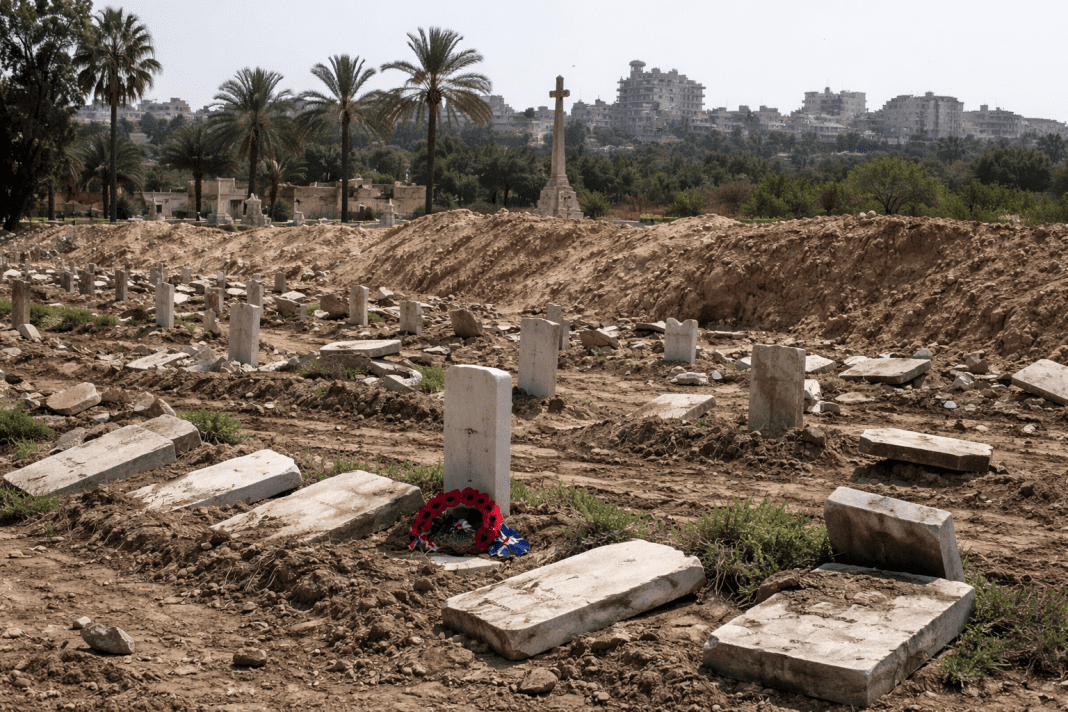

Australia has vowed to restore the graves of its soldiers buried in Gaza. Satellite images and witness reports show that parts of a Commonwealth war cemetery were damaged by military bulldozing during the ongoing conflict. The damage includes disturbed soil and removed gravestones. This has caused distress in Australia, where the graves are seen as sacred sites of remembrance. Authorities say all affected graves will be repaired. However, access to the cemetery may take time due to continued fighting in the area.
Damage to a Historic War Cemetery in Gaza
The Gaza War Cemetery in Tuffah, Gaza City, holds over 3,000 Commonwealth graves, including more than 250 Australian soldiers. Many served in the First and Second World Wars. The worst damage hit sections with Australian Second World War graves.
Satellite images show rows of headstones removed, soil churned, and heavy machinery marks. A large earth mound runs through the area, likely as a defensive barrier. Witnesses reported bulldozing inside and outside the cemetery walls, clearing olive trees and flattening a section near a memorial.
Beyond Gaza and Lebanon: Israel confronts a growing mental health emergency in its military
Australian authorities confirmed the damage included Australian graves and called the situation deeply troubling. They stressed that war graves are protected under international norms and honor soldiers who died far from home. Officials remain committed to restoring all affected graves once access is safe.
Australia’s Response and Restoration Commitment
Australia’s government, through its war graves authority, expressed deep concern over the damage at the Gaza War Cemetery. Officials said the country has a responsibility to care for the graves of its fallen soldiers, no matter where they are buried.
Plans are in place to restore the damaged graves, but work can only begin once it is safe to access Gaza. Authorities noted that after conflicts, priority is usually given to humanitarian needs, such as helping civilians and rebuilding essential services. As a result, full restoration may take months or even years.
The Commonwealth body that maintains war graves worldwide also expressed serious concern. It reported that headstones, boundary walls, memorials, storage areas, and staff facilities at the cemetery had all been damaged. Continued fighting increases the risk of further destruction.
IDF uncovers massive 7-km Hamas tunnel hidden beneath UN compound — one of Gaza’s biggest ever found
Veterans’ groups in Australia are closely monitoring the situation, emphasizing that war graves represent a solemn promise between the nation and those who served. Families of soldiers buried in Gaza have found the news distressing.
Australian officials reaffirmed their commitment to restore and properly maintain all affected graves. They emphasized that respect for the dead is a core value and that fallen soldiers deserve dignity, wherever they are buried.
Military Activity and Broader Context of the Conflict
The Israeli military confirmed that its forces conducted operations around the Gaza War Cemetery. They stated that the area was an active combat zone and that troops needed defensive measures for protection. Fighters operated nearby, and the military located and neutralized underground infrastructure. Senior commanders approved all sensitive activities, and troops carried them out carefully.
Despite this, historians and observers expressed concern over the damage to the cemetery. Many consider war cemeteries sacred and believe that armies should protect them even during conflict. Experts pointed out that Commonwealth war graves suffered damage in past wars, including in Iraq and Europe, and crews later repaired them once stability returned.
Calm before the storm? Gaza ceasefire hangs by a thread as Hamas digs in
Caretakers have long maintained the Gaza War Cemetery as a place of remembrance, and families and visitors from many countries honor those buried there. Ongoing fighting prevents officials from accessing the site, and they fear that troops or further conflict could damage more graves.
For Australians, the destruction of these graves is a deeply distressing consequence of the wider conflict. While humanitarian needs remain the immediate priority, the damage to soldiers’ final resting places adds another layer of emotional pain. Authorities have reaffirmed that restoring the cemetery will remain a priority as soon as it is safe to enter, reflecting the nation’s respect for those who served and died in war.