
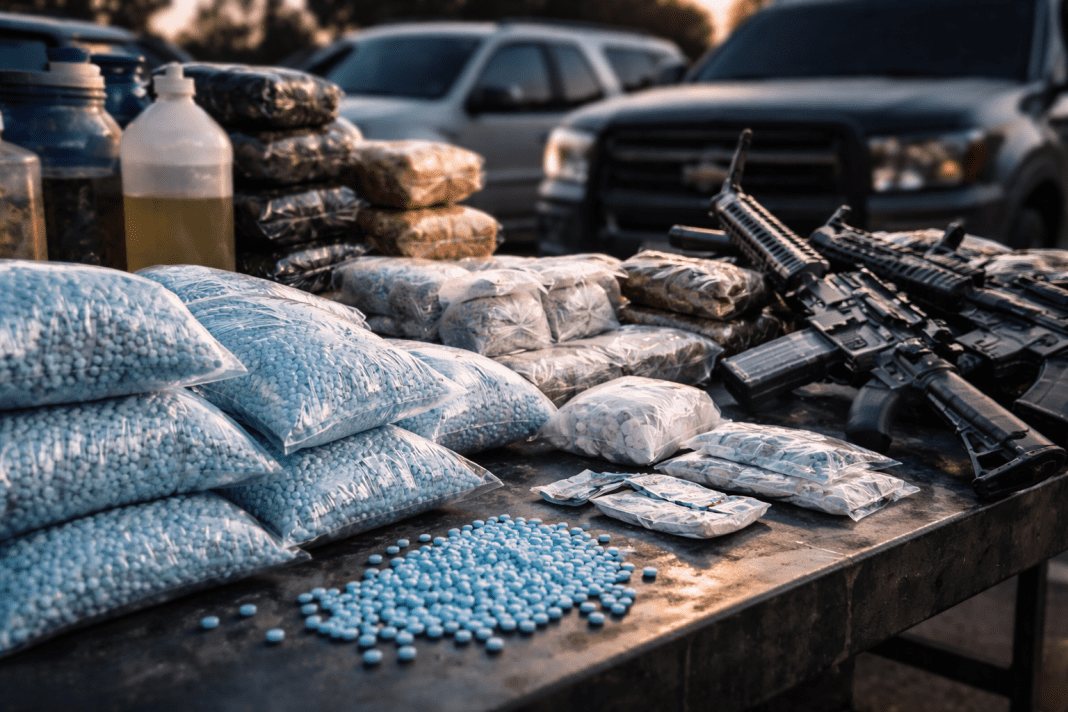

Federal prosecutors have charged a top Sinaloa Cartel fentanyl producer, raising alarms about the ongoing drug crisis. Mexican authorities recently arrested Ivan Valerio Sainz Salazar, also known as “Mantecas.” He now faces a newly unsealed U.S. federal indictment. Prosecutors say he allegedly produced and distributed deadly fentanyl pills. Authorities say he was a key figure in the cartel’s operations, helping supply millions of pills that have fueled overdose deaths in the United States.
Arrest of Sainz Salazar in Mexico Uncovers Fentanyl Operation
Mexican authorities captured Sainz Salazar on January 19, 2026, in the town of Badiraguato, Sinaloa. The operation involved the National Guard, Mexican Army, and Air Force. Officials reported that seven other alleged associates were detained alongside him. During the raid, authorities seized firearms, vehicles, and a fully equipped synthetic drug production center.
Omar H. Garcia Harfuch, Mexico’s Secretary of Security and Civilian Protection, confirmed the arrest on social media, saying Sainz Salazar led a faction linked to the Beltrán Leyva organization. The investigation into the group’s activities continues, highlighting the cartel’s complex network of drug production and trafficking operations.
Terror returns to Sinaloa — 13 cartel gunmen killed in one of Mexico’s deadliest clashes this year
According to the U.S. Department of Justice (DOJ), Sainz Salazar’s arrest is part of a broader effort to target the Sinaloa Cartel, which remains one of the main sources of fentanyl entering the United States. Fentanyl is a synthetic opioid far stronger than heroin, and it has caused a surge in overdose deaths across the country. Investigators say the cartel often relies on armed enforcers and military-grade weapons to protect labs, transportation routes, and leadership.
Charges and Alleged Role in Fentanyl Trafficking
The federal indictment accuses Sainz Salazar of conspiring to import fentanyl into the U.S. and conspiring to distribute it domestically. Both charges carry a mandatory minimum sentence of 10 years in prison, with the possibility of life imprisonment.
In addition, he faces charges related to firearms. Prosecutors say Sainz Salazar used and possessed machine guns and other destructive devices while running the alleged drug operation. One of the weapons charges carries a minimum sentence of 30 years, while other related counts could also lead to life in prison.
DEA arrests 617 people in nationwide operation targeting Sinaloa Cartel networks
U.S. Attorney Jay Clayton emphasized the seriousness of the charges, stating that Sainz Salazar played a major role in supplying the Sinaloa Cartel’s fentanyl to the United States. “Fentanyl kills, and violent dealers in fentanyl must be taken off our streets,” Clayton said. He highlighted that this case targets a major producer behind the Chapitos’ drug supply network, holding traffickers accountable at all levels.
Investigators allege that Sainz Salazar worked closely with the Chapitos, a faction of the Sinaloa Cartel led by the sons of notorious drug kingpin Joaquín “El Chapo” Guzmán. From 2022 to 2025, he reportedly helped produce millions of fentanyl pills, organize drug transactions under armed protection, and run labs central to the cartel’s drug operations.
Connections to the Guzmán Family and the Cartel’s Operations
The Sinaloa Cartel’s leadership passed to the Guzmán brothers after El Chapo was convicted and sentenced to life in prison in 2019. Joaquín Guzmán López, one of the so-called Chapitos, pleaded guilty in December 2025 to drug-trafficking and continuing criminal enterprise charges in a Chicago federal court. He admitted to overseeing the transport of large quantities of narcotics, mostly through underground tunnels.
Guzmán López’s plea deal allows him to avoid an automatic life sentence. His brother, Ovidio Guzmán López, had earlier reached a similar agreement on drug trafficking and money-laundering charges. Both brothers are reported to have expanded fentanyl production and created a large pipeline funneling drugs into the U.S.
The DOJ says the Guzmán family’s network, combined with producers like Sainz Salazar, has driven the flow of fentanyl across the U.S. border, contributing to a record number of overdose deaths. El Chapo himself remains in a U.S. maximum-security prison, serving life without parole. Authorities continue to monitor the cartel’s operations, seeking to dismantle the drug networks that threaten communities both in Mexico and the United States.
This arrest marks another significant step in ongoing U.S.-Mexico cooperation against drug trafficking, highlighting the dangers of fentanyl and the violent structures used by cartels to maintain control.