
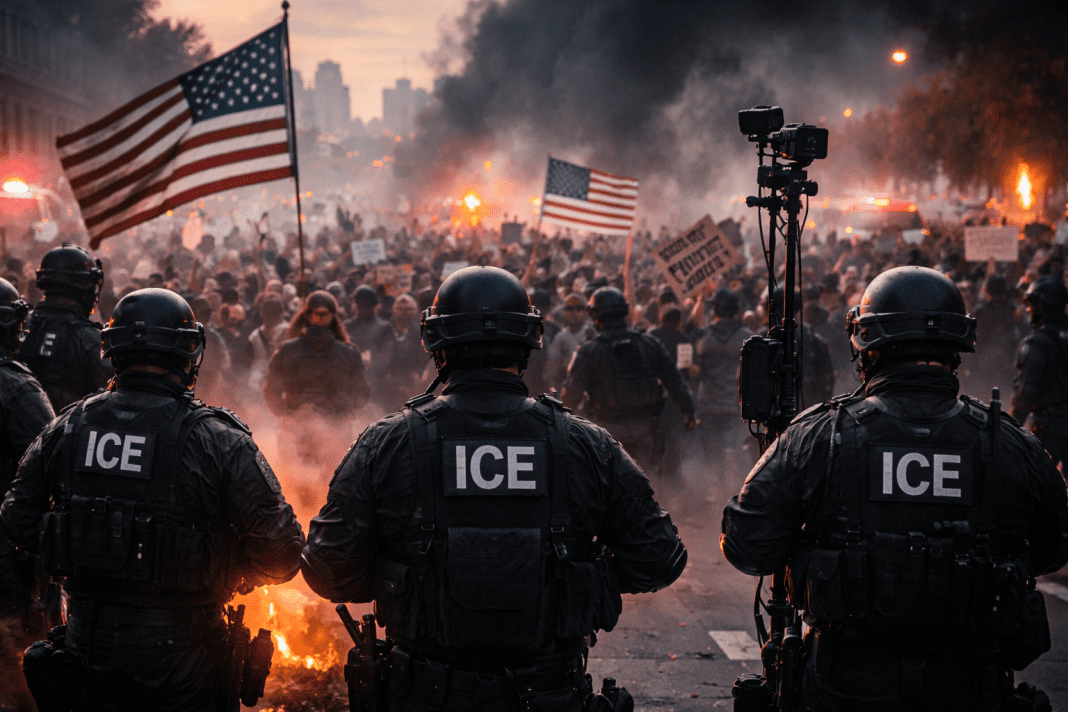

Many Americans once trusted their institutions to always protect them, but that faith is now under strain. US exceptionalism has weakened abroad, while deep divisions at home show up in elections, protests, and daily life. Global risk groups warn that political violence is now a real threat, raising fears of Civil Conflict in the United States. Much of the concern is focused on the rapid growth in power and presence of Immigration and Customs Enforcement, or ICE.
A Nation Under Pressure From Within and the Risk of Civil Conflict
The United States is experiencing extreme political polarization, with support for the government closely tied to party identity. One side shows strong approval while the other shows near-total rejection, a divide rarely seen in modern US history and often viewed as a warning sign of possible Civil Conflict.
Economic stress is intensifying these tensions. Recession risks have risen, the dollar has weakened, gold prices have increased, and consumer confidence has fallen, reflecting widespread anxiety. In deeply divided societies, similar economic pressure has historically contributed to Civil Conflict.
When economic fear combines with political anger, social stability weakens. Protests grow more frequent, policing becomes more forceful, and trust in institutions declines. Analysts see these conditions as early indicators of Civil Conflict.
Security experts now rank domestic unrest in the US above election disputes or conflicts in some fragile regions abroad. Rising threats against judges, election officials, and lawmakers, along with concerns about uneven law enforcement, are seen as factors pushing the country closer to Civil Conflict, as immigration enforcement becomes the top-funded federal policing priority.
ICE and the Growth of Enforcement Power
ICE has become the most heavily funded federal law enforcement agency in the United States, with a budget more than double that of other major agencies. Its roughly 22,000 employees are paid significantly more than local police. Critics say this expansion reflects preparation for managing internal unrest linked to fears of Civil Conflict.
Entry requirements are lower than most law enforcement roles. Recruits need only a high school diploma, can join at 18, and face no maximum age limit. This has attracted many combat veterans through dedicated recruitment programs, leading to a high share of agents with military experience, especially in Enforcement and Removal Operations, which operate like tactical units often associated with Civil Conflict responses.
More than 2,000 federal agents deployed as DHS carries out sweeping ICE operation in Minnesota
Training is shorter than for most police forces. In about eight weeks, agents can be deployed with advanced weapons. Language requirements have been dropped, while signing bonuses and benefits such as student loan forgiveness remain high. Supporters call this efficiency, while critics warn it reduces safeguards during periods of rising Civil Conflict risk.
ICE is also heavily equipped with surveillance technology, including facial recognition, phone tracking, and AI tools. These systems are increasingly used during protests. Masked ICE agents have appeared in major cities, sometimes outnumbering local police, fueling public backlash and concerns about escalation toward Civil Conflict.
Enforcement, Protest, and the Risk of Escalation
The use of immigration enforcement during public protests has raised serious concern in the United States. Protesters are increasingly described using national security language once reserved for violent threats, blurring the line between lawful dissent and criminal behavior. This shift is often seen as a warning sign of rising Civil Conflict.
There have also been debates about deploying military forces inside US cities under existing laws. While legal, this power is rarely used without state approval and has historically been limited to extreme emergencies or civil rights protection. Such discussions reflect growing fears of Civil Conflict.
ICE disclosure raises issues for OpenAI CEO Sam Altman as DHS reveals agency use of AI systems
Opposition lawmakers have warned against unlawful orders and have faced legal action in response. Political debate now frequently frames dissent as a security threat, a pattern common in societies under Civil Conflict pressure.
ICE has moved to the center of this tension. Agents increasingly share arrest videos online, praised by supporters as signs of order and criticized by others as aggressive policing. With the agency’s rapid expansion and strong political backing, accountability concerns are growing, while trust in other institutions continues to weaken amid fears of Civil Conflict.