
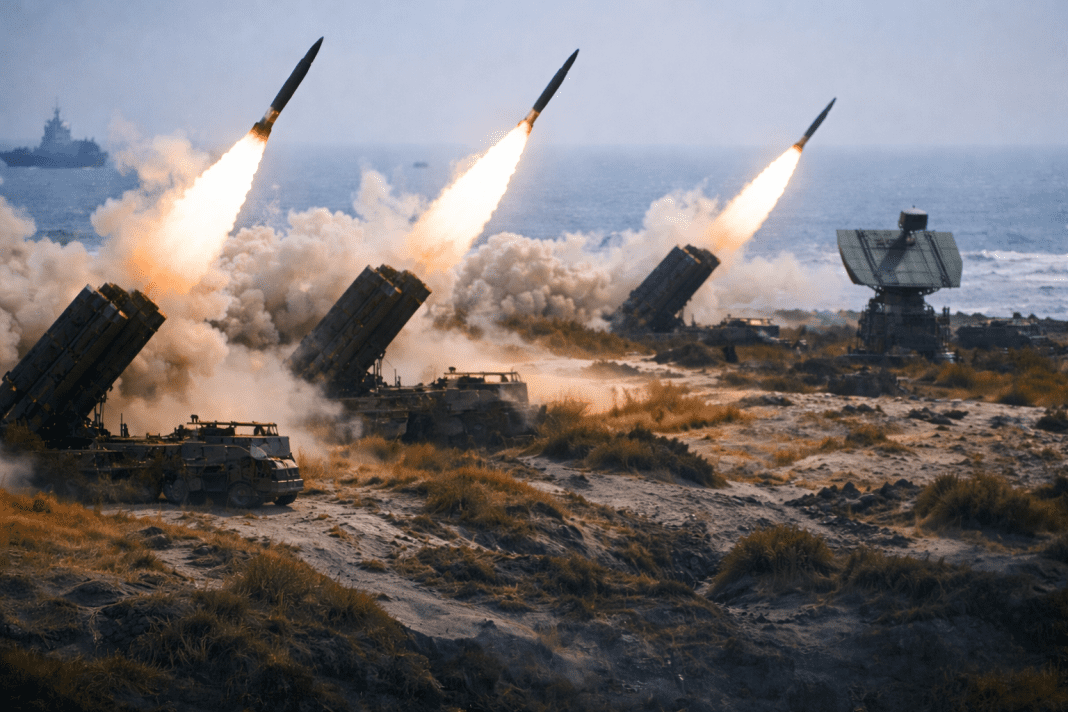

South Korea said it held phone talks with the United States and Japan after North Korea’s missile launch of several short-range ballistic missiles toward the East Sea. The missile launch broke UN rules and raised tensions in the region. The three countries shared information and coordinated their response. North Korea said it tested an upgraded rocket system during the missile launch and added that Kim Jong-un was present at the launch.
What Happened During the Missile Launch
On Tuesday, South Korea’s military said North Korea fired several short-range ballistic missiles toward the East Sea, the body of water between the Korean Peninsula and Japan. Such launches are often seen as a show of strength by Pyongyang. These missiles can travel hundreds of kilometers in a short time and can carry powerful warheads, which makes them dangerous.
Because of this threat, the United Nations has banned North Korea from testing or using ballistic missile technology. North Korea’s state media said it tested an upgraded rocket launcher system and that leader Kim Jong-un was present. South Korea, however, said the weapons were ballistic missiles that follow a high, curved path and are closely tracked by radar systems.
Pyongyang provokes — North Korea conducts missile test just before Trump’s South Korea trip
The launch happened just before a major party meeting in North Korea, making the timing more sensitive. Although no damage was reported, the test increased concerns about safety and stability in the region.
The Three-Way Phone Talks and Why They Matter
After the missile launch, South Korea, the United States, and Japan quickly used their communication channels to discuss the situation. South Korea’s Foreign Ministry said these channels are always ready to be used when North Korea carries out missile tests or other major military actions. The main aim is to share information quickly and understand what is happening.
The phone call included senior officials who deal with regional security and North Korea policy. They compared what each country had detected and talked about how to respond together. While the ministry did not share full details, it said the three sides stayed in close contact. One unusual part was how the news came out. Japan first reported the talks, and South Korea confirmed them later.
“I’ll Solve It!” — Trump Drops Bombshell on North Korea as Tensions Soar Again
In most past cases, all sides announced such talks at almost the same time. Even so, South Korea said the information-sharing system worked as it should. The Foreign Ministry repeated that North Korea’s missile launches break several United Nations Security Council resolutions. It said South Korea, the United States, and Japan will continue to work together because North Korea’s actions directly affect all three countries.
The Official Position and International Rules
South Korea’s government has repeated that there has been no change in its position regarding North Korea’s missile tests. The launches clearly violate international rules set by the United Nations. The UN created these rules to stop North Korea from developing and testing weapons that could threaten other countries.
Over the years, the United Nations Security Council has passed several resolutions that ban North Korea from using or testing ballistic missile technology. The council made these decisions because such weapons can carry large explosives and, in some cases, even nuclear warheads. Even when a test does not cause immediate harm, the international community still considers it a serious problem.
By saying that there has been “no change” in its position, South Korea is underlining that it will continue to respond in close coordination with the international community. This usually means sharing information, holding joint discussions, and working together with allies and partners.
South Korea on High Alert After North Korea Launches Missiles and Sends 15,000 Troops to Russia
The latest missile launch and the quick phone talks show how closely countries are watching the situation on the Korean Peninsula. Several countries track, discuss, and review every test at the same time. While the public does not always hear every detail of these discussions, officials say the communication lines are active and ready whenever something happens.
In this case, the main facts are clear: North Korea carried out another missile launch, South Korea confirmed that it spoke with the United States and Japan about it, and all three countries agree that such actions break international rules and need a firm, coordinated response.