
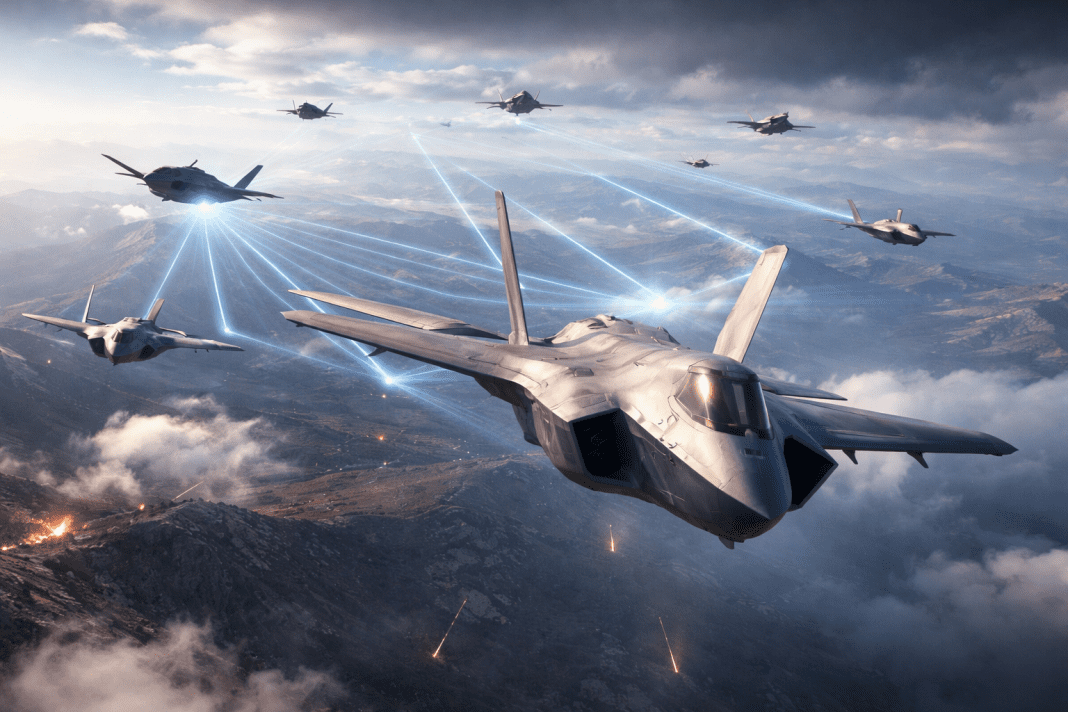

Collaborative Combat Aircraft (CCAs) are changing air warfare. Instead of relying on a single fighter, modern combat now focuses on teamwork between humans and machines. This approach acts faster, sees farther, and strikes smarter. Central to this shift is the F-35, evolving from a fifth-generation fighter into the commander of “wolfpack” operations, directing CCAs in coordinated missions.
F-35 as the Command Center
The F-35 is more than just a fighter jet—it was designed as a flying computer, collecting and sharing vast amounts of information from radars, sensors, and communications systems. This makes it one of the most connected aircraft in the sky. Originally, this data helped pilots make better decisions in combat, but today it is being used to control other aircraft.
With software upgrades and enhanced communication systems, the F-35 can act as the “quarterback” of a team, directing Collaborative Combat Aircraft (CCAs) in real time. These unmanned aircraft can fly ahead, gather intelligence, or engage enemy defenses without risking a pilot. Modern upgrades in computing and data processing allow one F-35 to manage multiple CCAs simultaneously, multiplying mission effectiveness.
U.S. Air Force orders second batch of JSM missiles to expand precision strike options for F-35
The concept is simple but powerful: the F-35 stays at a safe distance, while CCAs take on the most dangerous tasks. This combination of human judgment and autonomous action creates a new way to conduct air operations, where strength comes from teamwork between pilots and machines.
CCAs (Collaborative Combat Aircraft): Force Multipliers
CCAs are a game-changer in modern air combat. These unmanned aircraft cost much less than a full fighter jet—about a quarter of the price—but can perform dangerous missions that would put human pilots at risk. They can fly into heavily defended areas, act as forward sensors, or confuse enemy systems, allowing F-35 pilots to stay safe while still completing the mission.
The wolfpack concept combines the strengths of crewed and uncrewed aircraft. For example, four F-35s each controlling two or more CCAs could form a team of 12-20 aircraft. This setup achieves far more than the F-35s could alone. CCAs are expendable but highly effective, while F-35 pilots maintain command and strategic control.
Japan expands F-35 strike reach under $79M Joint Strike Missile agreement
CCAs also create new tactical opportunities. They can carry out electronic warfare, jam enemy radars, or launch surprise attacks. By taking on high-risk roles, they reduce danger to human pilots and allow commanders to rethink strategies that were once limited by safety concerns.
Integrating CCAs transforms the F-35 from a single fighter into a command hub for a much larger, more capable force. The combination of human judgment and autonomous persistence creates a powerful, flexible team that can act faster and strike smarter than ever before.
From Fifth to Sixth Generation: Behavior Over Hardware
Traditionally, new fighter generations were defined by the aircraft itself—faster engines, better missiles, or stealthier designs. The fifth generation added stealth, sensor fusion, and networked operations. Sixth-generation airpower, however, is defined by behavior, coordination, and human-machine teamwork rather than a new plane.
An F-35 flying alone today shows fifth-generation capabilities. When upgraded with advanced software and controlling multiple Collaborative Combat Aircraft (CCAs), it exhibits sixth-generation behavior. Physically the plane changes little, but the way it fights is completely different, allowing forces to achieve next-generation airpower without waiting for a new platform.
This shift also changes pilot training and culture. Pilots manage a networked team of autonomous aircraft, focusing on decision-making, delegation, and trust in machine teammates. They act as commanders, coordinating multiple units and making rapid decisions that shape mission outcomes. Simulations and live exercises let pilots practice safely before real-world deployment.
Denmark deploys F-35A stealth jets over Greenland with French tanker to strengthen Arctic readiness
Upgrading the F-35 while integrating CCAs also makes economic and strategic sense. Existing production lines, training programs, and international partnerships support the transition. Allied nations can deploy CCAs alongside F-35s, creating a flexible, cooperative airpower network.
Sixth-generation airpower is now achievable. Wolfpack behavior—human pilots commanding autonomous systems—multiplies combat effects, delivering capabilities that would otherwise take decades and billions to develop.