
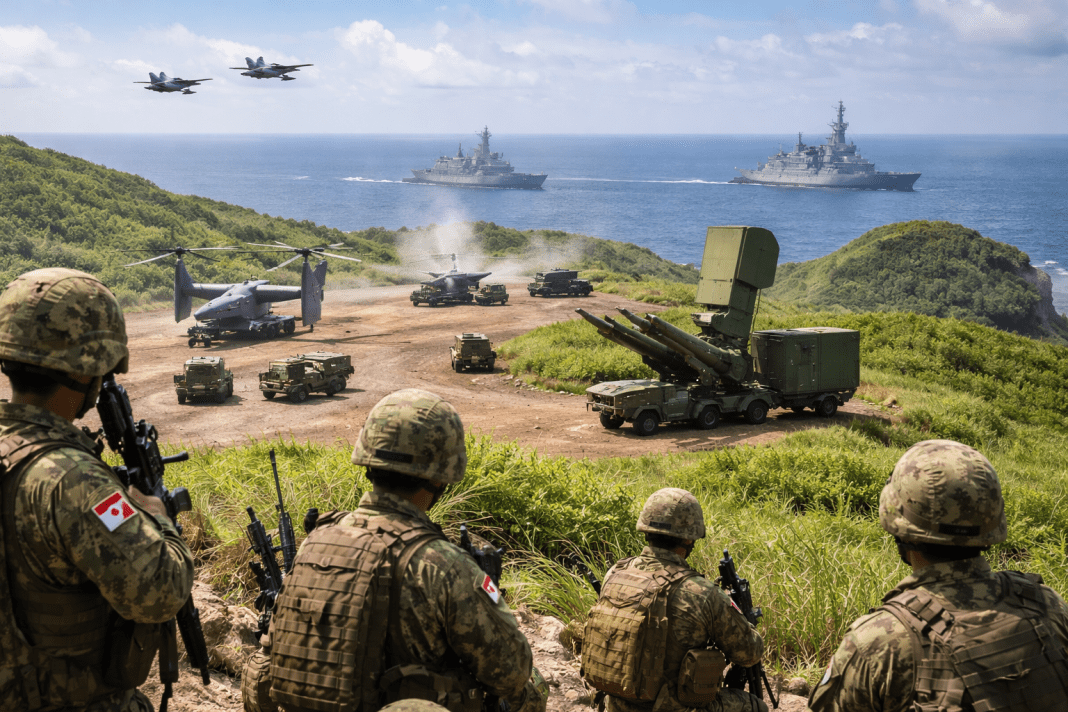

Japan and the United States have stepped up their security talks with a strong focus on Japan’s southwest islands after Defense Minister Koizumi Shinjiro met U.S. Defense Secretary Pete Hegseth in Washington on January 15. The two sides agreed to improve cooperation, expand joint training, and strengthen their military presence in the island chain near Taiwan amid rising tensions with China.
Growing Focus on Joint Training and Military Cooperation
Koizumi and Hegseth focused heavily on joint military training, agreeing that soldiers, sailors, and pilots must practice in realistic conditions. Hegseth emphasized exercises across the First Island Chain, including Japan’s southwest islands, while Japan’s Defense Ministry said both sides will expand advanced and practical joint drills in the region.
This cooperation is already underway. In 2023, the U.S. moved the Iron Fist exercise to southwest Japan, signaling training closer to potential crisis zones. In 2024, Resolute Dragon forces deployed a mobile radar to Yonaguni Island near Taiwan, and in 2025, they added NMESIS and a forward arming and refueling point to Yonaguni, enhancing flexibility and rapid response.
Japan begins deep sea mission to test rare earths extraction and reduce reliance on China
The talks also covered defense industry cooperation, including joint production of air-to-air and surface-to-air missiles, maintenance of U.S. ships and aircraft in Japan, and strengthening supply chains for critical materials. Koizumi also pushed for another Japan-U.S. Defense Industrial Cooperation meeting to deepen collaboration in both operations and production.
Japan Strengthens Defenses Across the Southwest Islands
Japan is stepping up its defenses in the southwest islands while continuing close cooperation with the United States. In November, Defense Minister Koizumi visited a JGSDF base on Yonaguni Island to reaffirm plans to deploy medium-range surface-to-air missiles, an upgraded Type 03 Chu-SAM system capable of intercepting cruise missiles. He also visited Miyako Island and Ishigaki Island to inspect underground shelters meant to protect personnel and equipment in emergencies.
The buildup in the southwest has been ongoing for years. In 2016, the JGSDF established a camp on Yonaguni to host a Coast Observation Unit, and in 2022, a JASDF squadron was added. An electronic warfare unit joined in 2023, and in 2026, an anti-aircraft electronic warfare unit is planned to disrupt enemy radar systems.
Buried history erupts as Chinese scholars accuse Japan’s emperor in Unit 731 crimes
Other islands are also seeing strengthened defenses. Miyako Island and Amami-Oshima Island received JGSDF bases in 2019, while Ishigaki Island got one in 2023. These bases improve Japan’s air and sea security in the region, providing better monitoring and rapid response capabilities.
Japan is also building a new air base on Mageshima Island, expected by 2030, and is considering deploying long-range missiles and a mobile warning and surveillance radar on Kita-Daitojima Island. Together, these steps aim to deter potential threats and ensure Japan can quickly respond to any challenges near its southwest islands.
Rising Regional Tensions and Local Concerns
The growing military presence in Japan’s southwest islands has raised concerns among local residents. Many fear that hosting Self-Defense Force bases could make their homes targets in a potential conflict. Some have urged Tokyo to focus more on diplomacy with China instead of only building up military power.
Defense Minister Koizumi acknowledged these worries during a visit to Okinawa in early January. He spoke about the heavy burden local people carry but did not announce any concrete steps to ease it.
Japan expands F-35 strike reach under $79M Joint Strike Missile agreement
Regional tensions have also been increasing. In December, Chinese aircraft targeted Japanese Self-Defense Force planes with radar, and Chinese and Russian strategic bombers flew routes toward Tokyo. During exercises near Taiwan, Chinese jets passed between Okinawa and Miyako Islands, highlighting how close these activities can come to Japanese territory.
Naval pressure continues as well. In 2025, Chinese Coast Guard vessels operated in Japan’s contiguous zone for 356 days, breaking the previous record of 355 days in 2024. These developments help explain why Japan and the U.S. are paying close attention to the southwest islands in their recent defense talks.