
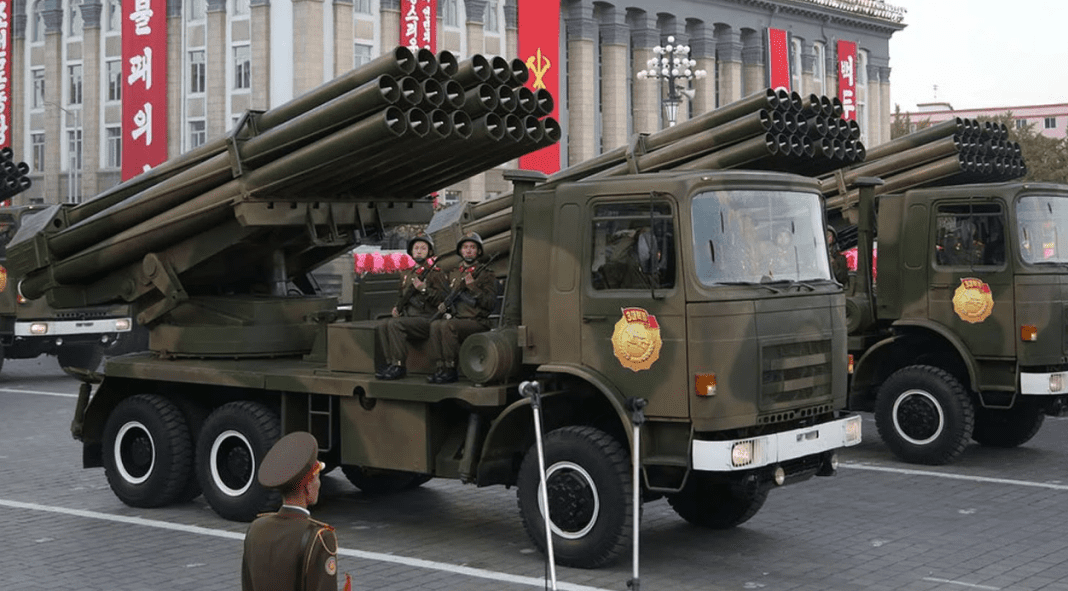

In a stunning display of precision, Ukrainian drone units have destroyed a North Korean–made M-1991 multiple launch rocket system (MLRS) in Russian-occupied territory. This marks the second confirmed Ukrainian strike against this deadly artillery system since Russia’s full-scale invasion began.
Ukraine Drones Destroy North Korean M-1991 Again
Ukraine’s Armed Forces Unmanned Systems (SBS), a specialized unit, conducted the operation using drones for precision strikes. The campaign was led by commander Robert “Madyar” Brovdi and took place between January 17 and 19, focusing on important Russian military targets in occupied territories. The mission demonstrates Ukraine’s growing capability to carry out coordinated drone attacks deep inside enemy lines.
One of the key targets of this operation was the M-1991 multiple launch rocket system (MLRS), a heavy 240mm artillery platform built in North Korea. This system is capable of firing long-range rockets designed to strike strategic military and infrastructure targets with significant destructive power. Its deployment in Russian-controlled areas posed a serious threat to Ukrainian forces.
NATO sidesteps North Korea’s war role—even as 14,000 troops back Russia in Ukraine
This strike marks the second confirmed destruction of an M-1991 by Ukrainian forces. The first was recorded on June 26, 2025, and both incidents were verified through visual evidence shared by SBS channels. The repeated elimination of this weapon highlights the effectiveness of Ukraine’s drone campaign in neutralizing high-value and long-range artillery systems.
Drone Units Hit Russian Air Defense and Military Supplies
Alongside the M-1991, Ukrainian drones also targeted other Russian military equipment, including a launcher vehicle linked to the S-300V surface-to-air missile system. While some images suggest it could be a 9A82 variant carrying two missile containers, the precise type of the destroyed launcher remains unclear. The strike took place in the Luhansk region, which is under Russian occupation.
The drone campaign was not limited to military hardware. Ukrainian forces also attacked critical infrastructure that supports Russian logistics and power networks. Several key substations were targeted, disrupting electricity for railways and industrial areas:
- Traction power substation “Sartana” near Mariupol – destroyed a 2,500 kVA transformer that supports railway operations between Mariupol and Donetsk.
- Substation “Karan” near Andriivka – hit two transformers ranging from 2,500 to 4,000 kVA, cutting power to a key section of electrified railway.
- Substation “Azovska” near Starobesheve in Donetsk – a 220 kV industrial power node, crucial for Russian defense industry operations.
Additionally, Ukrainian drones destroyed UAV storage depots in at least two locations. One depot belonged to Russia’s 144th Division of the 51st Army in Novokrasnianka, Luhansk region. Ukrainian forces also targeted another warehouse in occupied Donetsk, further limiting Russian drone operations.
Multiple SBS formations carried out the strikes, including the 1st Independent Center, 412th Nemesis Brigade, and Kairos Battalion of the 414th “Madyar’s Birds” Brigade. They coordinated the operations with Ukraine’s newly formed Deep Strike Center, highlighting the growing sophistication of Ukraine’s unmanned operations.
Massive Impact on Russian Military Assets
Ukraine’s special forces have reported large-scale damage to Russian air defense systems in 2025. The Security Service of Ukraine stated that they have destroyed or disabled more than $4 billion worth of Russian military equipment, including S-300, S-350, and S-400 missile systems. Ukrainian forces also targeted critical radar installations, such as Nebo-M, Podlet, and 92N6 arrays, opening new corridors for drone missions deep inside Russian-controlled territories.
The repeated destruction of the M-1991 MLRS highlights the increasing role of drones in Ukraine’s military strategy. The ability to strike high-value targets, including North Korean-made weaponry, underscores the sophistication of Ukrainian unmanned operations.
12,000 North Korean Troops Secretly Helped Russia Seize Kursk from Ukraine
Visual evidence shared by SBS-affiliated channels confirms the destruction of the M-1991, showing it completely obliterated. The exact location of the strike remains undisclosed. The operation is part of a broader campaign against Russian forces and critical infrastructure in occupied regions.
This success shows the precision and reach of Ukraine’s drone units. They can hit heavily fortified military targets and disrupt Russian logistics. It also signals that unmanned systems are becoming a key factor in the ongoing conflict. Ukraine can use them to counter powerful weaponry while keeping personnel at minimal risk.